
Pulse Jet Valve: Where to Buy Reliable Valves in India
If your baghouse is losing cleaning efficiency, chances are the problem starts with a single component: the pulse jet valve. This small device controls the compressed air blast that knocks dust off filter bags, and when it fails, everything downstream suffers – pressure drop rises, bags clog faster, and production slows down.
Plant engineers across cement, steel, and pharmaceutical units run into the same question every year: where do you actually find a pulse jet valve that survives real industrial conditions instead of failing within months? This guide walks through how these valves work, what separates a good one from a poor one, and where to source a unit built to last.
What Is a Pulse Jet Valve and How Does It Work?
A pulse jet valve is a diaphragm-based valve that releases a short, high-pressure burst of compressed air into a filter bag or cartridge. This burst travels down the bag, expands it momentarily, and shakes off the dust cake collected on its surface.
The valve sits on a compressed air tank mounted above the dust collector’s bag rows. A sequential timer controller signals each valve to fire in turn – usually for a fraction of a second – so cleaning happens row by row rather than all at once.
Most industrial units use a pilot operated valve design. A small pilot solenoid opens first, which changes the pressure balance across the main diaphragm and forces it open almost instantly. This two-stage action lets a small solenoid coil control a large volume of compressed air without burning out.
Why the Pulse Jet Valve Is the Heart of Your Dust Collector
Everything else in a reverse pulse jet cleaning system depends on this valve firing correctly and on time. If the valve response is slow, the air blast weakens before it reaches the bottom of the bag, and dust cake builds up unevenly.
Over time, this shows up as:
- Rising differential pressure across the filter bags
- Higher compressed air consumption for the same cleaning result
- Reduced bag life due to uneven stress and abrasion
- More frequent unplanned shutdowns for filter replacement
A dust collector pulse valve that opens fully, closes cleanly, and holds a tight air seal keeps compressed air usage predictable and filter bags cleaning evenly. This is exactly why experienced maintenance teams treat pulse valve selection as an engineering decision, not a routine parts purchase.
Diaphragm Valve vs Pilot Operated Pulse Valve
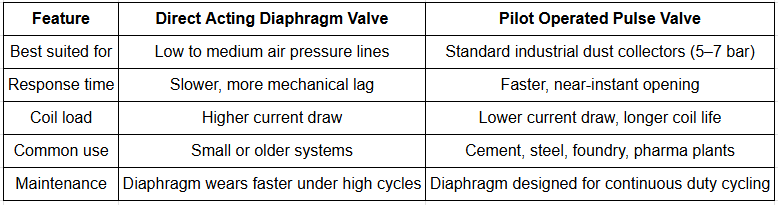
For most industrial-scale dust collection systems, a pilot operated pulse valve is the more reliable choice because it handles continuous cycling without overheating the solenoid coil.
Common Industrial Applications of Pulse Jet Valves
Pulse jet valves aren’t limited to one type of plant. They’re used wherever fine particulate needs to be captured and filter bags need periodic cleaning:
- Cement plants – clinker cooler vents, raw mill and cement mill dust collectors
- Steel and foundries – furnace off-gas cleaning, sand reclamation systems
- Pharmaceutical units – tablet coating dust extraction, powder handling booths
- Power plants – coal handling and ash handling dust collection
- Food processing – flour, grain, and spice dust extraction
- Chemical plants – reactor vent filtration, powder transfer systems
- Textile mills – lint and fiber dust collection
- Mining and woodworking – crusher house dust control, sawdust collection
Each of these environments puts different stress on the valve – temperature, humidity, dust abrasiveness – which is why valve material and build quality matter as much as the basic design.
Signs Your Pulse Valve Needs Replacement
You don’t need to wait for a complete failure to catch a failing valve. Watch for these early warning signs:
- Audible air leakage from the valve body even when it’s not firing
- Continuous hissing around the diaphragm or solenoid area
- Uneven bag cleaning, with some rows staying dustier than others
- Rising compressed air bills without a change in production load
- Delayed or weak pulse that you can hear or feel is shorter than normal
Catching these signs early prevents a single failing valve from dragging down the performance of an entire compartment.
How to Choose the Right Pulse Jet Valve
1. Match the Port Size to Your Tank and Bag Length
A valve that’s undersized for the tank outlet restricts airflow, while an oversized valve wastes compressed air. Port sizing should match your existing tank fittings and the bag length being cleaned.
2. Check the Coil Voltage and Duty Rating
Industrial timer controllers typically run at 24V DC or 220V AC. Confirm the solenoid coil matches your control panel, and check that it’s rated for continuous duty cycling, not intermittent use.
3. Confirm Compressed Air Pressure Compatibility
Most systems operate between 5 and 7 bar. A pulse solenoid valve rated below your operating pressure will wear out its diaphragm faster and may fail to seal properly.
4. Look at Diaphragm Material
NBR (nitrile) diaphragms handle general industrial dust well, while applications with higher temperatures or oil-laden air need Viton or similar heat-resistant compounds.
5. Verify Body Material for Your Environment
Aluminum bodies work fine for standard dry dust applications. Corrosive environments – chemical plants, certain food processing lines – benefit from stainless steel or coated bodies.
6. Prioritize a Manufacturer with Field Track Record
A pulse valve manufacturer with decades of application experience across industries like cement and steel understands failure patterns that a generic supplier won’t account for in their design.
Common Mistakes to Avoid When Buying Pulse Valves
- Buying on price alone. A cheaper valve that fails in eight months costs more in downtime and labor than a slightly higher-priced valve that runs for years.
- Ignoring compressed air quality. Moisture and oil carryover in compressed air lines degrade diaphragms faster than normal wear.
- Mismatching coil voltage with the existing timer controller, leading to weak or inconsistent firing.
- Skipping compatibility checks with tank port threads, resulting in leaks at the mounting point.
- Overlooking after-sales support. Industrial buyers often forget to check whether spare diaphragms and solenoid kits will be available locally when the valve eventually needs servicing.
Maintenance Tips to Extend Pulse Valve Life
- Inspect diaphragms during scheduled shutdowns, even if no fault has appeared yet
- Install a properly sized air dryer and filter regulator ahead of the tank to reduce moisture and oil contamination
- Check solenoid coils periodically for overheating or insulation wear
- Keep timer controller settings (pulse duration and interval) aligned with actual dust load rather than factory defaults left unchanged for years
- Replace diaphragms in sets rather than one at a time, so wear rates stay consistent across the compartment
- Log valve replacement dates to build a predictive maintenance schedule instead of reacting to failures
Preventive maintenance on pulse valves directly supports equipment reliability, lowers long-term maintenance costs, and reduces unplanned downtime across the whole dust collection system.
Where to Buy Reliable Pulse Jet Valves in India
This is where most engineers get stuck. Import brands come with long lead times and expensive spares. Unbranded local suppliers often cut diaphragm quality to hit a lower price point.
Maniks has manufactured reverse jet pulse valves, sequential timer controllers, and dust collector spare parts in India for over 47 years, serving cement, steel, foundry, pharmaceutical, power, food processing, chemical, textile, mining, and woodworking industries.
Because Maniks builds and tests its pilot operated pulse valves for continuous industrial duty cycles, plants get consistent air pulse strength, longer diaphragm life, and spare parts that are actually available when needed – not back-ordered for weeks.
If you’re evaluating a pulse jet valve for dust collector replacement or a new installation, the pilot operated reverse jet pulse valve from Maniks is engineered specifically for these operating conditions.
Why Plant Engineers Choose Maniks
- Decades of applied experience across dust collection systems in heavy industry
- Consistent diaphragm and solenoid quality tested for continuous duty
- Spare parts availability, so a single valve failure doesn’t stall an entire compartment
- Technical support from a team that understands compressed air optimization and bag filter performance, not just valve specifications
- Indian manufacturing, which means shorter lead times and easier communication for on-site troubleshooting
Frequently Asked Questions
1. What does a pulse jet valve do in a dust collector? It releases a short burst of compressed air into filter bags to shake off accumulated dust, restoring airflow and keeping differential pressure within normal range.
2. How long does a pulse valve typically last? With proper compressed air quality and regular inspection, a well-built pilot operated pulse valve can run for several years. Poor air quality or mismatched pressure ratings shorten this significantly.
3. What’s the difference between a pulse valve and a pulse solenoid valve? “Pulse valve” is the general term for the diaphragm valve itself. The “solenoid” refers specifically to the electrically controlled pilot component that triggers the valve to open – most industrial pulse valves are pilot operated and include this solenoid.
4. Can I replace just the diaphragm instead of the whole valve? Yes, in most cases. If the valve body and solenoid are still functioning correctly, replacing only the diaphragm kit is a cost-effective repair, provided the correct diaphragm material is used.
5. What compressed air pressure do pulse jet valves need? Most industrial dust collector pulse valves operate between 5 and 7 bar. Always check the manufacturer’s rated pressure range before installation.
6. Why is my pulse valve leaking air even when it’s not firing? This usually points to a worn or torn diaphragm, debris trapped in the valve seat, or a solenoid pilot that isn’t sealing correctly. It typically requires diaphragm replacement or a full valve inspection.
7. Do all pulse valves fit any dust collector tank? No. Port size, thread type, and mounting configuration vary by tank design. Always match the valve to your existing tank specifications or consult the manufacturer before ordering.
8. Where can I buy a reliable pulse jet valve in India? Maniks manufactures pilot operated reverse jet pulse valves designed for continuous industrial duty across cement, steel, pharmaceutical, and other heavy industries, with spare parts and technical support available directly from the manufacturer.
Conclusion
A dust collector is only as reliable as its weakest pulse jet valve. Weak air pulses, leaking diaphragms, and mismatched coil voltage don’t just affect one bag row – they raise compressed air costs, shorten filter bag life, and increase the risk of unplanned downtime across the entire system.
Choosing the right pulse jet valve means matching port size, pressure rating, and diaphragm material to your actual operating conditions, and buying from a manufacturer that stands behind the product with real technical support.
If your dust collector is due for a valve upgrade or replacement, explore the pilot operated reverse jet pulse valve from Maniks. With over 47 years of manufacturing experience across India’s heavy industries, Our team can help you identify the right valve specification for your system and answer any technical questions before you order. Reach out for a quotation or technical guidance – getting the specification right the first time saves both downtime and cost down the line.