
Top Features of a High-Performance Pulse Jet Valve
Two pulse jet valves can carry near-identical size and voltage specs on their datasheets and still perform completely differently once they’re firing thousands of cycles a week on a live baghouse. The gap between an average valve and a genuinely high-performance one usually comes down to a specific set of features – some obvious, some easy to overlook until they start costing you compressed air or unplanned downtime. If you’re specifying a pulse jet valve for a new dust collector or evaluating whether your current valve bank is underperforming, these are the features actually worth checking, and why each one matters in practice.
What Makes a Pulse Jet Valve “High-Performance”?
A high-performance pulse jet valve delivers three things consistently: a fast, complete pulse on every cycle; a tight seal with no air leakage between pulses; and a service life that holds up under sustained duty cycling without frequent unplanned failure. Everything on this list ultimately supports one of those three outcomes.
Feature 1: Fast, Consistent Pilot Response
In a pilot operated valve, a small internal pilot mechanism controls actuation of the main diaphragm. A high-performance valve’s pilot responds quickly and consistently at rated pressure, delivering a full, sharp pulse on the first firing – not a weak pulse that needs a second or third cycle to actually clean the bag. Inconsistent pilot response is one of the most common, and most overlooked, sources of wasted compressed air in a dust collector system.
Feature 2: Duty Cycle Rating Matched to Real Cyclic Use
Every pulse solenoid valve has a rated duty cycle – the maximum proportion of time its coil can be energized without overheating. High-performance valves are engineered specifically for frequent cyclic duty, with AC-powered units commonly rated to withstand energized time up to around 20% of the total cycle, and DC-powered units rated more conservatively near 10%. A valve built for lighter, occasional switching simply won’t hold up to the demands of continuous pulse-jet cleaning.
Feature 3: Diaphragm Material Engineered for Repeated Flexing
The diaphragm flexes on every single cycle, which makes it the component most likely to fail first on any pulse valve. High-performance valves use diaphragm compounds specifically engineered to resist cracking and elasticity loss under sustained, repeated flexing – and just as importantly, consistent molding quality from batch to batch, so replacement diaphragms perform the same as the original.
Feature 4: Precision-Machined Body and Seat
A precisely machined valve body and seat ensures the diaphragm forms a complete seal on every single cycle. Rough or inconsistent machining creates micro-leak paths that show up as a faint hiss long before the diaphragm has actually worn out – a fault that no amount of diaphragm replacement will fix, because the problem lives in the body itself.
Feature 5: Coil Insulation Rated for Sustained Heat
Coil insulation class determines how much heat the coil tolerates before insulation breakdown occurs. In high-cycle applications – cement and steel plants especially, where valves fire frequently in already-hot environments – a higher insulation class coil provides meaningfully more thermal margin, directly reducing premature coil burnout.
Feature 6: Enclosure Options Matched to the Installation Environment
A high-performance valve isn’t just internally well-built – it’s protected appropriately for where it’s installed. Look for flameproof enclosure options for hazardous zones in oil, gas, and chemical plants, and IP65/IP55-rated weatherproof housings for outdoor-mounted collectors. A valve with excellent internals but the wrong enclosure for its environment will still fail prematurely from moisture or corrosion.
Feature 7: Broad, Verified Voltage Compatibility
Reliable performance depends on the coil receiving stable, correctly rated voltage. High-performance valves typically offer standard AC and DC voltage options with a documented tolerance – commonly around ±10% – so the valve performs consistently even with the voltage fluctuations common in plants running heavy motor loads.
Feature 8: Correct Thread Size and Connection Match
Performance isn’t only about internal engineering – a valve that doesn’t match your existing ductwork’s thread size and connection type introduces leak points at the installation itself, regardless of how well the valve performs internally. High-performance valve ranges typically offer multiple sizes with standard BSP connections to avoid forcing custom adapters.
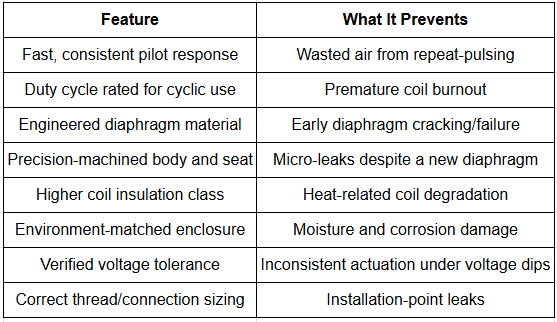
Feature Checklist at a Glance
Common Industrial Applications
- Baghouse and cartridge dust collectors in cement, steel, and foundry plants
- Reverse pulse jet cleaning systems in pharmaceutical and food processing lines
- Chemical and mineral processing dust extraction systems
- Any high-cycle pulse valve for dust collector application where compressed air optimization and bag filter performance both matter
Maintenance Tips to Preserve High Performance
- Inspect diaphragms during scheduled shutdowns, since even a well-engineered diaphragm is still a wear item that benefits from planned rather than reactive replacement.
- Match every replacement part to the exact valve model. An off-spec diaphragm or coil undermines the performance the original valve was engineered for.
- Keep a compressed air dryer functioning upstream. Moisture and scale entering the valve body degrade even a well-machined seat over time.
- Re-check duty cycle against actual pulse frequency periodically, especially after any change in production volume or dust load.
Buying Considerations
- Confirm duty cycle rating against your actual pulse frequency, not just the manufacturer’s maximum figure
- Ask about diaphragm material and batch testing, since this is the component most likely to determine real-world service life
- Match enclosure rating to your specific installation environment, not a generic standard option
- Verify thread size and connection type against your existing ductwork before ordering
- Choose a pulse valve manufacturer with documented in-house testing, since consistent quality control is what makes these features reliable across an entire valve bank, not just a single sample unit
Common Mistakes to Avoid
- Comparing valves on price and basic specs alone, without checking pilot response consistency or diaphragm material quality.
- Ignoring duty cycle rating when specifying valves for a high-frequency cleaning cycle, leading to repeated coil burnout.
- Assuming all diaphragms are interchangeable across brands, when material and molding quality vary significantly.
- Skipping enclosure specification for hazardous or humid environments, treating it as optional rather than essential to long-term performance.
- Selecting valve size based on pipe diameter alone, without verifying actual flow and pressure requirements.
Industry Best Practices
- Evaluate pulse jet valves on the full feature set – response speed, duty cycle rating, diaphragm quality, and enclosure fit – not on price and basic specs alone.
- Standardize on one high-performance valve model across a plant to simplify diagnosis, spares inventory, and maintenance training.
- Pair every pulse solenoid valve with a correctly matched sequential timer controller, since even the best valve underperforms with mistimed sequencing.
- Schedule diaphragm inspection alongside filter bag maintenance, since both wear on overlapping timelines.
- Request documented duty cycle and leak-rate testing data from any manufacturer before finalizing a bulk order.
Frequently Asked Questions
1. What makes a pulse jet valve “high-performance” compared to a standard one? A high-performance pulse jet valve delivers a fast, complete pulse consistently, seals tightly between cycles, and holds up under sustained duty cycling – driven by features like engineered diaphragm material, precision machining, and duty cycle ratings built for cyclic use.
2. Why does pilot response speed matter in a pulse jet valve? A fast, consistent pilot response ensures the valve cleans effectively on the first pulse, avoiding the wasted compressed air that comes from a sluggish valve needing repeat cycles to achieve the same cleaning result.
3. How does duty cycle rating affect pulse valve performance? Exceeding a valve’s rated duty cycle causes coil overheating and premature failure – high-performance valves are specifically rated for frequent cyclic use, unlike valves designed for occasional switching.
4. What’s the most common point of failure in a pulse jet valve? The diaphragm typically fails first, since it flexes on every single cycle – which is why diaphragm material quality and molding consistency are among the most important performance features to check.
5. Does enclosure type affect pulse valve performance? Yes – a valve with excellent internal engineering can still fail prematurely if its enclosure doesn’t match the installation environment, whether that’s a hazardous zone requiring flameproof protection or an outdoor location needing IP65-rated weatherproofing.
6. How do I know if a pulse valve manufacturer builds high-performance valves? Look for ISO-certified manufacturing, documented duty cycle and leak-rate testing, and consistent batch quality – a manufacturer willing to share this testing data is generally a stronger indicator than marketing claims alone.
7. Are all pulse valve diaphragms interchangeable across brands? No – diaphragm material and molding quality vary significantly between manufacturers, which is why matching replacement diaphragms to the exact valve model matters for maintaining consistent performance.
8. What should I check first when comparing pulse jet valves from different suppliers? Start with duty cycle rating against your actual pulse frequency and diaphragm material quality, since these two factors most directly determine real-world service life and performance consistency.
Specifying the Right Valve for Real Performance
A high-performance pulse jet valve isn’t defined by a single spec – it’s the combination of fast pilot response, duty-cycle-appropriate engineering, quality diaphragm material, precision machining, and the right enclosure for your environment, all working together across every cycle.
If you’re specifying valves for a new dust collector or evaluating whether your current valve bank is holding up to its actual duty cycle, Maniks‘ engineering team can review your application and recommend a configuration built for sustained, high-performance operation.
Explore Maniks’ full range of pilot operated pulse jet valves, or request a technical consultation.