
Timer Relay vs Sequential Timer Controller: Key Differences
A surprising number of dust collector wiring problems trace back to one basic mix-up: someone specified a timer relay where the application actually needed a sequential timer controller, or vice versa. On paper, both switch things on and off after a delay. In practice, they solve different problems, and using the wrong one either under-delivers or adds unnecessary cost and complexity.
If you’ve found yourself asking what is a sequential timer, how a timer relay actually works, or why your dust collector needs something more than a basic timing device, this comparison lays out the difference in plain terms – and where each one belongs in an industrial system.
What Is a Timer Relay?
A timer relay is a single-output switching device that turns one circuit on or off after a set time delay. It’s a building block, not a system – most timer relays handle exactly one timed action, triggered once or repeated on a fixed interval.
How Does a Timer Relay Work?
A timer relay works using an internal timing circuit, either electromechanical or solid-state, that counts down (or up) to a preset duration before energizing or de-energizing its output contact. Common types include delay-on-energize (waits, then switches on), delay-on-de-energize (switches on immediately, waits, then switches off), and repeat-cycle timers that toggle on a fixed interval indefinitely.
This makes a timer relay well suited to single, isolated timing tasks – delaying a motor start, holding a solenoid open for a fixed duration, or triggering one alarm after a set period.
What Is a Sequential Timer Controller?
A sequential timer controller is a multi-output device that energizes a series of outputs – typically pulse valves – one after another, in a fixed, repeating order. Instead of one timed action, it manages an entire coordinated sequence: valve one fires, waits, valve two fires, waits, and so on through every step, then loops back to the start.
This is the core difference: a timer relay handles one timed switch; a sequential timer controller orchestrates many, in order, continuously, without needing a separate relay wired for every single valve.
What Is a Sequential Control System?
A sequential control system is the broader category both devices belong to – any control setup where operations occur in a defined order, each step triggered by the completion of the one before it (or by elapsed time). A sequential timer controller is a specific type of sequential control system built for repeating, timed sequences, most commonly used to fire pulse valves in reverse pulse jet cleaning cycles.
Timer Relay vs. Sequential Timer Controller: Side-by-Side
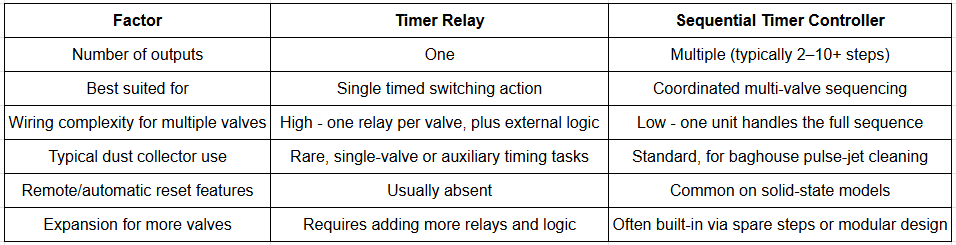
Why This Distinction Matters for Dust Collector Systems
Trying to build a multi-valve pulse-cleaning sequence out of individual timer relays technically works, but it means wiring and coordinating a separate relay – plus supporting logic – for every valve in the bank. That adds cost, complexity, and far more points of failure than a single sequential timer controller purpose-built for exactly this job.
A timer relay still has its place in a dust collector system – timing an auxiliary function, delaying a fan start, or handling a single isolated switching task – but the core pulse-jet cleaning cycle across multiple valves is squarely a sequential timer controller’s job.
What Are the Four Types of Controllers?
Industrial control systems are commonly grouped into four broad categories, worth knowing when specifying equipment beyond just pulse valve timing:
- On/off controllers – simple binary switching based on a setpoint
- Timer-based controllers – including both timer relays and sequential timer controllers, switching outputs based on elapsed time
- Sequential/logic controllers – managing ordered, multi-step operations, including PLCs for more complex automation
- Feedback (closed-loop) controllers – adjusting output based on continuous process measurement, such as PID controllers
A sequential timer controller sits primarily in the second and third categories – it’s fundamentally timer-based, but manages sequential logic across multiple outputs rather than a single switch.
Where Sequential Timer Controllers Are Used Beyond Dust Collectors
While baghouse and cartridge dust collector cleaning is the most common application, the same sequencing principle applies elsewhere:
- Sequence controller for burner and boiler ignition – staged purge and ignition sequencing
- HVAC compressor or AHU staging – sequential activation to reduce peak electrical load
- Multi-stage industrial process timing – any application requiring ordered, repeating output activation
Buying Considerations
- Number of outputs needed – count your actual valve bank size, plus reasonable headroom for expansion
- ON/OFF timing flexibility – independently adjustable pulse duration and interval, not a fixed ratio
- Automatic reset capability – restarts the sequence cleanly after a power interruption
- Remote control terminals – for integration into centralized plant automation
- Enclosure rating matched to your installation environment – flameproof, IP65, or standard
- Sequence controller price relative to the alternative cost of wiring individual timer relays for the same job – often the sequential controller is the more economical choice once wiring and labor are factored in
Common Mistakes to Avoid
- Using individual timer relays to build a multi-valve sequence, when a purpose-built sequential timer controller would be simpler and more reliable.
- Assuming a sequential controller is only for dust collectors, overlooking its use in burner sequencing, HVAC staging, and other multi-step timing applications.
- Sizing the controller to current valve count exactly, with no spare steps for future expansion.
- Ignoring automatic reset and remote control features when the application would clearly benefit from them.
Industry Best Practices
- Match the device to the task: timer relays for isolated single-point timing, sequential timer controllers for coordinated multi-output sequences.
- Size sequential controllers with expansion headroom rather than an exact match to current valve count.
- Standardize on one sequential controller platform across similar equipment to simplify spares and technician training.
- Document sequence timing settings so they can be replicated after maintenance or replacement.
Frequently Asked Questions
1. What is a sequential timer controller? A sequential timer controller is a multi-output device that energizes a series of outputs, typically pulse valves, one after another in a fixed, repeating order – commonly used to control reverse pulse jet cleaning in dust collector systems.
2. How does a timer relay work? A timer relay uses an internal timing circuit to switch a single output on or off after a preset delay, making it suited to isolated timing tasks rather than coordinated multi-step sequences.
3. What’s the main difference between a timer relay and a sequential timer controller? A timer relay controls one output; a sequential timer controller manages multiple outputs in a coordinated, repeating sequence – the difference between a single switch and an orchestrated cycle.
4. Can a timer relay be used for dust collector pulse valves? Technically yes for a single valve, but coordinating multiple valves with individual timer relays requires far more wiring and logic than a single sequential timer controller built for that exact purpose.
5. What is a sequential control system? A sequential control system is any setup where operations occur in a defined, ordered sequence – sequential timer controllers are a specific type built for repeating, timed multi-output sequences.
6. Is a sequence controller for burner applications different from one used in dust collectors? The underlying ON/OFF/next-step logic is the same; the application differs – burner and boiler sequence controllers manage staged ignition and purge sequencing rather than pulse-jet cleaning timing.
7. What determines sequence controller price? Price scales with the number of output steps, timing flexibility, enclosure type, and whether remote control or automatic reset features are included.
8. How many types of industrial controllers are there? Industrial controllers are broadly grouped into four categories – on/off, timer-based, sequential/logic, and feedback (closed-loop) controllers – with sequential timer controllers falling primarily into the timer-based and sequential logic categories.
Choosing the Right Device for Your System
A timer relay and a sequential timer controller solve different problems, and knowing which one your application actually needs prevents both under-engineering a multi-valve system and over-complicating a simple single-point timing task.
For any dust collector, burner sequencing, or multi-stage industrial timing application involving more than one output, Maniks’ engineering team can help match the right sequential timer controller configuration to your valve count and operating conditions.
Explore Maniks’ full range of solid-state sequential controllers, or request a technical consultation.