
Signs It’s Time to Replace Your Dust Collector Valves
Every dust collector valve eventually reaches a point where repair stops making sense and replacement becomes the smarter call – but that point is rarely obvious from a single symptom. Most maintenance teams keep swapping diaphragms and coils on the same valve body for years, not realizing the valve itself has quietly become the source of recurring problems.
Knowing when to repair versus replace dust collector valves saves both unplanned downtime and money spent on parts that won’t actually fix the underlying issue. This guide covers the clear signs that a valve – not just its wear components – has reached the end of its useful service life.
Why This Distinction Matters
A pulse valve for dust collector cleaning is built from two categories of parts: wear components (diaphragms, coils, seals) that are expected to fail periodically, and structural components (valve body, seat, pilot mechanism) that should last far longer. Repair makes sense when only the wear components have failed. Replacement becomes the right call when the structural components themselves are compromised – because no amount of diaphragm swapping fixes a worn seat or a degraded valve body.
Signs Your Dust Collector Valves Need Replacement, Not Repair
1. Repeat Failures Shortly After Repair
If a valve needs a new diaphragm or coil again within weeks of the last replacement, the wear part usually isn’t the actual problem. A pulse valve failing repeatedly and quickly points to a worn seat, a degraded pilot mechanism, or body damage that keeps stressing every new part installed on it.
2. Persistent Air Leaks After Diaphragm Replacement
A fresh diaphragm should stop a leak completely. If hissing continues after replacement, the seal surface inside the valve body itself has likely worn or pitted beyond what a new diaphragm can compensate for – a sign the valve body, not the diaphragm, is the actual failure point.
3. Visible Corrosion or Physical Damage to the Valve Body
Corrosion, cracking, or physical damage to the valve housing compromises structural integrity in a way no internal part replacement addresses. This is especially common in older valves that have spent years in humid, chemically aggressive, or high-vibration environments without an upgrade to a more corrosion-resistant enclosure.
4. Inconsistent or Delayed Pulse Response
A pilot operated valve that fires inconsistently – sometimes strong, sometimes weak, sometimes delayed – even after coil and diaphragm replacement usually has a worn pilot mechanism. This component isn’t typically field-serviceable, which makes valve replacement the practical fix rather than a full internal rebuild.
5. The Valve Predates Your Current Operating Conditions
If dust load, production volume, or process temperature has increased significantly since a valve bank was installed, older valves may simply be undersized or under-rated for current demands – no amount of maintenance changes a valve’s fundamental capacity.
6. Rising Maintenance Cost Approaches Replacement Cost
Once cumulative repair spend on a single valve – parts and labor combined – starts approaching the cost of a new pulse solenoid valve, replacement becomes the financially sound choice, not just the technically sound one.
7. Obsolete or Hard-to-Source Spare Parts
Older valve models from discontinued lines or from a pulse valve manufacturer no longer in business create a growing spares problem. If sourcing a replacement diaphragm or coil is becoming difficult or expensive, standardizing on a currently supported valve model removes that risk going forward.
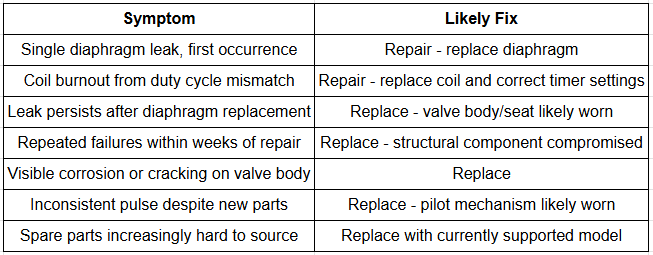
Repair vs. Replace: Quick Reference
Common Industrial Applications
- Baghouse and cartridge dust collectors in cement, steel, and foundry plants
- Reverse pulse jet cleaning systems in pharmaceutical and food processing lines
- Chemical and mineral processing dust extraction systems
- Any long-running dust collection system due for a valve bank age assessment
Maintenance Tips to Extend Valve Life Before Replacement Is Needed
- Track repair history by valve position, not just by date – a position with recurring failures is telling you something a single repair log entry won’t.
- Inspect valve seats during diaphragm replacement, not just the diaphragm itself, to catch seat wear before it causes a repeat leak.
- Match replacement parts exactly to the valve model – off-spec parts accelerate wear on the surrounding structural components.
- Reassess duty cycle and dust load periodically, especially after any production change, since valves rated for older operating conditions may be under strain without an obvious failure yet.
Buying Considerations When Replacing Dust Collector Valves
- Match flow capacity and duty cycle rating to current, not historical, operating conditions
- Confirm thread size and connection type against existing ductwork to avoid adapter fabrication
- Check enclosure options – flameproof, IP65, or corrosion-resistant housings – suited to your actual installation environment
- Choose a pulse valve manufacturer with documented spares support, to avoid repeating the sourcing problem that may have driven this replacement
- Standardize the model across the bank where feasible, simplifying future maintenance and diagnosis
Common Mistakes to Avoid
- Repeatedly replacing wear parts on a structurally worn valve, spending more over time than a single replacement would have cost.
- Ignoring persistent leaks after diaphragm replacement, assuming the new part simply needs “breaking in.”
- Replacing valves reactively, one at a time, after failure, rather than proactively assessing an aging valve bank as a group.
- Choosing a replacement based on price alone, without checking duty cycle rating against actual current dust load.
- Mixing old and new valve models within one bank, complicating future diagnosis and spares management.
Industry Best Practices
- Track repair frequency and cost by valve position to identify candidates for replacement before a failure forces the decision.
- Treat persistent post-repair symptoms as a signal to inspect the valve body and seat, not just the wear part.
- Reassess valve bank age and rated capacity whenever production conditions change materially.
- Standardize on a pulse valve manufacturer with reliable long-term spares availability to avoid future sourcing problems.
- Budget for planned valve bank replacement on a lifecycle basis, rather than treating every failure as an isolated event.
Frequently Asked Questions
1. How long do dust collector valves typically last? Service life varies significantly with duty cycle, dust load, and environmental conditions, but a valve requiring repeated repairs well before its expected lifecycle, or one showing structural wear, is a stronger replacement signal than age alone.
2. Should I repair or replace a leaking dust collector valve? If a fresh diaphragm stops the leak, repair was the right call. If leaking continues after diaphragm replacement, the valve body or seat is likely worn, and replacement is the more reliable fix.
3. What causes a pulse valve to fail repeatedly after repair? Repeated failure shortly after repair usually points to a structural issue – a worn seat, damaged valve body, or degraded pilot mechanism – rather than a defect in the replacement part itself.
4. Can a pilot operated valve be rebuilt instead of replaced? The pilot mechanism in most pilot operated valves isn’t typically field-serviceable, which is why persistent inconsistent response after standard part replacement usually points to full valve replacement rather than further internal repair.
5. How do I know if my dust collector valves are undersized for current operations? If production volume, dust load, or process temperature has increased significantly since installation, valves originally rated for lighter conditions may be under strain even without an obvious failure – worth reassessing against current, not historical, demand.
6. Is it cheaper to repair or replace a dust collector pulse valve? It depends on cumulative repair cost. Once repeated parts and labor spend on a single valve approaches the cost of a new pulse solenoid valve, replacement typically becomes the more cost-effective choice.
7. What should I check before choosing a replacement pulse valve manufacturer? Confirm duty cycle rating matches current operating conditions, thread size compatibility, enclosure options for your environment, and – critically – long-term spares availability to avoid a repeat sourcing problem.
8. Should an entire valve bank be replaced at once, or valve by valve? If several valves in a bank are approaching end of life around the same time, planned group replacement often reduces total downtime and cost compared to reactive, one-at-a-time replacement after each individual failure.
Making the Right Call for Your System
Knowing when a dust collector valve has reached the end of its service life – rather than simply needing another diaphragm – comes down to watching for repeat failures, persistent leaks after repair, and physical or structural wear that no wear-part replacement can fix.
If you’re seeing any of these signs across your valve bank, or you’re overdue for a lifecycle assessment of an aging dust collection system, Maniks’ engineering team can help evaluate your current valves and recommend the right replacement configuration.
Explore Maniks’ full range of pilot operated pulse jet valves, or request a technical assessment.