
Sequential Timer Controller for Energy-Efficient Dust Collection
Compressed air is one of the most expensive utilities in an industrial plant. Generating, treating, and distributing it costs energy at every stage. In a facility with a large bag filter system, the pulse jet cleaning circuit can account for a meaningful share of that consumption – and in many plants, it’s consuming significantly more than it needs to. The sequential timer controller is where that waste either gets managed or goes unchecked. A well-specified, correctly configured sequential controller matches the cleaning intensity of a bag filter to what the filter actually needs – no more, no less. A poorly specified one runs at maximum cleaning rate regardless of filter condition, cycling valves continuously whether the filter bags are loaded with dust or barely touched.
In 2026, with energy costs under scrutiny and compressed air efficiency increasingly part of industrial sustainability reporting, the sequential timer controller deserves more attention than it typically gets. This guide covers the features that actually reduce energy consumption, extend equipment life, and improve system reliability – and why each one matters in practice.
What Does a Sequential Timer Controller Do?
A sequential timer controller – also called a sequential controller or sequence controller in dust collection contexts – is the electronic control unit that manages the pulse jet cleaning cycle of a bag filter system. It sends timed electrical signals to each pulse jet solenoid valve in turn, triggering the compressed air bursts that clean filter bags row by row.
It controls three things that determine both cleaning effectiveness and energy consumption:
Which valve fires – the sequence order across all installed pulse valves. How long each valve stays open – the pulse duration, typically 50 to 150 milliseconds. How long between successive pulses – the pulse interval, which determines both cleaning frequency and the compressed air recovery time between pulses.
These three variables, set correctly for the specific filter installation, are the difference between a bag filter that cleans efficiently with minimum compressed air and one that overconsumes air while still struggling to maintain acceptable differential pressure.
Feature 1: Independently Adjustable Pulse Duration and Interval
This is the most important functional feature of any sequential timer controller for energy efficiency – and the one most frequently constrained in lower-specification units.
Why it matters: Pulse duration and pulse interval affect energy consumption in opposite directions and must be optimised independently.
A pulse duration that is longer than necessary wastes compressed air on every cycle without improving cleaning. If 80 milliseconds is sufficient to flex the filter bag and break the dust cake, running at 120 milliseconds delivers the same cleaning result at 50% more air consumption per pulse. Across 20 valves cycling continuously, that overconsumption is constant and cumulative.
A pulse interval that is too short doesn’t allow the compressed air manifold to recover pressure between pulses. The result is a sequence where early-sequenced valves fire at full pressure and later-sequenced valves fire at reduced pressure – uneven cleaning across the filter, with compressed air wasted on weak pulses that don’t clean effectively.
What to look for: A sequential controller with independently adjustable pulse duration (typically 50–200ms range) and pulse interval (typically 2–30 seconds range) that can be set and locked without affecting each other. Controllers that link these parameters – where changing the interval also changes the duration – prevent proper optimisation.
Feature 2: Differential Pressure-Based Demand Cleaning
This is the feature with the single largest energy efficiency impact – and it’s only available on higher-specification sequential controllers.
How it works: A differential pressure transmitter measures the pressure drop across the filter bags. The sequential controller monitors this signal. When differential pressure rises above a set upper threshold, the controller starts the cleaning cycle. When it falls below a lower threshold, it stops.
In a continuous production environment, dust loading on the filter bags varies with production rate, raw material characteristics, and process conditions. During periods of lower dust loading – startup, shift changeovers, reduced production – a bag filter on continuous cleaning mode is cycling valves unnecessarily. The filter bags are already clean. The compressed air consumption is real. The cleaning benefit is zero.
Demand-based cleaning eliminates this waste. The controller only runs when the filter needs it.
Measured impact: In variable-load applications – batch processes, operations with production breaks, facilities with significant load variation across shifts – demand cleaning can reduce compressed air consumption for pulse jet cleaning by 30 to 60% compared to continuous fixed-interval cleaning. Valve diaphragm cycle counts reduce proportionally, directly extending maintenance intervals.
What to look for: A sequential controller with differential pressure input capability, independently adjustable upper and lower setpoints, and a manual override that allows continuous cleaning when required (during startup, or when DP transmitter maintenance is underway).
Feature 3: Solid-State Electronic Design
This is the baseline reliability requirement for any sequential timer controller used in industrial dust collection – not a premium feature, but a non-negotiable specification.
Why it matters for energy efficiency: Electromechanical cam timers – still found in older bag filter installations across India – develop timing drift as mechanical components wear. Pulse durations that were set at commissioning gradually lengthen as cam profiles wear, delivering longer pulses than intended on every cycle. Intervals shorten as gear wear affects sequencing speed. Neither drift is visible without measurement, and both waste compressed air.
Solid-state sequential controllers use electronic timing circuits with no moving parts. Timing accuracy remains consistent from commissioning through the controller’s operational life – the pulse duration set at commissioning is the pulse duration delivered five years later.
Additional benefit: Electromechanical timers are a source of mechanical failure modes – cam damage, gear wear, contact degradation – that solid-state designs eliminate entirely. Fewer failure modes means fewer unplanned maintenance events on the control system itself.
What to look for: Confirmed solid-state electronic design with no mechanical timing components. Check this explicitly – some products marketed as “electronic” still use electromechanical output relays whose switching life limits the overall cycle count the controller can complete before maintenance is required.
Feature 4: Wide Adjustment Range Across All Parameters
A sequential timer controller with a narrow adjustment range for pulse duration or interval forces the installation to operate at sub-optimal settings when the ideal parameter falls outside the available range.
In practice, this means:
- Plants setting pulse duration at the minimum available (say, 80ms) when the optimal for their valve and manifold combination is 60ms – consuming 33% more air per pulse than necessary.
- Plants setting pulse interval at the maximum available (say, 15 seconds) when the manifold needs 20 seconds to recover properly – resulting in pressure-starved later-sequence valves and wasted compressed air on ineffective pulses.
What to look for: Pulse duration range from at least 50ms to 200ms. Pulse interval range from at least 2 seconds to 30 seconds or more. Both ranges should be continuously adjustable within these spans – stepped or fixed-point adjustment limits the ability to optimise.
Feature 5: Multi-Channel Capacity with Individual Channel Control
Energy efficiency in a bag filter system requires that the cleaning sequence cover all installed valve positions correctly – neither missing positions (leaving bags uncleaned) nor double-cycling positions (cleaning the same row twice before others are cleaned once).
Why individual channel control matters: Some sequential controllers activate all channels regardless of whether all positions have installed valves – cycling empty channel outputs repeatedly. In installations where the valve count doesn’t fill the controller’s channel capacity, this creates unnecessary electrical switching that contributes to controller wear without any cleaning benefit.
Higher-specification sequential controllers allow individual channel activation and deactivation – so a 16-channel controller used in a 12-valve installation only sequences through the 12 active positions, skipping the unused channels entirely.
For expandable installations: A controller with deactivatable channels can be commissioned for the current valve count and expanded later – activating additional channels when the filter system is extended – without replacing the controller. This is both a capital cost saving and an operational simplification.
Feature 6: Status Indication Per Output Channel
This feature doesn’t directly reduce compressed air consumption, but it significantly reduces the time and cost of diagnosing the energy-wasting conditions caused by valve failures.
How it helps: A sequential controller with LED status indication per output channel shows maintenance staff which channel is currently active during the cleaning cycle. A channel that should be firing – indicated as active on the controller – but produces no audible pulse at the valve identifies either a wiring fault or a valve failure immediately, without requiring instrumentation.
Unidentified valve failures – channels firing electrically but valves not responding – mean that the affected filter bag rows are not being cleaned. Differential pressure rises in those sections. The controller compensates by running more frequently (in DP-controlled mode) or the differential pressure simply climbs (in fixed-interval mode). In either case, energy is wasted and filter performance degrades until the fault is found.
Fast fault identification – enabled by per-channel status indication – means faster corrective action and less time operating with degraded cleaning efficiency.
Feature 7: Alarm Output and DCS Integration
For industrial plants with centralised DCS or SCADA systems, a sequential controller with a fault alarm relay output allows the filter cleaning system to be monitored alongside other plant utilities – alerting operators to control faults without requiring someone to physically inspect the filter panel.
Energy efficiency connection: A controller fault that stops the cleaning cycle entirely – while appearing operational from a distance – can allow filter bags to blind completely before the fault is identified. Returning a fully blinded filter to acceptable differential pressure requires extended high-frequency cleaning that consumes compressed air at maximum rate until the bags are clean. A relay alarm that notifies the control room immediately when a controller fault occurs enables faster response and prevents this high-consumption recovery scenario.
Sequential Controller vs. Fixed Cam Timer: Energy Efficiency Comparison
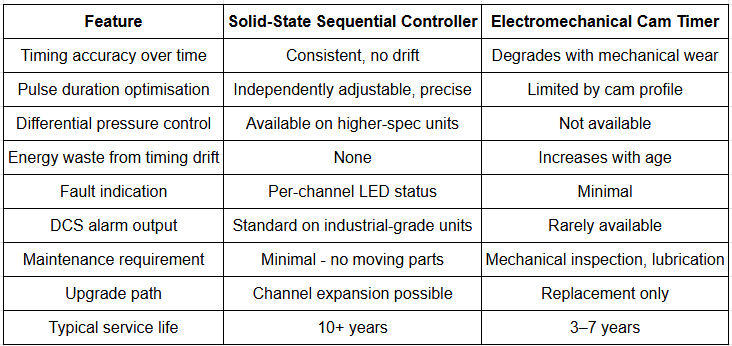
The energy efficiency case for replacing an ageing electromechanical cam timer with a solid-state sequential controller goes beyond the controller itself. Timing drift in a cam timer that has been in service for five or more years is often responsible for compressed air waste that no one has measured or attributed – because the original commissioning settings are assumed to still be in effect when they aren’t.
Configuring a Sequential Timer Controller for Energy Efficiency: Practical Steps
Step 1 – Establish the minimum effective pulse duration. Starting at the valve manufacturer’s recommended minimum, run a short test sequence and monitor filter differential pressure response. Increase duration incrementally until differential pressure responds normally to each cleaning cycle. The lowest duration that produces effective cleaning is the energy-optimal setting.
Step 2 – Establish the minimum adequate pulse interval. Monitor manifold supply pressure during a cleaning cycle with a gauge. Identify the interval at which pressure fully recovers between pulses – a gauge that returns to supply pressure before the next pulse fires confirms adequate recovery. The minimum interval that achieves full pressure recovery is the energy-optimal setting.
Step 3 – Set DP control thresholds if available. Commission upper and lower differential pressure setpoints based on the filter’s design operating range – typically the upper setpoint at 80–90% of the maximum acceptable differential pressure, the lower at 50–60%. Confirm the system responds correctly to these thresholds before leaving the installation running autonomously.
Step 4 – Document and lock settings. Record the commissioned pulse duration, interval, channel configuration, and DP setpoints. Lock or password-protect the settings if the controller supports this. Settings that drift from the commissioned optimum – through well-intentioned but undocumented adjustments – are a common source of energy waste that is difficult to attribute without the original documentation.
Step 5 – Review annually. Filter condition, production processes, and dust loads change. Settings that were optimal at commissioning may not remain optimal as the installation evolves. Annual review – comparing current differential pressure performance against the commissioning baseline – identifies when settings need adjustment.
Common Mistakes That Increase Energy Consumption Through Controller Settings
Running maximum pulse duration as a default. Longer pulses are not more effective once the diaphragm has fully lifted and delivered the peak air volume. Additional duration wastes air without additional cleaning. Start from the minimum effective duration, not the maximum available.
Setting very short intervals to “clean more often.” A short interval that doesn’t allow full manifold pressure recovery produces a sequence of progressively weaker pulses. The compressed air is consumed; the cleaning is ineffective. The correct response to high differential pressure is to identify and correct the underlying cause – not to increase cleaning frequency beyond the manifold’s recovery capacity.
Leaving demand control in manual override permanently. Demand-based DP control is only useful if it’s actually running. Overriding to continuous mode for a maintenance event and then not reinstating DP control is a common pattern that results in continuous maximum-rate cleaning indefinitely.
Not adjusting settings after filter bag replacement. New filter bags have different resistance characteristics from aged bags with established dust cake. After a full bag replacement, the optimal pulse duration and interval may differ from the pre-replacement settings. A brief recommissioning check after bag replacement avoids running sub-optimal settings for months.
Sequence Controller Price: What’s Worth Paying For
Sequential controller price in India ranges from basic units suited to small dust collectors to multi-channel industrial-grade units with DP control integration, DCS alarm outputs, and wide adjustment ranges.
The features that carry cost – DP control input, wide adjustment ranges, per-channel status indication, alarm relay outputs – are precisely the features that reduce compressed air consumption and maintenance costs over the controller’s service life.
For a 20-valve industrial bag filter installation running continuously, the compressed air saved by a DP-controlled sequential controller over a basic fixed-interval unit can justify the price difference between the two in under 12 months of operation – depending on local compressed air generation costs and the actual variation in filter loading.
Sequence controller price is therefore most usefully evaluated as an investment with a measurable return – not as a category where minimising upfront cost produces the best outcome.
Frequently Asked Questions
What is a sequential timer controller in a dust collection system?
A sequential timer controller is the electronic control unit that manages the pulse jet cleaning cycle of a bag filter. It sequences electrical signals to each pulse jet solenoid valve in turn, controlling which valve fires, how long each pulse lasts, and the interval between successive pulses. It is the component that determines both the cleaning effectiveness of the bag filter and the compressed air consumption of the pulse jet cleaning system.
How does a sequential controller reduce energy consumption in a dust collector?
A sequential controller reduces energy consumption through two mechanisms. First, precise and stable timing – using a solid-state design – ensures pulse duration is no longer than necessary for effective cleaning, eliminating compressed air waste on oversized pulses. Second, differential pressure-based demand cleaning runs the cleaning cycle only when the filter condition requires it – stopping the sequence when the filter is clean and restarting when differential pressure rises again. This demand approach eliminates continuous cleaning during periods when the filter doesn’t need it.
What is the difference between a sequential timer and a sequence controller?
In dust collection applications, sequential timer and sequence controller refer to the same category of equipment – the controller that sequences pulse valve operation in a bag filter. Both terms are used interchangeably. Note that a sequence controller for burner management is a different product entirely – it manages the ignition and shutdown sequence of industrial combustion equipment and is not interchangeable with a bag filter sequential controller despite the naming similarity.
What is demand-based cleaning and how much energy does it save?
Demand-based cleaning uses a differential pressure transmitter to control when the sequential controller runs its cleaning cycle – starting when DP rises above an upper threshold, stopping when it falls below a lower threshold. Rather than cycling continuously at a fixed interval, the system cleans only as much as the filter condition requires. In variable-load applications, this approach can reduce compressed air consumption for pulse jet cleaning by 30 to 60% compared to continuous fixed-interval cleaning, with proportional reductions in valve diaphragm wear.
What should I look for when comparing sequence controller prices in India?
When evaluating sequence controller price, compare total cost of ownership rather than upfront purchase price. Features that carry additional cost – differential pressure control, wide adjustment range, per-channel status indication, alarm relay output, solid-state design – directly reduce compressed air consumption, extend maintenance intervals, and shorten fault diagnosis time. A controller with DP control capability that costs more upfront typically recovers the price difference through compressed air savings within the first year of operation in a continuously running industrial installation.
Can I retrofit a solid-state sequential controller to an old bag filter with a cam timer?
Yes. Retrofitting a solid-state sequential timer controller to replace an ageing electromechanical cam timer is one of the most cost-effective maintenance upgrades available for older bag filter systems. The new controller must match the coil voltage of the installed pulse valves (24V DC, 110V AC, or 230V AC) and have sufficient output channels for the valve count. Confirm these specifications before ordering. The retrofit typically improves cleaning consistency immediately by eliminating the timing drift that develops in worn cam timers, and enables energy-saving features – such as DP control – that were not available with the original equipment.
Conclusion
The sequential timer controller is the component that either manages compressed air consumption in a bag filter system or allows it to run unchecked. The features that matter – solid-state design for timing accuracy, independently adjustable pulse duration and interval, differential pressure demand control, adequate channel capacity, and per-channel status indication – are not premium options for large installations. They are the specification baseline for any bag filter where energy efficiency and maintenance cost matter.
In industrial environments where compressed air generation is a significant operating cost, a correctly specified and configured sequential controller pays for the difference between a basic and capable unit quickly – and continues delivering that return for the operational life of the installation.
Choosing the right sequential timer controller is a specification decision that affects every compressed air pulse the bag filter system fires for the next decade. It deserves the same engineering attention as the valves it controls.
Looking for a sequential timer controller for your bag filter system?
Maniks manufactures solid-state sequential controllers specifically designed for industrial pulse jet dust collection – with independently adjustable timing parameters, differential pressure control options, and the domestic manufacturing and support infrastructure that keeps Indian industrial installations running reliably.
Whether you’re commissioning a new installation, replacing an ageing cam timer, or reviewing an existing system for energy efficiency improvements, our technical team can help you identify the right controller specification for your valve count, voltage requirements, and operating environment.
Explore the Maniks Solid-State Sequential Controller or contact us for a technical consultation and quotation.