
Introduction: Choosing the Right Control System Can Save You Big
If you’re running a small industrial setup in Pune or anywhere in Maharashtra, you’ve likely faced this question: Should I use a PLC or a sequence controller?
For many applications, especially in compact systems, a sequence controller can be a smarter, more efficient choice. It simplifies operations, reduces costs, and delivers reliable automation without unnecessary complexity.
In this blog, we’ll break down the differences between PLCs and sequence controllers, helping you decide what’s best for your application.
What Is a Sequence Controller?
A sequence controller (also known as a sequential timer or sequential timer controller) is an automation device designed to control operations in a fixed sequence.
How It Works
- Executes outputs step-by-step
- Operates based on time intervals or signals
- Ideal for repetitive processes
Common Applications
- Dust collectors
- Industrial filters
- Compressors
- Sequence controller for burner systems
- Pneumatic automation
What Is a PLC (Programmable Logic Controller)?
A PLC is a highly flexible industrial computer used to control complex automation processes.
Key Features:
- Custom programming
- Multiple inputs and outputs
- Advanced logic control
- Integration with large systems
Sequence Controller vs PLC: Quick Comparison
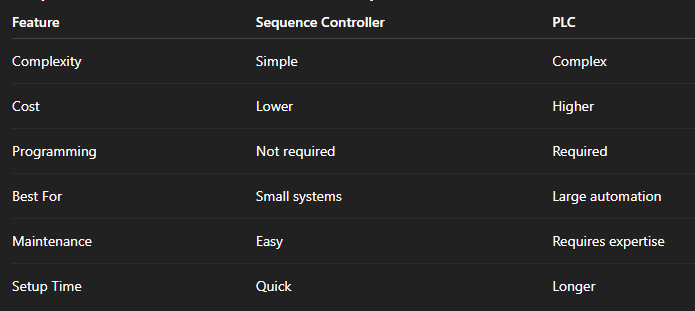
When Is a Sequence Controller Better Than PLC?
For many small and medium applications, a sequential controller is actually the better choice.
1. When Your Process Is Fixed
If your system follows a repetitive sequence, like:
- ON → Delay → OFF → Repeat
A sequential timer controller is perfect.
2. When You Want Cost Efficiency
PLCs can be expensive due to:
- Hardware cost
- Programming cost
- Maintenance
A sequence controller price is much more affordable, making it ideal for SMEs.
3. When You Need Quick Installation
- No complex programming
- Easy setup
- Faster deployment
Perfect for industries in Pune looking for quick automation solutions.
4. When You Don’t Need Advanced Logic
If your system doesn’t require:
- Complex decision-making
- Data processing
- Integration with SCADA
Then a PLC is overkill.
5. When Maintenance Simplicity Matters
Sequence controllers:
- Are easy to troubleshoot
- Require minimal technical expertise
- Reduce downtime
When Should You Choose a PLC Instead?
A PLC is better when:
- You need complex logic
- Multiple processes interact
- Real-time monitoring is required
- Integration with other systems is needed
Real-World Use Cases
1. Dust Collector System
A sequence controller controls:
- Pulse valves
- Cleaning cycles
No PLC needed
2. Burner Control System
A sequence controller for burner ensures:
- Safe ignition sequence
- Timed operations
3. Compressor Automation
Sequential control helps:
- Manage load cycles
- Improve efficiency
4. Small Manufacturing Units in Pune
For compact operations:
- Lower cost matters
- Simplicity is key
Sequence controllers are widely preferred
Advantages of Using a Sequence Controller
- Cost-Effective: Lower investment compared to PLC systems
- Easy to Use: No programming required
- Reliable: Designed for repetitive industrial operations
- Compact Design: Ideal for small panels and systems
- Faster ROI: Quick payback due to lower cost and efficiency
Limitations You Should Know
To be fair, sequence controllers also have limitations:
- Limited flexibility
- Not suitable for complex logic
- Less scalable
That’s where PLCs come in
Why Industries in Pune Prefer Sequence Controllers
Industrial units in Pune and across Maharashtra are increasingly choosing sequential timer controllers because:
- Cost-sensitive operations
- Need for simple automation
- Faster implementation
- Easy maintenance
Why Choose Maniks Sequence Controllers?
Maniks offers high-quality solid-state sequence controllers designed for Indian industrial conditions.
Key Benefits:
- Robust design
- Reliable performance
- Easy installation
- Long operational life
- Ideal for dust collectors, burners & more
FAQs
1. What is a sequence controller used for?
It is used to control operations in a fixed sequence, especially in repetitive industrial processes.
2. Is a sequence controller cheaper than PLC?
Yes, it is significantly more cost-effective for small systems.
3. Can a sequence controller replace a PLC?
It can replace a PLC in simple applications but not in complex automation systems.
4. What industries use sequence controllers?
Industries like cement, manufacturing, pharma, and automation use them widely.
5. What is a sequential timer controller?
It is another term for a sequence controller that operates based on timed sequences.
Conclusion: Smart Choice for Small Systems
If your application is simple, repetitive, and cost-sensitive, a sequence controller is often a better choice than a PLC.
It offers:
- Lower cost
- Easy setup
- Reliable performance
For industries in Pune and Maharashtra, it’s a practical and efficient solution for automation.
Ready to Upgrade Your System? Contact us to choose high-performance solutions from Maniks and simplify your automation.