
Pneumatic Diaphragm Valve Guide | Valve Supplier in India
Most diaphragm valve problems don’t start on the plant floor. They start at the purchase desk, when a valve gets selected on port size and price alone.
Six months later, the maintenance team is chasing weak pulses, rising differential pressure, and a compressor that never seems to unload. The valve was “the right size,” but it was wrong for the duty, the air quality, or the controller driving it.
This guide gives plant engineers and purchase managers a practical checklist for choosing a pneumatic diaphragm valve, and for judging the valve supplier in India behind it. Use it before your next order, whether you’re buying one valve or a hundred.
What Is a Pneumatic Diaphragm Valve?
A pneumatic diaphragm valve uses compressed air pressure acting on a flexible diaphragm to open and close a main air port. In a dust collector, it releases a short burst of air into the filter bags or cartridges to knock off accumulated dust.
A small pilot solenoid controls the diaphragm. When the timer controller energises the solenoid, pressure above the diaphragm vents, the diaphragm lifts, and a pulse of air passes through. When the solenoid closes, pressure rebuilds and the valve reseats.
Because the valve fires thousands of times a day, small differences in diaphragm material, seat finish, and solenoid response show up quickly in real plant performance.
Why Valve Selection Matters for Air Pollution Control Equipment
Pulse valves are the working heart of the cleaning system in most air pollution control equipment that uses bag filters. If the valve underperforms, the whole system does.
Weak or late pulses leave dust on the bags. Differential pressure climbs, the fan draws more power, and airflow at the hood drops. In the worst case, a plant struggles to meet emission norms even though the filter itself is fine.
That is why engineers who work with air pollution control equipment treat the valve as a critical spare, not a commodity item.
Step 1: Define the Duty Before You Compare Valves
Start with your own process data, not a catalogue.
- Dust type and loading: Abrasive, sticky, or hygroscopic dust changes how hard the filter needs cleaning.
- Cleaning frequency: A cement kiln filter pulses far more often than a woodworking collector running one shift.
- Operating pressure: Note the actual header pressure at the tank, not the compressor’s rated output.
- Ambient and gas temperature: This decides the diaphragm compound.
- Controller type: Know your timer or differential pressure controller’s output voltage and pulse settings.
Share these details with any industrial valve company you approach. A good one will ask for them before quoting.
Step 2: Check the Technical Specifications That Actually Matter
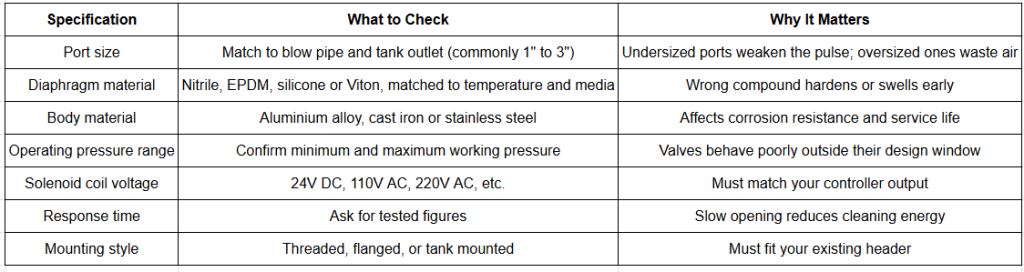
Ask the supplier for datasheets and, where available, cycle-life test data. Verbal assurances aren’t a specification.
Step 3: Match the Diaphragm to the Environment
The diaphragm is the part that wears out first, and it’s where most unplanned failures begin.
Standard nitrile suits many general industrial duties. Higher temperatures, oil mist in the compressed air, or chemical exposure may call for a different compound. Silicone and Viton variants exist for tougher conditions, though each has trade-offs in abrasion resistance and cost.
If you aren’t sure, tell the manufacturer your gas temperature and what’s in your compressed air. That one conversation can prevent a repeat failure.
Step 4: Confirm Compatibility With Your Existing System
New valves rarely work in isolation. Check these before ordering:
- Does the solenoid voltage match your sequential timer controller?
- Do the port dimensions and threads fit your tank and blow pipes?
- Will the pulse duration setting in your controller suit the new valve?
- Are you mixing brands on one header? Different geometries can produce uneven pulses across a row.
Mismatch problems are among the most common reasons a “good” valve underperforms after installation.
Step 5: Evaluate the Supplier, Not Just the Product
Two valves can look identical on paper and perform very differently, because the manufacturing behind them differs. When you compare an industrial valve manufacturer in India, look at:
- Manufacturing experience in dust collection specifically, not general plumbing valves
- Quality control: Is every valve tested before dispatch, or only sample batches?
- Technical support: Can they help with sizing and troubleshooting?
- Spares availability: Diaphragm kits and coils should be easy to reorder
- Lead times for both urgent replacements and bulk orders
- Track record in your industry segment
A reliable valve supplier in India should be willing to discuss all of this openly.
Where Pneumatic Diaphragm Valves Are Used
- Cement plants: Packing units, raw mill filters, clinker coolers
- Steel and foundries: Furnace fume extraction, shot blasting, sand handling
- Power plants: Coal and ash handling dust collection
- Pharmaceuticals: Powder handling and tablet coating dust control
- Food processing: Flour, grain, and spice dust collection
- Chemicals and textiles: Process dust and fibre extraction
- Mining and woodworking: Crusher houses, sawdust and chip collection
Manufacturing clusters such as Pune’s industrial belt, with its engineering, automotive, and foundry units, rely on the same pulse jet cleaning principle. Buyers searching for air pollution control equipment manufacturers in Pune are usually solving the same valve selection questions covered here.
Common Mistakes Engineers Make When Buying
Buying on price alone. A cheaper valve that fails early costs more in downtime and labour than a well-made one.
Ignoring compressed air quality. Moisture and oil shorten diaphragm life, regardless of brand.
Skipping sample testing. Trial a unit under real conditions before committing to volume.
Assuming all valves are interchangeable. Port geometry and response characteristics vary between manufacturers.
Forgetting spares. Diaphragms are wear items. Order a spare kit with the valves, not after the first failure.
Overlooking the controller. A valve and its timer controller work as a pair. Check both.
Maintenance Tips After You Buy
Good selection gets you halfway. Maintenance gets you the rest.
- Drain the air tank and check dryers and filters regularly.
- Inspect diaphragms during planned shutdowns, looking for cracks and stiffness.
- Watch differential pressure trends; a slow climb often signals weakening valves.
- Test solenoid response when pulses feel weak.
- Avoid over-tightening bolts during diaphragm replacement.
- Keep a labelled spares set matched to your valve model.
A quarterly inspection works as a sensible baseline for most plants, and more often for heavy dust loads.
Industry Best Practices
Experienced maintenance teams standardise on one proven manufacturer per plant to simplify spares. They log differential pressure and compressed air consumption so they can spot problems early, and they treat valve replacement as planned preventive maintenance rather than breakdown repair.
Pairing valve checks with controller checks, and reviewing compressed air quality at the same time, tends to reduce downtime and lower long-term maintenance cost.
Frequently Asked Questions
1. What should I check before buying a pneumatic diaphragm valve?
Check port size, diaphragm material, operating pressure range, solenoid coil voltage, response time, and mounting style, and confirm they match your dust collector, compressed air supply, and timer controller.
2. How do I choose the right diaphragm material?
Match it to your gas temperature, oil or moisture in the compressed air, and any chemical exposure. Standard nitrile suits many duties, while harsher conditions may need other compounds.
3. What makes a good valve supplier in India?
Look for dust collection experience, tested products, documented specifications, available spares, responsive technical support, and a record in your industry.
4. How often should diaphragm valves be inspected?
A quarterly inspection suits most plants. Heavy-dust applications like cement and foundries benefit from more frequent checks.
5. Can I mix valve brands on the same tank?
It’s best avoided. Different port geometries and diaphragm designs can cause uneven pulse strength across the filter bank.
6. How does valve quality affect air pollution control equipment performance?
Reliable valves keep cleaning consistent, which stabilises differential pressure and supports steady filtration and emission performance.
7. What affects the price of a pneumatic diaphragm valve?
Port size, body and diaphragm materials, quality control, and order volume all influence price. Total cost over the valve’s service life matters more than the unit price.
8. Should I test a sample before a bulk order?
Yes. Running a sample under real operating conditions confirms fit and performance before you scale up.
Conclusion
Selecting a pneumatic diaphragm valve comes down to knowing your duty, matching specifications to your system, and choosing a supplier whose quality and support you can verify. Do that, and you avoid the weak pulses, air waste, and repeat failures that trace back to a rushed purchase.
If you’re comparing options, treat any valve supplier in India the way you’d treat a critical equipment partner: ask for data, test a sample, and check how they support you after delivery.
Need help selecting the right valve for your dust collector? Maniks has spent over 47 years building pulse valves, timer controllers, diaphragms, and spares for dust collection systems across India. Contact our technical team for sizing guidance and a quotation matched to your system.