
Indian vs Imported Industrial Valves: What to Consider 2026
For OEM manufacturers and plant engineers sourcing industrial valves in 2026, the Indian vs imported question isn’t what it was ten years ago. The gap in manufacturing quality between established Indian industrial valve companies and their international counterparts has narrowed considerably – while the practical advantages of domestic sourcing have grown.
This comparison matters most in air pollution control and dust collection applications, where valve reliability directly affects emission compliance, maintenance costs, and operational continuity. Getting the sourcing decision right has real consequences – in both directions.
Here is what manufacturers and engineers should actually weigh before making that decision in 2026.
The Short Answer: It Depends on the Manufacturer, Not the Country
The most useful reframe for this comparison is to stop treating “Indian” and “imported” as quality indicators and start treating them as supply chain variables. The meaningful comparison is between:
- A well-established Indian industrial valve company with its own manufacturing facility, documented quality processes, and deep application experience in dust collection
- An imported brand with a strong international reputation, global testing data, and a premium price point
versus:
- A budget Indian assembler relabelling components from uncontrolled sources
- A budget import from a low-cost origin with no domestic technical support
The first comparison – established Indian manufacturer vs. reputable import – is a genuinely close call on quality. The second comparison isn’t close at all: both options carry similar risks regardless of origin.
The decision framework below applies to the meaningful comparison between credible options.
1. Quality and Manufacturing Standards
The historical reality: Imported valves from European and American manufacturers set the original benchmark for industrial valve quality in India. Plants commissioned in the 1980s and 1990s installed imported brands partly because domestic alternatives hadn’t reached the same standards.
The 2026 reality: Established Indian industrial valve manufacturers – particularly those that have focused on specific application areas like pulse jet dust collection for decades – now produce diaphragm valves, pilot operated valves, and solenoid assemblies to specifications that are directly comparable to imported alternatives for standard industrial applications.
What to look for in any manufacturer regardless of origin:
- Published flow coefficient (Cv) data
- Tested and documented cycle life ratings
- Material certificates for diaphragm compounds
- Dimensional consistency across production batches
- Calibrated test equipment and incoming material inspection
An Indian industrial valve company that meets these criteria is competing on quality – not on price alone.
2. Total Cost of Ownership vs. Unit Price
Unit price comparison: Imported valves typically carry a 30–60% price premium over equivalent Indian-made valves for comparable specifications. This gap widens further when import duties, freight, and insurance costs are factored in.
Where the calculation changes:
The total cost of ownership over a 3-to-5-year operating period includes far more than the initial purchase price:
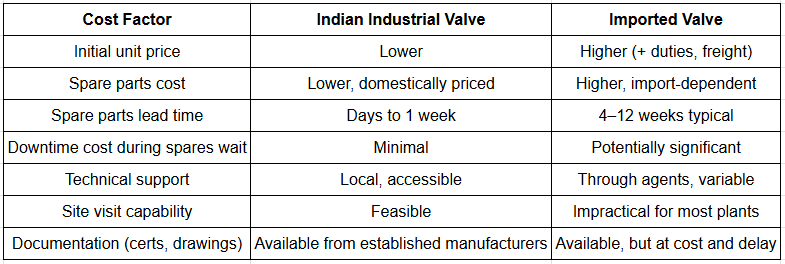
For a 20-valve bag filter installation running continuously, the spare parts lead time difference alone can determine whether a planned maintenance shutdown stays on schedule or extends – with operational cost implications that dwarf the initial valve purchase price difference.
3. Spare Parts Availability: The Decision That Matters Most at 2 AM
This is the factor most purchase managers underweight and most maintenance engineers overweight – and the maintenance engineers are right.
An imported pulse valve with excellent specifications and a 4–8 week diaphragm replacement lead time creates a maintenance dependency that affects production planning. A planned shutdown can accommodate this – but in Indian industrial reality, not every valve failure happens on schedule.
A reliable valve supplier in India with domestic stock of standard replacement diaphragm kits, O-rings, and solenoid coils provides something that no imported brand can match: the ability to have the right part on site within days of an unplanned failure.
For air pollution control equipment manufacturers in India building dust collectors for their customers, this spare parts consideration applies twice – once for their own maintenance, and once for the after-sale support they can offer their own customers. An OEM manufacturer sourcing components from a domestic industrial valve company can offer faster spare parts support to end users than one dependent on imported components.
4. Technical Support and Application Engineering
What imported brands offer: Comprehensive global technical documentation, international application data, and validated performance across a wide range of industrial environments. For highly unusual or demanding specifications – extreme pressures, unusual chemical exposures, export market regulatory requirements – this documentation depth can be valuable.
What established Indian industrial valve companies offer: Direct access to engineers who speak the same language, understand Indian industrial operating conditions, can visit the site, and can work through application-specific questions without international communication barriers or time zone delays.
For the most common industrial valve applications in India – pulse jet dust collection across cement, steel, power, pharmaceutical, and chemical sectors – the technical requirements are well within the capability of established Indian manufacturers, and the practical support advantages of domestic sourcing are significant.
The question to ask any potential valve supplier: If I have a technical problem with this valve in my installation, who do I call, and how quickly can you help? The answer reveals more about the support relationship than any specification sheet.
5. Delivery Lead Times for New Procurement
For new plant projects, capital replacements, and OEM equipment builds, delivery timeline affects project schedules directly.
Imported industrial valves from European or American manufacturers typically carry 8–16 week lead times for standard products, longer for non-standard specifications. When projects slip or specifications change – which they do – the imported supply chain has limited flexibility.
Established Indian industrial valve companies maintain stock of standard sizes and configurations, can modify specifications within shorter lead times, and can accommodate project schedule changes without the rigidity of international freight booking commitments.
For air pollution control equipment manufacturers in Pune and across Maharashtra building equipment for Indian end users, domestic valve supply with short lead times is a competitive advantage in project delivery.
6. Regulatory and Documentation Requirements in 2026
The regulatory environment for industrial equipment in India has evolved. Several considerations now favour domestic sourcing:
BIS compliance: Bureau of Indian Standards requirements for certain valve categories are more straightforward to demonstrate with domestically manufactured products.
Make in India procurement policies: Government-sector buyers in power generation, defence, and public sector industrial facilities increasingly require domestic sourcing – making an established Indian industrial valve company the only practical option for these buyers.
CPCB compliance documentation: For air pollution control equipment, the ability to provide equipment documentation in domestic formats and standards – without translation, conversion, or international quality certification complications – simplifies the compliance documentation process.
Export market considerations: For OEM manufacturers exporting dust collection equipment, specification of valves with CE or other international certifications may be required. Some established Indian valve manufacturers now hold these certifications. Confirm before assuming domestic manufacturers cannot meet export documentation requirements.
7. The Make in India Context for 2026
Government policy through the Production Linked Incentive (PLI) scheme, the Atmanirbhar Bharat initiative, and public sector procurement policies has created an explicit preference for domestic manufacturing across industrial categories.
For OEM manufacturers of air pollution control equipment – particularly those supplying government sector buyers in power, cement (public sector entities), steel (SAIL, RINL), and mining – sourcing components from an established Indian industrial valve company is no longer just a cost decision. In some procurement contexts, it’s a qualification requirement.
This policy environment continues to strengthen. The trajectory for 2026 and beyond favours domestic industrial valve manufacturers who meet quality standards – and creates increasing pressure on specifiers who default to imported components without justification.
When Imported Valves Still Make Sense
A fair comparison acknowledges the situations where imported valves remain the better choice:
- Highly unusual specifications not covered by Indian manufacturers’ standard ranges – extreme pressure classes, unusual body materials, or application-specific certifications that domestic manufacturers haven’t developed.
- Export market OEM requirements where the end customer’s specification explicitly requires a particular imported brand by name or requires certifications only held by certain international manufacturers.
- Established installed base where an entire plant is running a specific imported brand and complete standardisation – including spare parts compatibility – has operational value that outweighs the cost and lead time advantages of switching.
- First-of-kind applications in emerging process industries where internationally published application data and global reference installations provide confidence that domestic application data cannot yet match.
Outside these specific situations, the case for defaulting to imported valves in 2026 – particularly for dust collection and air pollution control applications in standard Indian industrial environments – is increasingly difficult to make on merit rather than habit.
The Practical Checklist for Manufacturers in 2026
Before finalising the sourcing decision for industrial valves in a dust collection or air pollution control application, run through these questions for each candidate supplier regardless of origin:
- Does the manufacturer publish flow coefficient (Cv) data for the specific valve?
- Can they provide tested cycle life data for the operating conditions of this installation?
- Are replacement diaphragm kits available domestically within a practical lead time?
- Can they provide material certificates for the diaphragm compound?
- Do they have documented experience in the specific industrial sector and application?
- Is direct technical support accessible – not just through a distributor or agent?
- Can they meet the documentation requirements of the procurement process?
A domestic industrial valve company that answers all these questions satisfactorily is a better sourcing decision than an imported alternative that doesn’t – regardless of where the valve is manufactured.
Frequently Asked Questions
Are Indian industrial valves as good as imported valves in 2026?
For standard dust collection and air pollution control applications, established Indian industrial valve companies now produce valves that are directly comparable to imported alternatives in material quality, dimensional precision, and service life. The quality gap that existed in the 1980s and 1990s has closed substantially for manufacturers with their own facilities and documented quality processes. The meaningful comparison is between specific manufacturers – not between countries of origin.
What is the main advantage of buying from an Indian industrial valve company?
Domestic spare parts availability is the single most practical advantage. An established Indian valve supplier can provide replacement diaphragm kits, solenoid coils, and other wear items within days. Imported alternatives typically require 4–12 weeks for spare parts delivery. In continuous industrial operations where maintenance schedules are fixed and unplanned downtime is costly, this difference is operationally significant.
What should OEM manufacturers of dust collection equipment consider when choosing between Indian and imported valves?
OEM manufacturers should evaluate: total cost of ownership over the equipment’s service life (not unit price alone); spare parts support they can offer their own end-user customers; project delivery lead times; documentation and certification requirements for target markets; and any government procurement policies that affect the end user’s procurement conditions. For OEMs supplying Indian industrial customers, domestic valve sourcing typically wins on all of these factors when the Indian manufacturer meets the quality baseline.
Are air pollution control equipment manufacturers in Pune reliable for OEM valve supply?
Maharashtra’s industrial region – including Pune – has a well-established cluster of air pollution control equipment manufacturers and industrial valve companies with decades of application experience. Several have supplied OEM manufacturers and end users in cement, steel, power, pharmaceutical, and chemical industries both domestically and internationally. When evaluating Pune-based suppliers, apply standard quality evaluation criteria: manufacturing basis, published specifications, spare parts availability, and application engineering capability.
When should a manufacturer still choose imported valves over Indian alternatives?
Imported valves remain the better choice when: the application requires specifications or certifications not available from domestic manufacturers; the export market end-customer’s specification requires a specific imported brand by name; or a plant has established complete standardisation on an imported brand with operational value in spare parts compatibility. Outside these specific situations, domestic sourcing from a quality Indian industrial valve company is typically the more practical and cost-effective decision for Indian industrial applications.
Conclusion
The Indian vs imported industrial valve question in 2026 is not a quality question – it’s a supply chain and total cost question. Established Indian industrial valve companies now compete directly with imported alternatives on material standards and manufacturing precision, while offering clear and growing advantages in spare parts availability, technical support accessibility, project lead times, and alignment with India’s domestic procurement policies.
For manufacturers sourcing valves for dust collection and air pollution control systems in Indian industrial applications, the default assumption should be that a quality domestic industrial valve company is the better choice – unless a specific, identifiable requirement points to an imported alternative.
The decision deserves that analysis. The answer, increasingly, points home.
Evaluating industrial valve suppliers for your dust collection or air pollution control system?
Maniks has been manufacturing precision-engineered industrial valves, pulse jet valve assemblies, and dust collector components for over 47 years – with the application experience, domestic manufacturing capability, and spare parts support infrastructure that makes the sourcing decision straightforward.
Whether you’re an OEM manufacturer specifying components for a new equipment range, a plant engineer reviewing an existing supply chain, or a purchase manager comparing domestic and imported options, our technical team can provide the specification guidance and commercial information you need to make the right decision for your application.
Explore the full Maniks product range or contact us to discuss your valve requirements and request a quotation.