
How to Choose a Pulse Solenoid Valve for Dust Collectors
Most pulse solenoid valve failures are not random. They are the predictable outcome of a specification decision that nobody reviewed carefully enough – a diaphragm material that wasn’t right for the process temperature, a coil voltage that didn’t match the controller output, a valve body too small for the flow requirement, or an IP rating that wasn’t adequate for the installation environment.
The valve worked at commissioning. It continued working for a while. And then it stopped – usually at a point where the maintenance team had already moved on to other concerns, and the root cause of the failure wasn’t obvious to anyone who hadn’t been involved in the original specification.
This is the situation this guide is designed to prevent. Whether you’re specifying a pulse solenoid valve for a new bag filter installation, replacing worn valves in an existing dust collector, or sourcing components for an OEM equipment build, the decisions covered here will determine how the valve performs over its service life – and how much it costs you in maintenance, downtime, and operational frustration if those decisions are made without the right information.
What Is a Pulse Solenoid Valve and What Does It Actually Do?
A pulse solenoid valve is an electrically actuated valve used to release high-pressure bursts of compressed air in a reverse pulse jet dust collection system. It receives a timed electrical signal from a sequential timer controller, opens for a fraction of a second – typically 50 to 150 milliseconds – and discharges compressed air through a blow pipe and venturi nozzle into a row of filter bags.
The resulting pressure wave flexes the filter bag outward, dislodging the dust cake that has accumulated on the bag surface. The dust falls into the collection hopper below, and the bag returns to normal filtration duty – all without interrupting airflow through the system.
In a typical industrial bag filter, you’ll have multiple rows of filter bags and one pulse solenoid valve per row. The sequential controller sequences through each valve in turn, ensuring systematic cleaning across the entire filter area. The valve’s job is simple in concept: open fast, deliver maximum compressed air volume in the shortest possible time, then close cleanly and reset for the next cycle.
Getting that right – consistently, across millions of cycles, in the conditions found in Indian industrial environments – requires a valve that’s designed and specified for the purpose.
Why 2026 Makes Valve Selection More Important Than Ever
Indian dust collection requirements have changed over the past five years in ways that affect valve selection. Several factors are shaping procurement decisions in 2026 that weren’t as prominent in earlier cycles.
Tighter CPCB emission enforcement. Stack emission monitoring has intensified across sectors – cement, steel, power, chemicals, textiles, and mining are all subject to stricter enforcement of particulate emission limits. A dust collector that doesn’t clean effectively because of underperforming pulse valves is an emission compliance risk, not just a maintenance inconvenience.
Continuous Emission Monitoring Systems (CEMS) in larger plants. Real-time emission monitoring means that underperforming filter cleaning – caused by weak or intermittent pulse valve performance – is no longer invisible between periodic manual stack tests. CEMS data creates a continuous record of filter system performance that regulators can access. This shifts the standard for acceptable valve performance from “works most of the time” to “works consistently.”
Higher compressed air costs. Energy prices and operational efficiency pressures have increased focus on compressed air consumption in Indian industry. A pulse valve that doesn’t seal cleanly between pulses wastes compressed air continuously. A valve that requires longer-than-necessary pulse durations to achieve the same cleaning result wastes air on every cycle. Correct specification at purchase reduces operating cost over the valve’s service life.
Growing OEM quality standards. Indian OEM manufacturers building dust collectors for domestic and export markets face increasing specification scrutiny from end users and in some cases from export market regulatory requirements. OEMs need pulse valve components that meet documented material and performance standards – not just valves that fit the manifold dimensions.
Step 1: Understand Your System Before You Specify a Valve
The most common mistake in pulse solenoid valve procurement is starting with the valve specification rather than with the system requirements. The valve must match the system – not the other way around.
Before specifying a replacement or new valve, gather the following:
Existing manifold or tank connection dimensions. Measure the port thread size and thread standard (BSP or NPT). In Indian industrial installations, both are common – BSP in older British-designed equipment and systems using Indian-made filters, NPT in American-specified equipment and imports.
Current valve body size. Confirm the nominal size – 1″, 1.5″, 2″, or 2.5″ are the most common in industrial bag filter applications. Larger sizes up to 3″ and beyond are used in tank-mounted configurations for high-volume applications.
Coil voltage. Check the output voltage of the sequential timer controller driving the valves. Common voltages are 24V DC, 110V AC, and 230V AC. If the installation predates your involvement and the original documentation isn’t available, measure the output voltage directly at the valve terminal before ordering a replacement coil.
Operating pressure. Confirm your compressed air supply pressure at the manifold – not at the compressor. Pressure drop between the compressor and the manifold can be significant, particularly in older installations with undersized piping. The valve must be rated for the actual operating pressure, not the nominal system design pressure.
Number of filter bags per row. This determines the compressed air volume needed per pulse – which, together with supply pressure and pulse duration, determines whether the valve body size is adequate for effective cleaning.
Process environment. Note the ambient temperature range in the filter installation area, the nature of the dust being collected, and whether the installation is indoors or outdoors. These factors drive diaphragm material selection and coil IP rating requirements.
Step 2: Select the Right Valve Body Size
Valve body size determines the flow coefficient (Cv) of the valve – which directly determines how much compressed air is discharged per pulse. Too small, and the pulse doesn’t have the volume to fully flex the filter bag and dislodge the dust cake. The bags blind progressively. Differential pressure climbs. The filter appears to be working – cleaning cycles are running – but the cleaning isn’t effective.
Too large isn’t generally a problem from a cleaning perspective, but it can cause excessive compressed air consumption and in some systems – particularly smaller manifolds – may exceed the manifold’s pressure recovery rate between pulses.
Matching valve size to the existing installation:
If you are replacing like-for-like – the same valve size from a different manufacturer – confirm the new valve’s Cv value is equal to or greater than the original. Nominal port size (1″, 2″, etc.) does not guarantee the same Cv between manufacturers. Ask for this specification; reputable pulse valve manufacturers publish it.
Sizing for a new installation:
For new installations, work from the filter OEM’s specification sheet or the filter design drawings. The OEM will specify the valve port size based on the filter bag area per row, the blow pipe and venturi geometry, and the design cleaning pulse requirement. Follow this specification unless you have engineering grounds to modify it.
Common size to application guide:
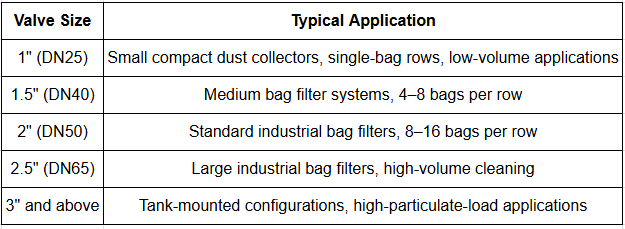
These are indicative ranges. The correct size for any specific installation depends on the actual filter bag area, blow pipe design, and system operating pressure – not on the bag count alone.
Step 3: Select the Right Diaphragm Material
The diaphragm is the primary moving and sealing element in the pulse solenoid valve. It is also the primary maintenance item – the component that will require periodic replacement over the valve’s service life. Selecting the right diaphragm material for your specific process environment is the single specification decision that most affects maintenance frequency and valve service life.
NBR (Nitrile Butadiene Rubber)
- Best for: General industrial dust collection – cement grinding, raw material handling, food grain dust, woodworking, textile fibre dust, light chemical dust.
- Temperature range: Typically –20°C to +80°C continuous.
- Properties: Good resistance to oils, fats, and general industrial process environments. The most widely used diaphragm material in Indian industrial dust collection. Cost-effective, widely available as a spare part.
Avoid when: The process involves significant solvents, ozone, or temperatures above 80°C.
PTFE-Coated NBR
- Best for: Chemical processing environments with mild corrosive dusts or gases, pharmaceutical ingredient handling, applications where surface contamination of the diaphragm is a concern.
- Temperature range: Similar to NBR base, with enhanced surface resistance.
- Properties: The PTFE coating adds chemical resistance and reduces particulate adhesion to the diaphragm surface – useful where dust particles might otherwise bond to the diaphragm and cause premature wear.
EPDM (Ethylene Propylene Diene Monomer)
- Best for: Applications involving ozone, steam, hot water vapour, or outdoor installations with significant UV exposure. Also suited to some chemical environments where NBR is not compatible.
- Temperature range: –40°C to +120°C in suitable applications.
- Properties: Superior ozone and weather resistance compared to NBR. Increasingly used in Indian installations where ambient temperature variation is extreme or where the compressed air supply contains residual steam.
Full PTFE
- Best for: Aggressive chemical environments, pharmaceutical applications requiring non-reactive materials, installations where regulatory material requirements specify inert compounds.
- Temperature range: Wide range, depending on the specific compound.
- Properties: Maximum chemical inertness. Higher cost than NBR or EPDM. Specify only when the application genuinely requires it – the performance benefit in standard industrial dust collection is not worth the additional cost and reduced availability.
High-Temperature Compounds
- Best for: Cement clinker cooler bag filters, kiln area installations, steel plant fume extraction at elevated ambient temperatures, power plant boiler area installations.
- Properties: Specific high-temperature NBR or silicone-based compounds rated for sustained service above 100°C. Confirm the compound’s continuous rated temperature matches your actual installation ambient conditions – not a worst-case estimate.
Step 4: Select the Correct Coil Voltage
This is the specification error that causes immediate, obvious failure at commissioning or first replacement – and it is remarkably common.
The solenoid coil must match the output voltage of the sequential timer controller exactly. The three most common voltages in Indian industrial installations are:
24V DC: Standard in modern industrial control panels, particularly in installations designed with PLC-based control or where intrinsic safety requirements prefer low voltage DC.
110V AC: Common in older installations designed to international specifications, or in plants with control panels designed for American or British voltage standards.
230V AC: The most common coil voltage in Indian industrial installations designed with domestic control voltage standards. If you are unsure and the system was designed in India, this is the most likely specification – but always verify before ordering.
Running a coil at higher voltage than rated destroys it immediately and sometimes dramatically. Running at lower voltage produces insufficient electromagnetic force to open the pilot – the valve won’t fire. Neither failure is recoverable without a coil replacement.
If the installation documentation isn’t available and you need to identify the coil voltage, measure the output voltage at the terminal block for one valve in the system before ordering. This takes five minutes and prevents a potentially expensive mistake.
Step 5: Specify the Right IP Rating for the Installation Environment
The IP (Ingress Protection) rating of the solenoid coil enclosure determines its resistance to dust and moisture ingress. In Indian industrial environments – where ambient dust levels in and around filter installations can be significant, and where monsoon humidity adds moisture to the equation – coil IP rating is not a peripheral specification point.
IP54: Rated for limited dust ingress and splash water protection. The minimum practical rating for enclosed indoor industrial installations with moderate dust exposure.
IP65: Fully dust-tight, rated for water jet protection. Appropriate for dusty filter plant rooms, installations near filter hoppers, and any installation where the ambient dust level is consistently elevated. This should be the standard specification for most Indian industrial dust collection installations.
IP67: Fully dust-tight, rated for temporary immersion in water. Appropriate for outdoor installations, installations near washdown areas, and filter housing areas exposed to direct monsoon rainfall.
IP68: Rated for continuous submersion. Rarely required in standard dust collection applications.
Specifying IP65 across all valves in a standard Indian industrial dust collection installation is practical and not excessive. The cost difference between IP54 and IP65 coils is minimal; the cost of coil failures from moisture ingress in an installation that should have been specified IP65 is not.
Step 6: Evaluate the Manufacturer – Not Just the Valve
Two valves that appear identical on paper – same body size, same diaphragm material, same coil voltage, same IP rating – can perform very differently in service. The difference lies in manufacturing quality: diaphragm moulding precision, seat machining tolerances, pilot orifice consistency, coil winding quality, and finished product testing before despatch.
When evaluating pulse valve manufacturers in India, these questions reveal the quality behind the specification:
Do they publish cycle life data? A pulse valve manufacturer confident in their product’s durability publishes tested cycle life ratings. Ask for this. If it isn’t available, ask why.
Can they provide material specifications for the diaphragm compound? Not just the material name – the compound specification and temperature rating. In regulated industries (pharmaceuticals, food, chemicals), this is a qualification requirement. In any industry, it’s evidence that the manufacturer controls their material supply chain.
What is the standard lead time for replacement diaphragm kits? The answer tells you whether spare parts are held domestically in stock or sourced on demand. For maintenance planning purposes, same-week availability of standard diaphragm replacement kits is the practical baseline for a reliable domestic pulse valve manufacturer.
Can they provide a reference from an installation similar to yours? A cement plant that has been running Maniks pulse valves for several years is more meaningful validation than any specification sheet.
Does the supplier offer any application engineering support? A manufacturer whose technical team can review your system configuration and confirm the valve specification is appropriate – or flag where it isn’t – is providing genuine value beyond a product catalogue.
Pilot Operated vs. Direct-Acting Pulse Solenoid Valves: Which Is Right for Your System?
All pulse solenoid valves for dust collection use one of two actuation principles. Understanding the difference helps when you encounter both types in the market.
Pilot Operated Pulse Valves
A pilot operated valve uses a small solenoid to control a pilot mechanism, which manages air pressure behind the main diaphragm. The solenoid doesn’t move the main valve element directly – it opens a small pilot orifice, which vents back-pressure and allows the main diaphragm to lift under the pressure differential.
This design allows a small, low-power solenoid to control a large main valve orifice – delivering high compressed air flow per pulse with low electrical power consumption. Pilot operated designs are the standard for industrial bag filter systems across Indian industry.
When to specify pilot operated: Any standard industrial bag filter system with supply pressure above approximately 2.5 bar and filter bag rows requiring significant compressed air volume per pulse – which covers the vast majority of cement, steel, power, chemical, pharmaceutical, and food processing installations.
Direct-Acting Pulse Valves
A direct-acting valve moves the valve seat directly by electromagnetic force from the solenoid. This is simpler in construction and can operate at lower minimum pressures – but the solenoid must be powerful enough to move the main valve element against full line pressure, which limits the practical orifice size.
When to specify direct-acting: Very small compact dust collectors with minimal compressed air flow requirements per pulse, or applications where compressed air supply pressure is below the minimum operating pressure of pilot operated designs.
For the overwhelming majority of industrial dust collection systems in India, pilot operated pulse solenoid valves are the correct specification. If a supplier is proposing direct-acting valves for a standard industrial bag filter application, it’s worth asking why.
Common Specification Mistakes and How to Avoid Them
Ordering by part number without verifying specifications. Part numbers change between product generations, between suppliers, and between catalogue revisions. Always verify body size, diaphragm material, coil voltage, and thread standard when reordering – don’t assume the part number alone guarantees the right product.
Specifying NBR diaphragms for high-temperature cement applications. Standard NBR begins to harden and lose flexibility above 80°C continuous exposure. In cement clinker cooler installations where ambient temperatures can exceed this, NBR diaphragms will fail substantially earlier than their rated cycle life. Specify high-temperature compound from the outset.
Mixing valve brands on the same manifold. Different manufacturers’ pulse valves have different flow coefficients and diaphragm geometry. A manifold with mixed valve brands produces uneven cleaning – some rows receive more compressed air per pulse than others. The result is uneven differential pressure across the filter and early failure of bags in the under-cleaned rows. Standardise on a single valve specification across each filter installation.
Assuming all 2″ valves are equivalent. A 2″ valve from a precision-engineered specialist pulse valve manufacturer typically has a significantly higher flow coefficient (Cv) than a 2″ valve from a general solenoid valve company applying a standard body to a dust collection application. Request and compare Cv values rather than relying on nominal size.
Delaying diaphragm replacement to save cost. A diaphragm operating beyond its service life delivers progressively weaker pulses as the material loses flexibility and begins to fatigue. The operational consequence – rising differential pressure, increasing compressed air consumption, early filter bag failure – costs substantially more than the diaphragm replacement itself. Establish a planned replacement schedule at commissioning and maintain it.
Not checking compressed air quality before attributing failure to the valve. Most premature pulse valve diaphragm failures in Indian industrial installations have an upstream cause: moisture, oil, or particulate contamination in the compressed air supply. Replacing the valve without addressing the air quality will produce the same failure at the same interval. Check the coalescing filter bowl and air dryer performance before placing a reorder.
Maintenance Schedule for Pulse Solenoid Valves in Indian Industrial Conditions
Indian industrial environments – with monsoon humidity, variable compressed air quality, and the combination of high ambient temperatures and dust loads found in cement, steel, and chemical sectors – place specific demands on pulse solenoid valve maintenance intervals.
Monthly: Monitor filter differential pressure trends. A consistent upward trend during normal operation – despite the cleaning system running – suggests that one or more valves are underperforming. This is an early warning that allows investigation before the problem worsens.
Quarterly: Conduct a manual pulse test of each valve. Listen for consistent, sharp response from each valve in sequence. A weak or delayed pulse indicates a diaphragm nearing end of life or a pilot passage that needs cleaning. Document any valves producing inconsistent response.
Six-monthly (high-cycle applications): In continuous-production installations running 24 hours – cement plants, steel mills, power stations – inspect diaphragms visually at the six-month point. Look for surface cracking, edge wear, or hardening. Replace any diaphragm showing early degradation rather than waiting for the annual interval.
Annually: Full diaphragm inspection and planned replacement in standard applications. Solenoid coil resistance check. Manifold pressure verification. Compressed air treatment equipment service (dryer, coalescing filter element replacement). Controller timing parameter review and documentation update.
After any unplanned production shutdown: Inspect the complete valve set as part of the return-to-service procedure. An unplanned shutdown often indicates a system problem; identifying and correcting it before resuming production prevents recurrence.
Pulse Solenoid Valve Selection Checklist
Use this before finalising any pulse solenoid valve purchase for an Indian dust collection application.
System parameters confirmed:
- Manifold port size and thread standard (BSP/NPT)
- Compressed air supply pressure at manifold (not at compressor)
- Sequential controller output voltage
- Number of filter bags per row (for sizing validation)
- Ambient temperature range in valve installation area
Valve specification confirmed:
- Body size matches manifold dimensions
- Flow coefficient (Cv) equal to or greater than original (for replacements)
- Diaphragm material appropriate for process temperature and chemical environment
- Coil voltage matches controller output exactly
- IP rating appropriate for installation environment (IP65 minimum recommended)
- Valve type (pilot operated) appropriate for system pressure and flow requirements
Supplier validated:
- Cycle life data available and appropriate for duty cycle
- Material certificates available for diaphragm compound
- Replacement diaphragm kits available domestically within acceptable lead time
- Application engineering support available for specification questions
- Reference from comparable installation available on request
Frequently Asked Questions
What is a pulse solenoid valve?
A pulse solenoid valve is an electrically actuated valve used in reverse pulse jet dust collection systems to release short, high-pressure bursts of compressed air that clean filter bags. It opens for a fraction of a second on a signal from a sequential timer controller, discharges compressed air through a blow pipe and venturi nozzle to flex the filter bag and dislodge accumulated dust, then closes and resets for the next cleaning cycle. Pilot operated pulse solenoid valves – where a small solenoid controls the main valve indirectly through a pilot mechanism – are the standard design for industrial bag filter applications.
How do I choose the right size pulse solenoid valve for my dust collector?
Match the valve body size to your manifold port dimensions and compare the flow coefficient (Cv) to the original specification or the filter OEM’s requirement. Common sizes are 1″, 1.5″, 2″, and 2.5″ for industrial bag filter applications. For replacement valves, confirm the new valve’s Cv is equal to or greater than the original – nominal port size alone does not guarantee equivalent flow performance between manufacturers.
What diaphragm material should I choose for a cement plant dust collector?
For standard cement grinding and raw material handling applications where ambient temperatures are below 80°C, NBR (Nitrile) is the standard choice. For cement clinker cooler bag filters and kiln area installations where ambient temperatures regularly exceed 80°C, specify a high-temperature diaphragm compound rated for the actual installation temperature. Using standard NBR in high-temperature cement plant applications is a frequent cause of premature diaphragm failure.
What voltage coil do I need for a pulse solenoid valve in an Indian dust collector?
The three most common coil voltages in Indian industrial dust collection installations are 24V DC, 110V AC, and 230V AC. 230V AC is most common in systems designed with Indian domestic control voltage standards. Always measure the output voltage of the sequential timer controller at the valve terminal block before ordering, particularly for replacement valves where the original documentation may not be available. Incorrect voltage causes immediate coil failure and cannot be remedied without coil replacement.
How often should pulse solenoid valve diaphragms be replaced?
In standard industrial duty with clean compressed air, annual diaphragm inspection with replacement as needed is appropriate. In high-cycle applications – cement, steel, power plants running continuous 24-hour operations – planned replacement every 8 to 12 months is practical preventive maintenance. Diaphragm life is strongly influenced by compressed air quality: moisture and oil contamination upstream of the manifold can halve expected service life. Establishing a maintenance schedule at commissioning and maintaining it prevents the unplanned failures that cause the most operational disruption.
What IP rating should I specify for pulse solenoid valve coils in Indian installations?
IP65 is the recommended standard for most Indian industrial dust collection installations – fully dust-tight and protected against water jets. This covers the dusty ambient conditions common in cement, steel, and chemical plant filter rooms. For outdoor installations or areas exposed to direct rainfall, specify IP67. IP54 is technically adequate only for cleaner, lower-humidity indoor environments. Given the monsoon humidity and ambient dust levels typical in Indian industrial installations, IP65 as a baseline minimises the risk of coil failures from environmental ingress.
Can I mix pulse solenoid valve brands on the same manifold?
This is not recommended. Different manufacturers’ pulse valves have different flow coefficients and diaphragm geometries. Mixing brands on the same manifold produces uneven cleaning – rows with higher-Cv valves receive more compressed air per pulse than rows with lower-Cv valves. The result is uneven differential pressure distribution across the filter, accelerated bag wear in under-cleaned rows, and a system that appears to be working but isn’t cleaning evenly. Standardise on a single valve specification – ideally a single manufacturer – across each filter installation.
What is the difference between a pulse solenoid valve and a pilot operated valve?
In the context of dust collection, these terms usually describe the same component or closely related variants. A pilot operated valve is a specific design type in which a small solenoid controls the main diaphragm indirectly through a pilot mechanism – rather than moving the valve seat directly by electromagnetic force (which would be a direct-acting design). Most industrial pulse solenoid valves for bag filter applications are pilot operated, because this design delivers higher flow capacity with lower solenoid power. When suppliers use the term “pulse solenoid valve,” they are typically referring to a pilot operated design unless the system is very small and specified for direct-acting.
Conclusion
Choosing a pulse solenoid valve for an Indian dust collection system in 2026 is a specification exercise with real operational consequences. The right valve – correctly sized, correctly specified for the diaphragm material and coil voltage, with an appropriate IP rating for the installation environment and sourced from a manufacturer whose quality you can verify – performs consistently for years and demands minimal maintenance.
The wrong valve creates a pattern of recurring problems that takes maintenance teams months to diagnose correctly, because the root cause – a specification decision made at procurement – is no longer visible by the time the consequences appear in operational data.
The checklist and guidance in this article covers everything needed to make that specification decision well. The remaining variable is the manufacturer you choose to supply it – and the technical support they provide when questions arise during commissioning, operation, and maintenance.
Ready to specify the right pulse solenoid valve for your dust collector?
Maniks has been engineering pilot operated pulse jet valves for Indian industrial dust collection systems for over 47 years – across cement, steel, power, pharmaceutical, chemical, and food processing applications. Our technical team can review your installation requirements, confirm the right valve specification, and provide the domestic supply reliability your maintenance planning depends on.
Whether you need a like-for-like replacement, an upgrade to better-specified valves, or guidance on specifying a new installation from the ground up, we’re ready to help.
Contact us for a technical consultation and quotation.