
Bag Filter Sequence Controller Features for 2026
A bag filter system can have well-specified pulse valves, good quality filter bags, and a properly designed compressed air supply – and still underperform if the sequence controller driving the cleaning cycle isn’t correctly specified and configured.
The bag filter sequence controller is the component that most maintenance engineers take for granted until it causes problems. It sits in the panel, it runs automatically, and for months or years it requires no attention. Then a timing fault develops, cleaning becomes uneven, differential pressure climbs, and the investigation begins – often looking at filter bags, valves, or compressed air quality before anyone checks the controller.
This guide covers what a bag filter sequence controller actually does, which features matter most in 2026’s industrial environments, how to evaluate options for your specific application, and the configuration and maintenance practices that keep pulse cleaning systems running reliably over the long term.
What Is a Bag Filter Sequence Controller?
A bag filter sequence controller – also called a sequential timer controller, sequential controller, or pulse controller – is the electronic control unit that manages the pulse jet cleaning cycle of an industrial dust collection system.
It sends timed electrical signals to each pulse jet solenoid valve in sequence, triggering the short compressed air bursts that clean individual rows of filter bags. The controller determines which valve fires, for how long, and with what interval between successive pulses.
In a correctly configured system, the controller works through every valve row in a defined sequence – typically one valve at a time – giving each row time to clean, the dislodged dust time to settle into the hopper, and the compressed air manifold time to recover pressure before the next pulse.
Without this sequencing, you’d either have all valves firing simultaneously – which collapses manifold pressure and delivers weak, ineffective pulses to every row – or valves firing in an uncontrolled order that leaves some filter sections cleaned repeatedly while others are ignored.
The sequence controller is, in this sense, the coordinator of the entire pulse jet cleaning process. Get it right, and the filter runs at design efficiency with minimal compressed air waste. Get it wrong, and every other component in the system works harder to compensate for a problem that exists in the control panel.
How a Sequential Timer Controller Works
The operating principle of a solid-state sequential timer controller is straightforward, though the quality of implementation varies significantly between products.
The controller cycles through a preset number of output channels – one per pulse valve – activating each in sequence. For each channel, it applies the configured pulse duration (the on-time, typically 50–150 milliseconds), waits for the configured interval (the off-time or pause between successive pulses), then moves to the next channel.
After completing the full sequence across all active channels, the cycle repeats – running continuously in online cleaning mode, or stopping when a differential pressure setpoint is reached in demand-based systems.
Modern solid-state sequential controllers use electronic timing circuits rather than the electromechanical cam timers found in older installations. This eliminates the mechanical wear that caused timing drift in older systems, provides more precise and repeatable timing, and allows wider adjustment ranges for both pulse duration and interval.
The number of output channels determines how many pulse valves the controller can manage. Controllers are available in configurations from 6 to 24 or more channels, and multi-module systems can be configured for larger installations with 48 or more valve outputs.
Key Features That Define a Reliable Bag Filter Sequence Controller in 2026
Not all sequential timer controllers offer the same capability or reliability. These are the features that genuinely matter in industrial dust collection applications.
Solid-State Electronic Design
Solid-state controllers have no moving parts in the timing and switching circuitry. This is the baseline for reliability in an industrial environment – electromechanical alternatives wear mechanically over time, developing timing drift that affects pulse duration and sequencing accuracy.
A solid-state design maintains consistent timing performance across the operational life of the controller without the calibration drift that affects cam-based timers. In high-cycle applications where the controller may trigger millions of pulses per year, this consistency directly affects filter cleaning performance.
Independently Adjustable Pulse Duration and Interval
The ability to set pulse duration and pulse interval independently is essential for optimising cleaning performance for a specific filter installation.
Pulse duration (on-time) determines how long the valve stays open per pulse. Too short, and the compressed air burst doesn’t fully flex the filter bag – cleaning is incomplete. Too long, and you waste compressed air and stress the valve diaphragm unnecessarily. The optimal duration depends on the valve size, manifold pressure, blow pipe design, and filter bag type.
Pulse interval (off-time) determines how long the controller waits between successive valve activations. This must be long enough for manifold pressure to recover between pulses, for the dislodged dust to settle in the hopper, and for the cleaned bag section to return to stable filtration before being pulsed again.
A controller that only allows adjustment of one parameter, or that links the two – so changing the interval also changes the duration – limits your ability to optimise the system for your specific operating conditions.
Wide Adjustment Range
Industrial applications vary enormously in filter size, bag count, airflow, and dust load. A controller with a wide adjustment range for both pulse duration and interval accommodates this variation without requiring bespoke equipment for different installations.
For maintenance engineers managing multiple plant locations with different filter configurations, a controller with a common design but wide parameter range simplifies spare parts management and staff training.
Multi-Channel Capacity with Scalable Configuration
The number of output channels must match the number of pulse valves in the installation – or exceed it, to allow future expansion. A controller sized exactly to the current valve count with no headroom creates a replacement requirement rather than an upgrade if the filter system is expanded.
Multi-module or expandable controller designs allow additional channel cards to be added as the installation grows, which is more practical than replacing the entire controller for a capacity increase.
Robust Industrial Enclosure
The controller enclosure’s protection rating (IP rating) determines its suitability for the installation environment. In dusty filter plant rooms, IP54 is a practical minimum. In wet or washdown areas, IP65 is appropriate. In outdoor installations or where the controller is mounted close to the filter housing, consider IP65 or IP66.
A controller mounted in an inadequate enclosure in a cement plant filter room – where ambient dust can be significant – will develop connection and contact problems that produce intermittent timing faults. The enclosure is not a minor specification point.
Clear Status Indication
A controller with LED or indicator-based output channel status display allows maintenance staff to confirm that each output is firing correctly during a manual inspection, without requiring instrumentation. Seeing which channel is currently active, and whether each channel activates in sequence as expected, takes seconds with good status indication – and can be difficult or impossible without it.
For plants with minimal instrumentation in the filter control room, this feature enables basic diagnostics to be carried out by plant operators rather than requiring an instrumentation engineer for every fault investigation.
Differential Pressure Integration (Demand-Based Cleaning)
Higher-specification sequence controllers can accept a differential pressure signal from a transmitter measuring the pressure drop across the filter bags, and use this to control the cleaning cycle. Rather than running continuously, the controller activates the cleaning sequence when differential pressure rises above a set threshold and stops when it falls below a lower threshold.
This demand-based cleaning approach reduces compressed air consumption compared to continuous cleaning – the system only cleans as much as the filter condition requires. It also reduces valve cycle count, extending diaphragm service life in applications where the filter doesn’t require continuous maximum-rate cleaning.
For plants managing compressed air supply carefully, or for applications where the dust load is variable – such as batch processes or operations with significant production downtime – differential pressure controlled cleaning is worth the additional controller specification cost.
Fault Indication and Alarm Output
Industrial-grade sequential controllers provide fault indication – at minimum a visible alarm on the panel, and ideally a potential-free relay contact output that can be connected to the plant’s DCS or building management system. This allows filter system faults to be monitored centrally alongside other plant equipment, rather than requiring manual inspection of the filter control panel.
Sequence Controller vs. Sequential Timer: Is There a Difference?
In practice, these terms are used interchangeably in the Indian industrial market. A sequential timer, sequential timer controller, and bag filter sequence controller all refer to the same category of equipment – the electronic control unit that sequences pulse valve firing in a dust collection system.
The term “sequence controller” is also used in burner management and combustion control contexts – a sequence controller for burner applications manages the start-up, firing, and shutdown sequence of industrial burners. This is a completely different application from bag filter pulse jet control, though the naming overlap occasionally causes confusion when engineers are researching products online.
When specifying a sequence controller for a dust collection application, confirm that the product is designed for pulse jet bag filter control – with pulse duration and interval settings relevant to solenoid valve driving – rather than a combustion control application.
Comparing Sequential Controller Types: Electromechanical vs. Solid-State
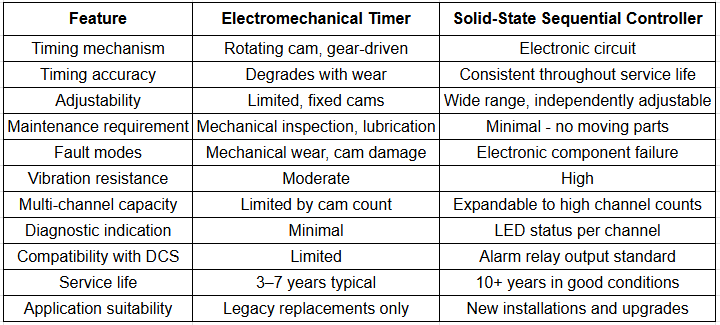
Electromechanical cam timers remain in service in older installations across India, particularly in cement and steel plants that were commissioned in the 1980s and 1990s. Upgrading these to solid-state sequential controllers is one of the most cost-effective maintenance improvements available for plants with ageing filter systems – it eliminates a class of mechanical failure mode and typically improves cleaning consistency immediately.
Sequence Controller Price: What Drives the Cost and What to Watch For
Sequence controller price varies with the number of output channels, the feature set, the enclosure specification, and the manufacturer’s quality and support infrastructure.
A basic solid-state sequential controller for a small bag filter with 6–8 pulse valves will cost substantially less than a multi-module system for a large cement plant bag filter with 32 or more valves and differential pressure control integration. This is expected – the specifications are fundamentally different.
What to watch for when evaluating price:
Channel count vs. actual requirement. A controller priced attractively may have fewer output channels than your installation actually requires – confirm the channel count before comparing prices.
Spare parts and serviceability. A controller from a supplier with no domestic spare parts or service capability is a risk. When a component fails – and eventually all electronic equipment requires attention – the ability to source a replacement board or get a service technician on site matters considerably.
Enclosure specification included vs. extra. Some suppliers quote the controller board price and charge separately for the enclosure, cable entry, DIN rail, and terminal blocks. Confirm what is included in the quoted price.
Warranty and post-sale support. A 12-month warranty with accessible technical support is a reasonable baseline. Suppliers who offer only basic warranty terms with no clear escalation path for technical issues post-commissioning are a higher-risk procurement choice.
Common Industrial Applications for Sequential Timer Controllers
Cement Manufacturing
Cement plant bag filters are among the most demanding environments for sequential controllers. Kiln feed, clinker cooler, and cement grinding mill filters run continuously, handle high dust loads, and are subject to significant ambient temperature variation. Controllers in these installations need robust enclosures, wide temperature operating ranges, and the reliability to run for months between attended inspections.
Differential pressure-controlled cleaning is particularly valuable in cement plant applications, where dust loading varies with production rate and raw material characteristics. Matching cleaning intensity to actual filter condition avoids unnecessary compressed air consumption during periods of lighter production.
Steel and Foundry
Electric arc furnace and cupola furnace fume extraction bag filters run in high-temperature, high-particulate environments. The sequential controller drives valves that may cycle very frequently in these high-duty applications – making solid-state reliability and accurate timing particularly important.
Fault alarm relay outputs are valuable in steel plant applications, where the filter system is typically integrated into broader plant automation and unattended operation is common during shift changes.
Power Plants
Coal handling and fly ash filter systems in power generation require continuous operation with high reliability. Power plant maintenance teams often value the diagnostic capability of solid-state controllers with channel-by-channel status indication, as this allows rapid identification of individual valve or channel faults without requiring the entire filter to be taken offline for investigation.
Pharmaceuticals and Food Processing
These installations require control panels that can be cleaned, sometimes with washdown procedures. IP65-rated enclosures are appropriate, and the controller should be free of surfaces that accumulate dust or that cannot be cleaned without damage to the unit.
Validated performance is also relevant in pharmaceutical applications – a controller whose timing parameters can be verified and documented supports the equipment qualification processes these industries require.
Batch and Variable-Load Processes
In process industries where production is batch-based – reactors, packaging operations, ingredient handling – the filter system may experience periods of high dust load followed by periods of minimal load. A sequential controller with differential pressure control handles this variation efficiently, cleaning aggressively during production peaks and reducing cleaning frequency during idle periods.
Configuration Best Practices for Bag Filter Sequence Controllers
Set pulse duration based on the valve and system, not convention. A 100ms pulse duration is not universally correct. For smaller valves on compact bag filter systems, 60–80ms may be optimal. For larger valves on high-volume manifolds, longer durations may be appropriate. Commission with the valve manufacturer’s recommended settings and adjust based on differential pressure performance.
Allow adequate pulse interval for manifold pressure recovery. The interval between pulses must be long enough for manifold pressure to recover to the supply setpoint before the next valve fires. If the interval is too short, each successive pulse is weaker than the last – filter rows at the end of the sequence receive less cleaning than those at the beginning. Check manifold pressure with a gauge during commissioning and adjust the interval until pressure recovery is consistent.
Start with fewer active channels and expand. During commissioning, activate channels progressively rather than all at once. This confirms that each valve is responding correctly to its controller output before the full sequence is running, making individual faults easier to identify.
Document the commissioned settings. Record the pulse duration, interval, channel count, and any differential pressure setpoints at commissioning. This documentation is essential for future maintenance reference – it tells the next engineer what the system was designed to do and provides a baseline for diagnosing any subsequent performance changes.
Review settings after filter bag replacement. New filter bags have different resistance characteristics from bags that have developed a stable dust cake. After a bag replacement, the differential pressure profile will change, and the controller settings may need adjustment to maintain optimal cleaning.
Maintenance and Troubleshooting for Sequential Controllers
Annual inspection: Confirm that all output channel indicators activate correctly during a manual test cycle. Verify that terminal block connections are secure – vibration in plant environments can loosen connections over time, causing intermittent output faults.
Check timing consistency: If a differential pressure gauge is installed across the filter, observe the pressure profile during a cleaning cycle. A consistent, steady pressure reduction as the sequence progresses indicates even cleaning. Spikes or plateaus suggest individual channels are not firing correctly.
Investigate rising differential pressure systematically: Before assuming the issue is filter bags or compressed air, confirm that the controller sequence is running correctly and that all channels are activating. A channel fault that disables one row of valves can produce rising differential pressure that appears to be a filter or air supply problem.
Thermal checks: In hot environments, the controller enclosure temperature should be within the unit’s rated operating range. Overtemperature is a common cause of electronic component failure in controllers mounted in direct sunlight or near heat-generating equipment.
Spare unit on site: For critical filter applications in continuous-process industries, holding a spare sequential controller on site is sound practice. The cost of the spare is small relative to the cost of production downtime while waiting for a replacement controller to be sourced and delivered.
Common Mistakes When Specifying or Configuring Sequence Controllers
Specifying by channel count alone without checking compatibility. A controller with the right number of channels for the current installation may use output voltages, connector configurations, or current ratings that don’t match the solenoid valves installed. Confirm full compatibility before procurement.
Leaving factory default settings in service. Factory defaults are starting points, not optimised settings. Commissioning includes adjusting pulse duration and interval for the specific installation – a controller left at defaults may be over-cleaning, under-cleaning, or wasting compressed air unnecessarily.
Ignoring the importance of earthing. Poor earthing of the controller panel in electrically noisy industrial environments can cause erratic timing behaviour and false fault indications. Proper earthing is a commissioning step that’s sometimes overlooked in the rush to complete installation.
Upgrading the controller without checking valve compatibility. Replacing an old electromechanical timer with a modern solid-state sequential controller requires confirming that the output voltage and current of the new controller matches the solenoid coil requirements of the existing valves. A mismatch causes either coil overheating or insufficient actuation force.
Assuming controller faults are valve faults. When a pulse valve appears not to fire, the fault may be in the controller output channel, the wiring between controller and valve, or the valve itself. A systematic check – confirming the controller output with a meter before replacing the valve – saves unnecessary component replacement and speeds fault resolution.
Frequently Asked Questions
What is a bag filter sequence controller?
A bag filter sequence controller is the electronic control unit that manages the pulse jet cleaning cycle of an industrial dust collection system. It sends timed electrical signals to each pulse jet solenoid valve in sequence, triggering the compressed air bursts that clean filter bags. It controls which valve fires, for how long (pulse duration), and with what pause between firings (pulse interval) – coordinating the entire cleaning process to maintain filter efficiency and emission compliance.
What is the difference between a sequential timer and a sequence controller?
In the context of dust collection systems, a sequential timer and a sequence controller refer to the same category of equipment – the controller that sequences pulse valve operation in a bag filter. Both terms are used interchangeably in the Indian industrial market. Note that “sequence controller” is also used in burner management applications, which is a completely different product. When specifying for dust collection, confirm the product is designed for pulse jet bag filter control.
How do I choose the right sequential controller for my bag filter?
Key selection criteria: the number of output channels must match or exceed your pulse valve count; the output voltage must match your solenoid coil specification (typically 24V DC or 230V AC); pulse duration and interval must be independently adjustable across a range appropriate for your system; the enclosure IP rating must suit the installation environment; and the manufacturer must be able to provide domestic technical support and spare parts. For larger or more demanding installations, differential pressure control integration is worth considering.
What pulse duration should I set on a sequential timer controller?
Pulse duration – the length of time each valve remains open per firing – is typically set between 50 and 150 milliseconds for industrial bag filter applications. The correct setting depends on valve size, manifold pressure, blow pipe design, and filter bag type. Start with the valve manufacturer’s recommended range and adjust based on cleaning performance – monitoring filter differential pressure to confirm that each cleaning pulse is effective. Longer is not always better: excessive pulse duration wastes compressed air and stresses valve diaphragms.
What is the typical sequence controller price in India?
Sequence controller prices in India vary with channel count, feature set, and enclosure specification. Basic solid-state controllers for small bag filter systems (6–12 channels) are available at modest cost. Multi-channel systems for large industrial filters with differential pressure control and alarm outputs carry a higher price reflecting the additional capability. Total cost of ownership – considering controller service life, spare parts availability, and the cost of downtime from premature failure – is a more reliable basis for supplier comparison than unit price alone.
Can a sequence controller be used for a burner application?
A sequence controller for burner management is a different product from a bag filter sequential timer controller. Burner sequence controllers manage the start-up, purge, ignition, and shutdown sequence of industrial combustion equipment – a safety-critical function with specific regulatory requirements. Bag filter sequential controllers manage pulse valve timing in dust collection systems. Despite similar naming, these are distinct products with different specifications, safety classifications, and applications. Do not substitute one for the other.
How do I know if my sequential controller is causing poor bag filter performance?
Signs that the controller may be the source of a bag filter performance problem include: rising differential pressure despite the cleaning system appearing to run; audibly inconsistent pulse timing between valve rows; individual valves that don’t fire during a manual test cycle despite the valve checking out as functional; and channel indicator lights on the controller that don’t activate in the expected sequence. A systematic channel-by-channel output check with a multimeter during a test cycle confirms whether the fault is in the controller, the wiring, or the valve.
What is demand-based cleaning and when should I use it?
Demand-based cleaning – also called differential pressure controlled cleaning – uses a pressure transmitter measuring the pressure drop across the filter bags to control the cleaning cycle. The sequential controller activates cleaning when differential pressure rises above a set threshold and stops when it falls below a lower threshold, rather than running continuously. This reduces compressed air consumption and extends valve diaphragm life in applications where continuous maximum-rate cleaning isn’t always necessary. It’s most beneficial in variable-load processes, batch operations, and installations where compressed air supply is constrained.
Conclusion
The bag filter sequence controller is the component that ties the entire pulse jet cleaning system together. Without it functioning correctly – with accurate timing, reliable sequencing, and appropriate settings for the installation – even well-specified pulse valves and quality filter bags will underperform.
In 2026, the right sequential timer controller for an industrial dust collection system is a solid-state design with independently adjustable pulse duration and interval, sufficient channels for the installation, a robust enclosure, and clear status indication. For larger or more demanding applications, differential pressure integration and alarm relay outputs add meaningful capability that reduces compressed air waste and integrates the filter system into broader plant monitoring.
The cost of the right controller is small relative to the cost of a bag filter system that runs inefficiently, requires early filter bag replacement, or creates emission compliance problems because the cleaning cycle wasn’t properly managed.
Choosing a controller from a manufacturer who understands dust collection applications – and who can support the installation with technical guidance during commissioning and domestic spare parts availability throughout the equipment’s service life – is the practical approach to getting this right the first time.
Looking for a sequential timer controller for your bag filter system?
Maniks manufactures solid-state sequential timer controllers specifically designed for industrial pulse jet dust collection systems, with over 47 years of application experience across cement, steel, power, pharmaceutical, and process industries across India.
Whether you’re specifying a controller for a new installation, replacing a worn electromechanical timer on an existing filter, or troubleshooting a cleaning system that isn’t performing as expected, our technical team can help you identify the right solution for your specific valve count, voltage requirements, and operating environment.
Explore the Maniks Solid-State Sequential Controller or contact us for a technical consultation and quotation.