
Air Pollution Control Equipment Suppliers in India 2026
Environmental compliance is no longer a background concern for Indian industry. CPCB emission standards have tightened steadily, state pollution control boards are increasing site inspection frequency, and industries that can’t demonstrate effective dust and emission control face the kind of regulatory attention that disrupts operations far more than maintenance ever could.
For plant engineers and factory owners, this changes the calculus around air pollution control equipment suppliers. Choosing a supplier used to be primarily an equipment-cost decision. In 2026, it’s a decision that affects your plant’s operating licence, your regulatory reporting, and your ability to run production without interruption.
This guide covers what makes an air pollution control equipment supplier genuinely reliable for industrial operations, how to evaluate options in the Indian market, what the critical equipment components are, and the practical criteria that separate a capable long-term partner from a supplier that creates problems at the worst possible moments.
What Is Air Pollution Control Equipment and Why Is It Critical for Industry?
Air pollution control equipment refers to the systems and components used to capture, filter, and remove particulate matter, dust, fumes, and gaseous pollutants from industrial process exhaust before it is discharged to the atmosphere.
In most industrial manufacturing environments, the primary equipment category is the bag filter – also called a fabric filter or dust collector – combined with the components that keep it operating effectively: pulse jet solenoid valves, sequential timer controllers, diaphragm assemblies, compressed air manifolds, and the mechanical structure housing the filter bags.
These systems matter for two distinct reasons. The first is regulatory: CPCB and state PCB standards set limits on particulate matter emissions from industrial stacks. Plants that exceed these limits face notices, penalties, and in persistent cases, operational shutdowns. The second is operational: a dust collection system that runs effectively keeps process areas cleaner, protects equipment from particulate contamination, reduces housekeeping burden, and prevents the health and safety risks that come with uncontrolled industrial dust.
When the air pollution control system works, it’s invisible. When it doesn’t, every consequence is visible – in the emission stack, in the maintenance logs, and eventually in correspondence from the pollution control board.
The Regulatory Landscape for Indian Industry in 2026
The Central Pollution Control Board’s emission standards for particulate matter cover a wide range of industrial sectors – cement, thermal power, steel, chemical, ceramic, textile, pharmaceutical, and others. Alongside national standards, state PCBs issue sector-specific and site-specific conditions through Consent to Operate (CTO) and Consent to Establish (CTE) processes.
The direction of regulation has been consistently toward stricter standards and more rigorous enforcement. Online Continuous Emission Monitoring Systems (CEMS) are now mandated for large industrial units in several sectors, creating real-time visibility of stack emissions for regulators rather than relying on periodic manual monitoring.
For plant engineers, this means that air pollution control equipment isn’t something you commission and then revisit only when there’s a problem. It requires routine maintenance, documented performance, and the kind of component reliability that keeps the system performing within permitted limits every day – not just on the days when inspectors are on site.
Choosing air pollution control equipment manufacturers and suppliers who understand this operational reality – and who design and support their products accordingly – is the starting point for an effective compliance strategy.
Key Components of an Industrial Air Pollution Control System
Understanding what goes into a bag filter system helps when evaluating suppliers. The equipment categories that most influence system reliability in service are:
Pulse Jet Solenoid Valves
The pulse jet valve is the component that cleans the filter bags. It opens for a fraction of a second – releasing a burst of compressed air through a blow pipe and venturi nozzle – and the resulting pressure wave dislodges accumulated dust from the outside of the filter bag. The dust falls to the collection hopper, and the bag returns to filtration duty.
In a typical industrial dust collector, there are multiple rows of filter bags and one valve per row, sequenced by the timer controller. If the valves perform poorly – weak pulses, intermittent response, or outright failure – the bags blind progressively, differential pressure rises, and the system’s ability to maintain emission limits deteriorates.
For plant engineers managing regulatory compliance, pulse valve reliability is therefore directly connected to stack emission performance.
Sequential Timer Controllers
The sequential timer controller (also called a pulse controller or bag filter controller) is the electronic brain of the pulse jet cleaning system. It sequences the pulse valves in turn, controls pulse duration and interval, and determines whether the system runs in continuous (online) or compartment-isolated (offline) cleaning mode.
A well-configured controller, matched to the actual filter area and dust load, maintains consistent cleaning across all filter bag rows without overworking the compressed air system. A poorly specified or malfunctioning controller produces uneven cleaning – some rows over-cleaned, others neglected – which leads to differential bag wear and reduced overall filter efficiency.
Diaphragms and Replacement Spares
The diaphragm is the moving element inside the pulse jet valve. It’s the component with the shortest service life in the system, and the one that most directly determines maintenance frequency. In high-cycle industrial applications – cement, steel, power plants – diaphragm replacement may be required annually or more frequently.
Access to genuine replacement diaphragms from a reliable supplier is a maintenance planning requirement, not a luxury. Plants that can’t source the right diaphragm quickly are left running the system with degraded valves – which means degraded bag cleaning and, eventually, emission compliance risk.
Tank Mounted Valves
In larger bag filter installations, tank mounted valves integrate the compressed air reservoir directly onto the filter housing. This provides higher compressed air volume per pulse and sharper pulse delivery compared to remote manifold configurations – which improves cleaning effectiveness in heavy-particulate-loading applications such as cement clinker coolers and steel mill fume extraction.
What to Look for When Evaluating Air Pollution Control Equipment Suppliers
The Indian market has a broad range of suppliers – from engineering-focused manufacturers with decades of dust collection experience to distributors carrying multiple brands with limited technical depth. Here’s what actually matters when shortlisting:
Engineering Experience in Dust Collection
A supplier who has been engineering components specifically for dust collection systems across multiple industrial sectors brings application knowledge that a general industrial valve company cannot replicate. They understand how valve specification interacts with blow pipe design, how filter bag area relates to pulse frequency, how ambient temperature affects diaphragm material selection, and how compressed air quality drives maintenance intervals.
This depth of knowledge shapes better specification decisions at the outset – reducing the chance of an installation that works at commissioning but creates problems six months later.
Domestic Manufacturing with Quality Controls
Air pollution control equipment manufacturers in India with their own manufacturing facilities – rather than assembling or labelling imported components – can control material quality, manufacturing tolerances, and batch consistency. This matters for both initial reliability and spare parts interchangeability over the equipment’s service life.
For plants in Pune, Maharashtra, and the wider western and central Indian industrial corridor, proximity to a domestic manufacturer also means shorter lead times, easier site visits when technical issues arise, and a supplier relationship that functions without the friction of international supply chains.
Spare Parts Support
The most reliable dust collection system eventually needs maintenance. The question is whether the right spare parts are available when required – not in six weeks, but this week.
A valve supplier in India with domestic stock of standard diaphragms, coils, O-rings, and replacement valve bodies enables responsive maintenance and planned shutdown schedules. This is particularly important for plants running continuous production, where the maintenance window is planned months in advance and a missed spare part delays the entire shutdown.
Technical Support Capability
When a bag filter system starts showing rising differential pressure, inconsistent pulse behaviour, or unexpected emission spikes, the plant maintenance team needs diagnostic support – not just a parts catalogue. An air pollution control equipment supplier with engineers who can discuss the system configuration, ask the right questions, and suggest a root cause is a genuinely different resource from a supplier who can only confirm stock availability.
Certifications and Documentation
For regulated industries and export-oriented OEM manufacturers, the ability to provide material certificates, test certificates, and quality documentation is a basic requirement. Not all suppliers in the Indian market can provide this routinely. For pharmaceutical, food, chemical, and power sector applications where equipment qualification requirements apply, confirm documentation capability before committing to a supplier.
Industrial Sectors and Their Specific Air Pollution Control Needs
Cement Manufacturing
Cement plants generate particulate emissions at multiple points: raw material handling, kiln feed systems, clinker coolers, cement grinding circuits, and packing operations. Each source requires dedicated dust collection – and the operating conditions vary significantly between them.
Clinker cooler bag filters operate in high-temperature, high-dust-load conditions. Cement mill bag filters handle fine, abrasive dust. Raw material handling systems may involve outdoor installations with variable ambient conditions. A supplier who understands these sector-specific requirements can specify appropriate valve materials, diaphragm compounds, and controller configurations for each application rather than applying a generic solution.
Steel and Foundry
Electric arc furnace fume extraction, cupola furnace bag filters, and shot blasting dust collection all involve metallic and abrasive particulate – often at elevated temperatures. These applications demand robust diaphragm materials, high-IP-rated solenoid coils, and reliable compressed air quality upstream of the valves.
In steel plants and foundries, unplanned filter system downtime carries a particularly high operational cost. Specifying equipment from suppliers with demonstrated reliability in these environments – and maintaining good spare parts availability on site – is the practical approach to managing that risk.
Power Plants
Coal handling and conveying dust control, coal mill vents, and fly ash management all require reliable bag filter systems in power generation facilities. The regulatory scrutiny on power plant emissions is high, with many plants subject to CEMS monitoring and regular CPCB reporting.
For power sector applications, the combination of continuous duty operation, abrasive fly ash, and regulatory visibility means that equipment reliability is a compliance requirement, not just an operational preference.
Pharmaceuticals and Food Processing
These industries use dust collection in ingredient handling, granulation, tablet coating, and packaging operations. Specific requirements include food-grade or pharmaceutical-grade diaphragm materials, clean manufacturing environments for the valve components themselves, and material documentation for equipment qualification purposes.
An air pollution control equipment manufacturer who can supply material certificates and, where required, FDA or GMP-compatible materials is necessary for these sectors rather than a general industrial supplier.
Chemical Plants
Chemical manufacturing involves process dusts and vapours that may attack standard valve materials. Diaphragm compatibility with the specific chemical environment must be confirmed – not assumed. Chemical plant applications may also require ATEX-rated electrical components for installations in hazardous classified areas.
Mining and Minerals Processing
Crushing, screening, conveying, and materials handling in mining generate heavy particulate loads that put significant demand on dust collection systems. Mine sites often have challenging compressed air supply conditions – variable pressure, potential moisture contamination – that affect valve performance and maintenance intervals.
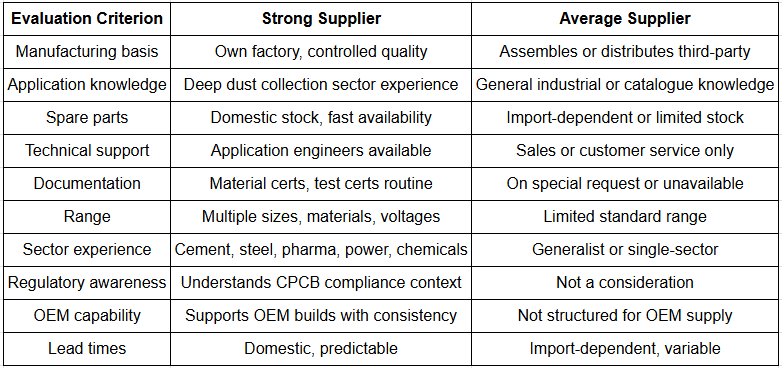
Comparison: What Good vs. Average Air Pollution Control Equipment Suppliers Look Like
Common Mistakes When Procuring Air Pollution Control Equipment
Treating air pollution control as a one-time capital purchase. A bag filter system requires ongoing maintenance – diaphragm replacement, coil inspection, compressed air treatment. Procuring from a supplier who can’t support the aftermarket need creates problems the first time maintenance is required.
Prioritising lowest equipment cost over total cost of ownership. Cheaper pulse valves that require diaphragm replacement at half the interval, or controller components that fail within 18 months, cost more over a 5-year period than better-specified alternatives at a higher initial price.
Selecting suppliers without verifying domestic spare parts support. This is the single most common cause of extended maintenance downtime in plants that have otherwise well-specified equipment. Before purchase, confirm that the diaphragm kits, solenoid coils, and other wear items are available domestically within a reasonable lead time.
Neglecting compressed air quality. Moisture and oil contamination upstream of the pulse valve manifold is the most reliable way to shorten diaphragm life and generate recurring valve maintenance problems. A refrigerant air dryer and coalescing filter is standard upstream protection – but it needs its own maintenance schedule.
Not reviewing controller settings after installation. Pulse duration and interval settings that were configured at commissioning may not be optimal for the current dust load or filter bag condition. Periodic review of controller settings – particularly after bag replacement or any change in production process – keeps the cleaning system operating efficiently.
Overlooking emission trend monitoring between formal compliance checks. Plants with CEMS installed can track differential pressure and emission trends continuously. Plants without CEMS should conduct regular manual checks of stack conditions and differential pressure to identify developing problems before they become compliance events.
Industry Best Practices for Air Pollution Control System Performance
Commission with a full system test. Before operational handover, conduct a manual cycle test of every pulse valve – confirming consistent response, correct pulse duration, and proper sequencing. Document the commissioning test results as the baseline for future performance comparison.
Establish a maintenance calendar. Define diaphragm inspection and replacement intervals based on your specific installation’s cycle frequency. In high-duty applications, annual inspection is the minimum; planned replacement on a defined cycle prevents emergency failures.
Maintain regulatory documentation. Keep records of filter system maintenance events, diaphragm replacements, and any stack monitoring data. In the event of a PCB inspection or notice, documented maintenance history demonstrates that the plant takes emissions management seriously and acts on it.
Train maintenance staff on the cleaning system. The pulse valve and controller system is not complicated, but maintenance staff who understand how it works – how to identify a weak pulse, what rising differential pressure indicates, how controller settings affect bag cleaning – can catch developing problems before they cause compliance issues.
Build a relationship with your equipment supplier before you need it urgently. The time to establish that a supplier can provide the right spare part quickly is before the emergency, not during it. A test order for a routine diaphragm replacement kit tells you a great deal about supplier reliability and logistics.
Frequently Asked Questions
What is air pollution control equipment?
Air pollution control equipment refers to systems used to capture, filter, and remove particulate matter, dust, fumes, and gaseous pollutants from industrial process exhaust before it reaches the atmosphere. In industrial manufacturing, the primary equipment is the bag filter (fabric filter dust collector), combined with pulse jet cleaning components – solenoid valves, sequential timer controllers, and diaphragm assemblies – that keep the filter bags clean and the system performing within emission limits.
Which industries require air pollution control equipment in India?
Under CPCB regulations, air pollution control equipment is required across a broad range of industries including cement, thermal power, steel and foundries, chemicals, pharmaceuticals, food processing, textiles, ceramics, mining, and woodworking. Any industrial process that generates particulate emissions at a level that could affect ambient air quality is subject to emission limits and the compliance equipment required to meet them.
What should I look for when evaluating air pollution control equipment suppliers in India?
Key criteria: own manufacturing capability rather than distribution, deep application experience in dust collection systems, domestic spare parts availability for wear items such as diaphragms and solenoid coils, application engineering support beyond sales, certification and documentation capability for regulated sectors, and a demonstrable track record in your specific industry. For OEM buyers, also evaluate batch consistency, production capacity, and documentation processes.
How does a pulse jet bag filter system control emissions?
A pulse jet bag filter draws process exhaust through fabric filter bags, which capture particulate matter. As dust accumulates on the bag surface, a sequential timer controller triggers pulse jet solenoid valves to release short bursts of compressed air that flex the bags and dislodge the dust cake into a collection hopper. This continuous online cleaning keeps the filter bags operating efficiently and the stack emission within permitted limits.
What is the role of a sequential timer controller in an air pollution control system?
The sequential timer controller manages the pulse jet cleaning cycle of the bag filter. It sequences each pulse valve in turn, controls how long each valve opens (pulse duration), and sets the interval between cleaning pulses. Correct controller configuration ensures even cleaning across all filter bag rows, efficient use of compressed air, and consistent bag filter performance – which directly affects the system’s ability to maintain emission limits.
How often should air pollution control equipment be maintained?
Pulse jet solenoid valves should be inspected quarterly and diaphragms replaced on a planned annual or sub-annual schedule depending on duty cycle intensity. Sequential timer controllers should be checked annually. Compressed air treatment equipment – dryers and filters upstream of the valve manifold – should be inspected at the same frequency. Maintaining a site spare parts inventory of diaphragm replacement kits enables immediate response to unexpected failures between scheduled maintenance events.
What are air pollution control equipment manufacturers in Pune known for?
Pune and the broader Maharashtra industrial region hosts several established air pollution control equipment manufacturers, particularly in the dust collection components sector. Manufacturers in this region supply pulse jet valves, diaphragm assemblies, sequential timer controllers, and complete bag filter components to industrial customers across India and to export markets. The region’s manufacturing ecosystem supports precision engineering for industrial applications across cement, steel, chemical, pharmaceutical, and power sectors.
How does air pollution control equipment compliance work in India?
Industrial units require Consent to Operate (CTO) from the relevant State Pollution Control Board, which specifies emission limits for stack particulate matter and other pollutants. Compliance is demonstrated through periodic manual stack testing, and increasingly through Continuous Emission Monitoring Systems (CEMS) for large units. The air pollution control equipment – primarily the bag filter and its cleaning system – must maintain emission levels within permitted limits at all times, not just during formal monitoring events. Documented maintenance history supports compliance demonstrations during PCB inspections.
Conclusion
The industrial compliance environment in India in 2026 demands more from air pollution control equipment than it did even five years ago. Tighter emission standards, more frequent inspections, and CEMS-based continuous monitoring mean that the bag filter system sitting at the back of your plant is now directly connected to your operating licence and your regulatory standing.
Selecting the right air pollution control equipment suppliers is not a procurement formality. It’s a decision that affects how reliably your dust collection system performs, how quickly your maintenance team can respond when components need attention, and whether your plant can demonstrate compliance on any given day – not just on inspection days.
The strongest suppliers combine genuine manufacturing capability with deep dust collection application experience, domestic spare parts availability, and the technical support that goes beyond a datasheet. These qualities are built over years of industrial service, not assembled quickly to compete on price.
Maniks has been supplying pulse jet valves, sequential timer controllers, diaphragm assemblies, and dust collector components to Indian industry for over 47 years – across cement, steel, power, pharmaceutical, chemical, and process manufacturing sectors. That depth of application experience shapes every product specification and every customer conversation.
Reviewing your air pollution control equipment setup for 2026 compliance?
Whether you need replacement components for an existing bag filter system, guidance on upgrading underperforming dust collection equipment, or technical support selecting the right components for a new installation, Maniks’ engineering team is available to help.
We work with plant engineers, maintenance teams, OEM manufacturers, and purchase managers across India – providing the application knowledge and domestic supply reliability that keeps dust collection systems performing within compliance limits.
Explore Maniks Air Pollution Control and Dust Collection Equipment or contact us to discuss your application, get a technical recommendation, and request a quotation.