
Sequential Timer Failure: Voltage, Panel Protection Tips
A sequential timer is a small, quiet component. It sits in a panel beside the bag filter and runs for years without attention, until one day it doesn’t. A dead channel, an erratic sequence, or a controller that simply won’t power up, and suddenly the whole cleaning system is in question.
When a sequential timer fails, the controller often gets the blame. In practice, many failures trace back to the environment around it: unstable supply voltage, electrical noise, heat, dust, moisture, and an unprotected panel. These conditions can be tough on any electronic device, and industrial plants can be demanding places for control panels.
This guide explains the main causes of sequential timer failure, how voltage fluctuations and switching events affect the controller, what panel protection helps, and a simple maintenance routine that can extend service life.
Safety note: isolate and lock out power before opening any panel. Electrical measurements and protection upgrades should be carried out by qualified personnel following your plant’s procedures and applicable electrical codes.
Why Controller Failures Are Often Environmental
A sequential timer controller, also called a sequential controller or sequence controller, switches solenoid coils on and off continuously. Its electronics have to cope with:
- The quality of the incoming supply
- Electrical disturbances from nearby motors, drives, and switchgear
- Heat generated inside the enclosure
- Dust and moisture that find their way into panels
- Vibration from fans and machinery
A well-made solid-state controller can handle ordinary conditions, but repeated stress from an unprotected environment can shorten its life or cause intermittent faults that are hard to trace. Protecting the controller is often cheaper than repeatedly replacing it.
Common Causes of Sequential Timer Failure
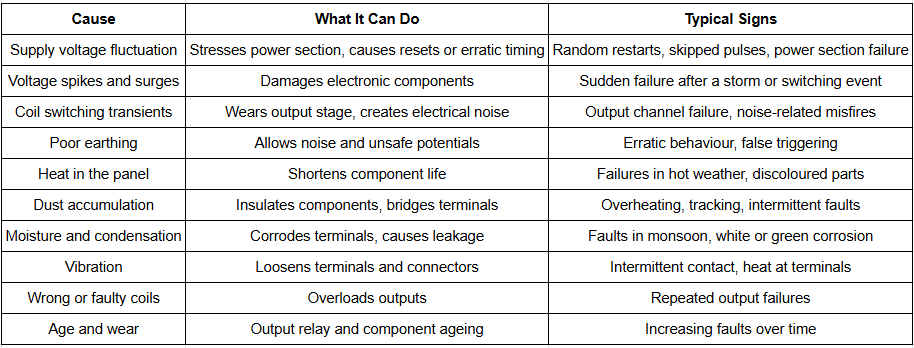
1. Voltage Fluctuations
Supply quality varies from plant to plant. Depending on location and plant setup, a controller may be exposed to low voltage, high voltage, short dips, and interruptions.
Situations that can contribute:
- Weak or heavily loaded supply causing low voltage at the panel
- Large motors starting and pulling voltage down for a moment
- Changeover between grid and generator, with brief interruptions or voltage swings
- Supply restoration after outages, which can bring surges or transients
- Long cable runs with significant voltage drop
What can happen:
- Low voltage may cause resets, unstable timing, or coils that don’t pull in properly.
- High voltage or surges can overstress the power section and other components.
- Repeated interruptions can disturb running sequences and settings.
How to check:
- Measure the supply voltage at the controller terminals under normal load.
- Check it again when large loads start and during generator changeovers.
- If problems are suspected, ask your electrical team to log the supply over a shift or longer to catch dips and spikes.
- Compare readings with the supply range stated in the controller’s specification.
What can help:
- Confirm the controller’s rated supply range and whether your supply stays within it.
- Where supply quality is poor, discuss options with your electrical team, such as a suitable voltage regulating device, an isolation transformer, or a dedicated clean supply for control equipment.
- Use a surge protection device (SPD) at the panel input where surges are a concern.
- Provide a properly rated, dedicated feeder with correct fuse or breaker protection.
Select and size any protective device with a qualified electrician, using manufacturer data.
2. Switching Transients from Solenoid Coils
Solenoid coils are inductive loads. When a coil is switched off, it can generate a voltage spike. Over millions of operations, those spikes can wear the output stage and add electrical noise to the panel.
What can help:
- Check whether your controller or valve coils have built-in suppression. Many do, and some do not.
- If suppression is needed, use the type suited to the coil: for example, an RC network or varistor for AC coils, and a diode for DC coils, as recommended by the manufacturer.
- Keep valve cables well routed and in good condition.
Confirm the right arrangement with the controller and coil supplier before adding any component, since the wrong device can affect valve response.
3. Earthing and Electrical Noise
Poor earthing can cause strange symptoms, including random misfires and false triggering, particularly where drives and large motors are nearby.
What can help:
- Make sure the panel, controller, and cable shields are properly earthed according to the manufacturer’s wiring instructions.
- Keep control wiring separated from power and drive cables.
- Use shielded cable where signals are sensitive.
- Check earth connections for corrosion and looseness during maintenance.
4. Heat Inside the Panel
Electronics generally last longer when kept cool. Panels exposed to sun, mounted near hot equipment, or sealed without ventilation can run hot, especially in summer.
What can help:
- Check that the controller’s rated operating temperature suits the panel’s actual temperature.
- Shade outdoor panels from direct sun.
- Provide ventilation or cooling suitable for the environment, using filtered ventilation where dust is present.
- Don’t pack panels so tightly that heat can’t escape.
- Look for heat marks or discolouration on terminals and components during inspections.
5. Dust and Moisture
Dust collector installations are dusty by definition, and humidity during the monsoon can be high in many regions.
Dust risks: it can insulate components, bridge terminals, and clog ventilation openings. Moisture risks: corrosion, leakage paths, and condensation inside enclosures.
What can help:
- Use an enclosure with an ingress protection rating suited to the environment. For dusty plant rooms, a higher rating is generally preferable.
- Keep doors, gaskets, and cable glands in good condition, and seal unused entries.
- Consider an anti-condensation heater in panels exposed to humidity or temperature swings, if appropriate for the installation.
- Keep panel doors closed. Don’t leave them open during dusty operations.
- Clean panels as part of routine maintenance, using safe methods only with power isolated.
6. Vibration and Loose Terminals
Vibration from fans, compressors, and the filter structure can slowly loosen screw terminals. A loose terminal creates resistance, which creates heat, which can cause intermittent faults and eventually burn the connection.
What can help:
- Mount the panel on a stable surface away from heavy vibration where possible.
- Re-tighten terminals at scheduled intervals.
- Use appropriate terminals and ferrules for stranded wire.
- Look for heat discolouration at connections.
7. Coil Faults and Output Overload
A shorted or faulty valve coil, or damaged cable between panel and valve, can overload a controller output and damage it. Using coils with the wrong voltage or load rating can have the same effect.
What can help:
- Match coil voltage and load to the controller output specification.
- Protect outputs with suitable fuses where the manufacturer recommends it.
- When one channel fails repeatedly, check the coil and cable for faults before replacing the controller or output again.
8. Age and Wear
Every controller has a finite life. Older units, especially electromechanical timers with moving parts, are more prone to wear-related faults. If faults are becoming more frequent and spares are hard to find, replacement may be more sensible than repeated repairs.
Panel Protection Checklist
Supply side
- Dedicated, correctly rated feeder and protection device
- Surge protection where appropriate
- Voltage conditioning where supply quality is poor
- Supply range checked against controller specification
Controller and wiring side
- Correct coil and controller matching
- Suppression on inductive loads where needed
- Shielded cable and separated routing for signals
- Secure terminations with correct ferrules
- Good earthing throughout
Enclosure side
- Suitable ingress protection rating
- Healthy gaskets, glands, and seals
- Ventilation or cooling suited to the location
- Anti-condensation measures where humidity is a risk
- Shade or shelter for outdoor panels
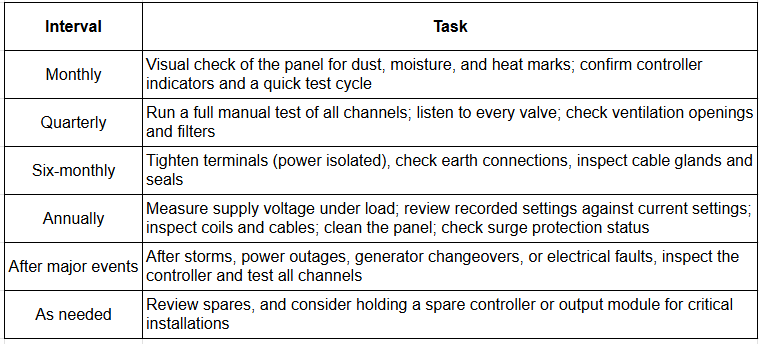
Preventive Maintenance Schedule
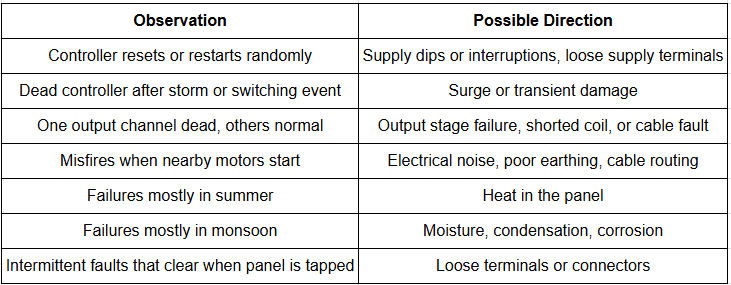
Diagnosing a Suspected Power-Related Failure
Repair or Replace? Sequence Controller Price in Context
When a controller fails, compare repair cost, downtime, and the likelihood of repeat faults against replacement. Sequence controller price varies with channel count, features, adjustment range, and enclosure. If replacing, consider a unit with the features that suit your conditions, such as status indication, a wide supply range where specified, and robust construction. Support and spare parts availability in India matter as much as the price. Whatever you choose, fix the underlying cause (supply, earthing, heat, moisture) or the new controller may face the same stress.
A Note on “Sequence Controller for Burner”
A sequence controller for burner applications is a combustion safety device. It is a different product from a sequential timer for dust collector cleaning. Don’t use one in place of the other, and don’t apply dust collector protection advice to burner safety systems.
Common Mistakes
- Replacing the controller without checking the supply
- Ignoring earthing because the system “has always worked”
- Leaving panel doors open or gaskets damaged in dusty areas
- Not tightening terminals in vibrating installations
- Adding suppression devices without checking compatibility
- Using unsuitable coils and overloading outputs
- Skipping preventive checks and relying on failure as the trigger
- Not holding spares for a critical filter
- Not recording settings, making recovery slow after a failure
Frequently Asked Questions
Why do sequential timers fail in industrial plants?
Often because of the environment around them rather than the controller alone. Unstable supply voltage, surges, switching transients, poor earthing, heat, dust, moisture, and vibration can all stress the electronics and the terminals. Faulty coils and ageing components also contribute.
Can voltage fluctuations damage a sequential timer controller?
They can. Low voltage may cause resets and unstable timing, while surges or high voltage can overstress components. Check that your supply stays within the controller’s rated range, and discuss protective measures such as surge protection or voltage conditioning with your electrical team if supply quality is poor.
How can I protect a sequential controller panel?
Use a correctly rated supply and protection device, surge protection where appropriate, proper earthing, shielded and separated cabling, a suitable enclosure rating, and ventilation or cooling for the location. Keep the panel sealed against dust and moisture, and tighten terminals regularly.
How often should a sequential timer panel be maintained?
A quick visual check and test cycle monthly, a full channel test quarterly, and terminal tightening and earth checks about every six months is a practical routine. Do a more complete inspection annually, and after storms, outages, or electrical faults.
Why does my sequential timer fail more often in the monsoon?
Humidity and condensation can corrode terminals and create leakage paths, particularly in panels without good sealing or anti-condensation measures. Check enclosure seals and glands, keep doors closed, and consider anti-condensation measures where suitable.
Is a sequence controller for burner the same as a dust collector sequential timer?
No. A burner sequence controller manages ignition and shutdown of combustion equipment and is a safety device. A dust collector sequential timer sequences pulse valves for filter cleaning. They are different products with different purposes.
What affects sequence controller price when I need a replacement?
Channel count, adjustment range, features such as status indication or input and output options, enclosure rating, and the manufacturer’s support. Compare ownership cost and local support, not just the purchase price, and address the cause of the failure so the new unit lasts.
Conclusion
Many sequential timer failures in industrial plants are preventable. Unstable voltage, poor earthing, heat, dust, moisture, and loose terminals do their damage gradually, and a controller that isn’t protected from them will keep failing no matter how often it’s replaced.
A few simple measures make a difference: confirm the supply, protect the panel, keep it clean and sealed, tighten terminals, and run regular test cycles. Combine this with a good solid-state sequential timer controller and documented settings, and the cleaning system becomes far more dependable.
Dealing with repeated sequential timer failures in your plant?
Maniks has manufactured sequential timer controllers and dust collector components for over 47 years, serving cement, steel, power, pharmaceutical, chemical, and other industries across India. Tell our technical team about your supply conditions, panel environment, and failure history, and we’ll help you choose a suitable controller and think through sensible protection for your installation.
Explore our Solid-State Sequential Controller or contact us for technical assistance and a quotation.