
Best Pulse Jet Valves for Cement, Steel & Power Plants 2026
Cement, steel, and power generation are three of India’s most emissions-intensive industries. They are also three of the most demanding operating environments for dust collection equipment – and specifically for the pulse jet valves that keep bag filter systems cleaning effectively under conditions that would degrade a poorly specified valve within months.
In 2026, with CPCB emission enforcement intensifying, online CEMS monitoring increasingly mandatory for large industrial units, and compressed air operating costs under scrutiny at every plant, the pulse jet valve selection decision carries more weight than it did five years ago. A valve that performs marginally in these industries isn’t just a maintenance problem – it’s an emission compliance risk and an energy efficiency problem simultaneously.
This guide covers what engineers and plant managers in cement, steel, and power generation should look for in a pulse jet valve for 2026, how the operating conditions in each sector shape the correct specification, and what separates the valves that perform reliably across years of continuous duty from those that create a recurring maintenance burden.
What Is a Pulse Jet Valve and Why Does It Matter in Heavy Industry?
A pulse jet valve – also called a pulse solenoid valve, dust collector pulse valve, or pilot operated valve depending on the context – is the electrically actuated valve that controls the compressed air pulses used to clean filter bags in a reverse pulse jet bag filter system.
It receives a brief electrical signal from a sequential timer controller, opens for 50 to 150 milliseconds, and releases a high-pressure burst of compressed air through a blow pipe and venturi nozzle into a row of filter bags. The pressure wave flexes the bag outward, breaks the accumulated dust cake, and allows it to fall into the collection hopper below. The valve then closes and resets – ready for the next cleaning cycle.
In a large industrial bag filter, this happens dozens of times per minute, across every valve in the system, continuously, 24 hours a day, for months between planned maintenance events.
In cement, steel, and power applications, the stakes attached to each cleaning cycle are higher than in lighter industrial environments. Heavy dust loads mean that cleaning effectiveness – determined by the sharpness and volume of each pulse – directly affects how quickly differential pressure rises between cleaning events. Regulatory visibility through CEMS monitoring means that a gradual decline in filter cleaning performance is no longer invisible until the next manual stack test. And the scale of these operations means that the compounded cost of sub-optimal valve performance – in compressed air waste, early filter bag replacement, and maintenance labour – is significant.
What Makes Heavy Industrial Environments Difficult for Pulse Jet Valves
Before specifying a pulse valve for dust collector applications in cement, steel, or power generation, understanding the specific challenges of each environment helps identify what must be non-negotiable in the specification.
Continuous Duty Cycles
In all three industries, dust collection systems run continuously. A cement plant kiln doesn’t stop. An electric arc furnace doesn’t take maintenance breaks. A coal-fired power station runs its bag filter systems around the clock. Pulse jet valves in these applications may complete 5 to 10 million cycles per year – a demand level that exposes weaknesses in diaphragm quality, pilot passage design, and coil construction that would take years to appear in lighter-duty applications.
Elevated Ambient Temperatures
Filter installations in cement clinker cooler areas, kiln feed systems, steel plant fume extraction zones, and power plant boiler areas regularly expose valve components to ambient temperatures that exceed the continuous service rating of standard diaphragm materials and coil insulation classes. A valve specified without accounting for the actual installation temperature will degrade faster than its rated cycle life predicts.
Heavy and Abrasive Particulate
Clinker dust, metallic fume, and coal ash are all abrasive. They attack pilot orifices when contamination enters the compressed air supply, accelerate diaphragm surface wear in valves with exposed diaphragm faces, and create housekeeping conditions around the valve installation that require robust coil enclosure ratings.
Regulatory Pressure
Cement, steel, and power generation are all priority sectors under CPCB emission monitoring. Large units in these sectors increasingly operate under CEMS conditions where stack particulate matter is monitored continuously and reported in real time. A bag filter system that doesn’t clean effectively – because the pulse jet valves are underperforming – produces a rising emission trend that is visible to regulators without waiting for a scheduled inspection.
Pulse Jet Valve Requirements for Cement Plant Dust Collectors
The Cement Operating Environment
Cement manufacturing generates particulate emissions at multiple points across the production process. Each dust collection application within a cement plant has distinct operating conditions:
- Raw mill bag filters handle fine limestone and additive dust in enclosed grinding circuits. Ambient temperatures are moderate, but dust loads are high and the fine particle size means that effective bag cleaning is critical for maintaining filtration efficiency.
- Kiln feed and preheater bag filters operate near the kiln system where elevated temperatures are a constant factor. Hot gas bypass systems may expose filters to process gases that are chemically challenging for standard diaphragm materials.
- Clinker cooler bag filters are the most thermally demanding dust collection application in cement manufacturing. Clinker dust is abrasive, ambient temperatures can reach and exceed 120°C in some installation areas, and the high dust loading means cleaning cycles are frequent.
- Coal mill bag filters involve combustible dust and require considerations around spark and heat source management in the installation design. Compressed air quality is particularly important – any contamination that enters the pilot passage of a coal mill pulse valve creates maintenance requirements that have operational safety implications.
- Cement grinding and packing plant bag filters handle fine, abrasive cement dust at moderate temperatures. These are typically high-volume installations where valve count is significant and standardisation of specification across the installation simplifies maintenance.
What to Specify for Cement Plant Pulse Jet Valves
- Diaphragm material: Standard NBR for raw mill, cement grinding, and packing plant applications where ambient temperatures are consistently below 80°C. High-temperature diaphragm compounds – modified NBR or silicone-based – for clinker cooler, kiln feed, and coal mill applications where temperature regularly exceeds 80°C.
- Solenoid coil insulation class: Class F (155°C) as the standard specification for cement plant pulse valves. The elevated ambient temperatures common in cement plant filter rooms make Class B (130°C) marginal – Class F provides the insulation margin that translates to longer coil service life in thermally demanding locations.
- IP rating: IP65 minimum across all cement plant installations. Cement dust is fine, penetrating, and present at elevated concentrations in and around bag filter installations even during normal operation. IP54 coils in these environments degrade through ingress faster than their rated life.
- Body size and Cv: Match to the filter OEM specification for each installation point. Clinker cooler filters typically require larger body sizes – 2″ to 2.5″ or tank-mounted configurations – for the air volume needed to clean heavily loaded filter bags. Packing plant dust collectors may be adequately served by 1″ to 1.5″ valves.
- Cycle life rating: For clinker cooler and kiln system filters running continuously, prioritise manufacturers who publish tested cycle life data rated to 5 million cycles or more. This specification is the most direct predictor of maintenance interval in high-duty cement plant applications.
Pulse Jet Valve Requirements for Steel Plant Dust Collectors
The Steel Plant Operating Environment
Steel manufacturing produces some of the most challenging conditions for dust collection equipment of any industrial sector. The combination of metallic and abrasive particulate, elevated temperatures, high dust loading, and continuous-duty operation creates an environment where valve specification decisions have immediate and significant consequences.
- Electric arc furnace (EAF) bag filters handle fume from steel melting – fine metallic particulate, hot gases, and variable dust loading that peaks at each heat cycle. EAF fume extraction systems must respond to the cycle of the furnace – high-load periods during melting, lower load between heats – which creates a variable-duty cleaning requirement.
- Ladle furnace bag filters handle secondary steelmaking fumes – typically finer and at higher temperature than EAF fume. Continuous operation is common during ladle furnace heats.
- Converter gas and secondary emission control in integrated steel plants involves large bag filter systems with significant valve counts. These installations run continuously alongside production and have no scheduled downtime for routine valve maintenance during production campaigns.
- Shot blasting and surface preparation dust collectors generate metallic and abrasive particulate at moderate temperatures. The abrasive nature of the dust makes compressed air quality particularly important – metallic particulate in the compressed air supply is highly damaging to pilot orifices and diaphragm surfaces.
- Sinter plant and blast furnace secondary emission control involves complex dust chemistry, elevated temperatures, and regulatory-critical emission control requirements that make filter reliability non-negotiable.
What to Specify for Steel Plant Pulse Jet Valves
- Diaphragm material: NBR for shot blasting and moderate-temperature applications. High-temperature compounds for EAF, ladle furnace, and sinter plant locations. Verify the specific ambient temperature at the valve installation location – not the process temperature – before finalising material specification.
- Solenoid coil insulation class: Class F minimum for all steel plant applications. Class H (180°C) for the most thermally demanding locations near furnace installation areas.
- IP rating: IP65 standard, IP67 where metallic dust combined with cooling water spray creates a wet, conductive particulate environment. Metallic particulate is electrically conductive – coil insulation degradation from metallic dust ingress is faster than from non-conductive industrial dusts.
- Compressed air treatment: In steel plant applications, the compressed air treatment system upstream of pulse valve manifolds requires particular attention. Metallic particulate that enters the air supply through a poorly maintained treatment system will block pilot orifices and score diaphragm surfaces rapidly. Three-stage treatment – particulate filter, coalescing filter, refrigerant dryer – is the baseline for steel plant installations.
- Pilot passage design: For steel plant applications, favour pilot operated pulse valves whose pilot passages are designed for cleanability or for tolerance of small particulate. A pilot passage that blocks from minor compressed air contamination is a chronic maintenance problem in steel plant environments.
Pulse Jet Valve Requirements for Power Plant Dust Collectors
The Power Plant Operating Environment
Coal-fired and biomass power generation facilities use bag filter systems at multiple points in the plant. The emission compliance requirements in the power sector – particularly for large thermal power stations – are among the most rigorous in Indian industry, with CEMS monitoring mandatory for units above a threshold capacity.
- Coal handling dust control covers conveyor transfer points, crusher houses, stacker-reclaimer areas, and coal stockyard ventilation. These are typically lower-temperature applications with fine coal dust – combustibility is a consideration in system design, and compressed air quality is particularly important because coal dust in the air supply is both abrasive and combustible.
- Coal mill bag filters handle fine pulverised coal – combustible, abrasive, and produced continuously during boiler operation. These are critical emission control points where filter performance directly affects compliance with stack emission limits for particulate matter.
- Boiler and ESP bypass bag filters may operate at elevated temperatures depending on the bypass system design. Temperature variation – including cold starts – creates thermal cycling stress on diaphragm materials.
- Fly ash management systems – silo venting, ash conditioning, and handling system dust collection – involve fine, abrasive fly ash with varying chemistry depending on coal quality. Some fly ash types have chemical characteristics that affect diaphragm compatibility.
- Flue gas desulphurisation (FGD) system dust collection in plants with FGD equipment may involve exposure to mildly corrosive process conditions that require diaphragm material evaluation beyond standard NBR.
What to Specify for Power Plant Pulse Jet Valves
- Diaphragm material: NBR for coal handling and fly ash management applications at moderate temperatures. High-temperature compounds for boiler area installations. EPDM or PTFE-coated NBR where FGD or process chemistry creates mild corrosive exposure. Confirm fly ash chemistry compatibility with the diaphragm compound before finalising specification for fly ash handling applications.
- Solenoid coil insulation class: Class F for boiler area and coal mill installations. Class B is adequate for coal handling and ambient-temperature ash handling applications.
- IP rating: IP65 standard across power plant dust collection installations. IP67 for outdoor installations – coal stockyard and transfer point dust control systems that are exposed to direct rainfall during monsoon season.
- Reliability documentation: Power plant maintenance is planned around planned outage schedules – typically major overhauls at extended intervals. The ability to document valve performance between outages, and to source replacement diaphragm kits with same-week domestic availability, directly supports the outage planning process. Source from a pulse valve manufacturer who can provide test certificates and material documentation for power sector procurement requirements.
- Online cleaning capability: Power station bag filters typically use continuous online pulse jet cleaning – the filter remains in service while cleaning cycles run, without isolating compartments. Pulse valves for online cleaning applications must maintain consistent response over extended continuous-duty periods without the rest intervals that offline cleaning systems provide between cycle sequences.
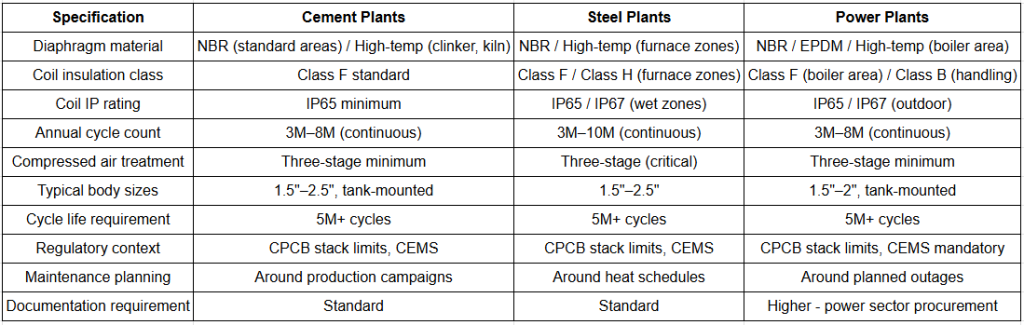
Sector Comparison: Pulse Jet Valve Specification Requirements
Common Pulse Jet Valve Failures Specific to Heavy Industrial Applications
Understanding which failure modes are most common in heavy industrial environments helps when evaluating valves and when diagnosing problems in existing installations.
Diaphragm Hardening (Temperature-Related)
- Sectors most affected: Cement clinker cooler, steel furnace zones, power plant boiler areas.
- Mechanism: Standard NBR diaphragm material progressively hardens when exposed to sustained temperatures above 80°C. The hardened diaphragm loses the flexibility needed to fully open from the seat – reducing effective Cv and pulse volume. Cleaning becomes progressively less effective over months before the diaphragm eventually cracks.
- Prevention: Specify high-temperature diaphragm compounds for any installation where ambient temperature regularly exceeds 80°C. Verify the ambient temperature at the valve installation location – not the process temperature – before finalising specification.
Pilot Passage Contamination (Air Quality-Related)
- Sectors most affected: Steel plants (metallic particulate), power plants (coal dust and fly ash), cement plants (abrasive clinker dust).
- Mechanism: Particulate that enters the compressed air supply through inadequate upstream filtration deposits in the small-diameter pilot passage. Accumulation restricts pilot airflow, causing delayed or partial valve opening. The pulse is slow and weak rather than sharp – reducing cleaning effectiveness without obvious valve failure.
- Prevention: Three-stage compressed air treatment upstream of every pulse valve manifold. Regular inspection and service of treatment equipment – filter elements, dryer performance, drain function. In steel plant applications, specify valves whose pilot passages are sized or designed to minimise contamination sensitivity.
Coil Insulation Degradation (Temperature and Ingress)
- Sectors most affected: Cement plant filter rooms, steel furnace zones, outdoor power plant installations.
- Mechanism: Thermal degradation of coil winding insulation in under-rated coils, combined or in isolation with moisture or conductive particulate ingress through inadequate IP-rated enclosures. Early symptoms are intermittent response. Final failure is coil open-circuit.
- Prevention: Match coil insulation class to actual installation ambient temperature. Specify IP65 or IP67 as appropriate. In steel plant environments with electrically conductive metallic particulate, IP65 is more critical than in non-conductive dust environments.
Diaphragm Swelling (Air Contamination-Related)
- Sectors most affected: All three sectors – wherever oil-injected air compressors are in service without adequate downstream treatment.
- Mechanism: Oil in the compressed air supply causes NBR diaphragms to swell. Swelling changes the diaphragm geometry, reduces the lift from seat, and in severe cases prevents the valve from closing fully – causing continuous compressed air leakage between pulses.
- Prevention: Coalescing filter with automatic drain, properly maintained, downstream of every compressor feeding pulse valve manifolds. Regular bowl inspection at quarterly maintenance intervals.
How to Evaluate Pulse Jet Valve Manufacturers for Heavy Industrial Supply
For cement, steel, and power generation procurement – where the stakes of getting the valve wrong are higher than in lighter industrial applications – supplier evaluation deserves more rigour than a price comparison.
Sector-Specific Application Experience
A pulse valve manufacturer who has supplied clinker cooler bag filters across multiple cement plants understands the temperature and duty cycle requirements of that application in a way that cannot be replicated from a specification sheet. Ask specifically about experience in your sector and application type. Request references from comparable installations.
Published and Verifiable Cycle Life Data
For continuous-duty heavy industrial applications, the valve’s tested cycle life rating at operating pressure and temperature is the most direct predictor of maintenance interval. Ask every potential supplier for this data. If they cannot provide it – or if the testing conditions are not clearly defined – the claim of long service life is unsupported.
Domestic Manufacturing and Spare Parts
A pulse valve manufacturer with domestic manufacturing capability and a genuine spare parts stock – not a 4–6 week import lead time for replacement diaphragm kits – is a practical requirement for heavy industrial supply. Plant maintenance schedules in cement, steel, and power are built around production campaigns and outage windows. A valve supplier who cannot provide spare parts within the maintenance planning window is not suitable for these sectors.
Technical Documentation Capability
Power generation procurement in particular frequently requires material certificates, test certificates, dimensional drawings, and in some cases third-party inspection. Confirm the supplier’s standard documentation capability before shortlisting – not as a special request during the order process.
Coil Voltage and Configuration Flexibility
Heavy industrial installations across cement, steel, and power may use different coil voltages across different parts of the same plant. A pulse valve manufacturer with a comprehensive range – 24V DC, 110V AC, 230V AC standard; multiple body sizes; manifold-mounted and tank-mounted configurations – can supply the correct specification for every position rather than requiring the plant to adapt its systems to available product options.
Maintenance Intervals for Pulse Jet Valves in Cement, Steel, and Power Applications
Given the duty cycles in these industries, standard maintenance guidance needs adjustment for the actual operating conditions.
Monthly: Track filter differential pressure trends for each filter installation. In continuously operated systems, a rising trend is the early indicator of degrading valve performance – catching it at this stage allows planned intervention rather than emergency repair.
Quarterly: Manual pulse test of every valve. In cement, steel, and power plant filter installations, this test should include pressure gauge confirmation at the manifold to verify that supply pressure is within specification and that recovery between pulses is adequate. Inspect the compressed air treatment equipment – bowl drain function, filter element condition, dryer performance.
Six-monthly (all three sectors): Visual diaphragm inspection for any valve that showed inconsistent response during the quarterly pulse test. In clinker cooler, furnace zone, and boiler area installations where high-temperature compounds are specified – inspect for surface hardening or cracking at this interval rather than waiting for the annual event.
Annually: Full planned diaphragm replacement for standard-duty positions. Complete diaphragm and coil inspection for high-duty positions. Manifold pressure verification. Controller timing parameter review and documentation update. Air dryer full service. Compressed air treatment element replacement.
At every planned outage: In power stations and steel plants where major maintenance outages occur at extended intervals, conduct a complete valve set inspection and replace any diaphragm showing wear – even if the annual interval hasn’t been reached. The extended period to the next outage makes preventive replacement more cost-effective than the risk of in-service failure between outages.
Industry Best Practices for 2026 Heavy Industrial Pulse Jet Valve Management
Register every valve. Maintain a valve register for every bag filter installation – recording valve position, body size, Cv, diaphragm material, coil voltage, IP rating, installation date, and maintenance history. In heavy industrial installations with large valve counts, this register is the foundation of systematic maintenance management.
Standardise specification across each installation. Using a single valve specification – same manufacturer, same Cv, same diaphragm material – across all positions in a single filter installation ensures even cleaning performance and simplifies spare parts management. Mixed specifications produce mixed performance.
Review emission data alongside maintenance records. In CEMS-monitored installations, correlate stack emission trends with valve maintenance events. A gradual emission increase between maintenance events – followed by improvement after diaphragm replacement – confirms the valve’s contribution to emission performance and supports the case for proactive maintenance scheduling.
Align valve replacement with filter bag replacement schedules. In heavy industrial applications where both filter bags and valves require periodic replacement, aligning these schedules reduces the number of maintenance shutdowns and the total maintenance labour cost over a multi-year period.
Build a supplier relationship, not just a supply transaction. For heavy industrial sectors where valve performance is directly linked to emission compliance, having a pulse valve manufacturer whose engineering team knows your installation – and can provide application-specific guidance when conditions change – is a genuine operational asset. This relationship is built over time and through repeated engagement, not established at the point of a first purchase order.
Frequently Asked Questions
What is a pulse jet valve and how does it work in a dust collector?
A pulse jet valve is the electrically actuated valve that controls compressed air pulses in a reverse pulse jet bag filter system. It receives a brief signal from a sequential timer controller, opens for 50 to 150 milliseconds, and releases a high-pressure compressed air burst through a blow pipe and venturi nozzle into a row of filter bags. The pressure wave flexes the bags outward, breaks the accumulated dust cake, and allows it to fall into the collection hopper below. In cement, steel, and power plant dust collectors, these valves cycle millions of times per year – making correct specification for the operating conditions essential for reliable long-term performance.
Which pulse jet valve specification is best for a cement clinker cooler bag filter?
For cement clinker cooler bag filters – where ambient temperatures regularly exceed 80°C and dust loading is heavy – the correct specification includes: high-temperature diaphragm compound (not standard NBR) rated for the actual installation temperature; Class F solenoid coil insulation; IP65 coil enclosure; body size of 2″ to 2.5″ or tank-mounted configuration for the air volume needed to clean heavily loaded filter bags; and a cycle life rating of 5 million cycles or more from a manufacturer who can provide tested cycle life data. Three-stage compressed air treatment upstream of the manifold is a prerequisite for achieving the rated valve service life in this application.
How often should pulse jet valves be replaced in a steel plant bag filter?
In steel plant applications – particularly EAF fume extraction and ladle furnace bag filters running continuously – planned diaphragm replacement every 8 to 12 months is appropriate preventive maintenance for high-temperature zones. In lower-temperature steel plant applications (shot blasting, material handling), annual inspection with replacement as needed is the standard approach. Complete valve body replacement is only required when the valve body seat is damaged – diaphragm replacement is the normal maintenance event. Maintaining a domestic spare parts inventory from a reliable pulse valve manufacturer in India ensures replacement diaphragm kits are available within the maintenance planning window.
Are pilot operated pulse valves better than direct-acting valves for heavy industrial dust collectors?
Yes, for heavy industrial bag filter applications in cement, steel, and power plants. Pilot operated pulse valves use a small solenoid to control the main diaphragm indirectly through a pilot mechanism – delivering high compressed air flow rates with low solenoid power consumption. This design handles the larger body sizes and higher flow coefficients needed to clean heavily loaded industrial filter bags effectively. Direct-acting valves move the valve seat directly by electromagnetic force, which limits practical flow capacity. For compact or small dust collectors, direct-acting designs are adequate – but for the filter sizes used in cement, steel, and power plant applications, pilot operated valves are the correct specification.
What compressed air pressure is needed for pulse jet valves in cement and steel plants?
Standard reverse pulse jet systems in cement, steel, and power plant applications operate at 5 to 7 bar compressed air pressure at the valve manifold. Some heavy-duty applications – clinker cooler filters with high particulate loading – use pressures up to 8 bar. The pressure rating of the valve must cover the actual system operating pressure. Equally important is manifold pressure recovery between pulses – the supply system must maintain adequate pressure recovery at the cleaning interval in use. In continuous-duty installations with high valve counts, manifold sizing and supply capacity should be reviewed alongside valve specification.
What makes a dust collector pulse valve suitable for power plant applications in 2026?
For power plant applications in 2026, the key requirements are: consistent performance in continuous online cleaning duty (no compartment isolation between cleaning cycles); appropriate diaphragm material for the specific installation (NBR for coal handling, high-temperature compound for boiler area, EPDM where FGD exposure is present); Class F coil insulation for boiler area installations; IP65 or IP67 for outdoor installations; documented cycle life rating of 5 million cycles or more; domestic spare parts availability to support planned outage maintenance schedules; and material and test documentation capability to meet power sector procurement requirements. Given CEMS monitoring requirements, valve reliability is directly tied to emission compliance management – making specification quality and supplier support critical factors alongside the product specification itself.
How do I know if my pulse jet valves are causing rising differential pressure in my bag filter?
A manual pulse test is the fastest first-check. Activate each valve individually from the sequential controller and listen to the pulse. A correctly performing pulse jet valve produces a sharp, consistent crack – a fast, clean opening and closing. A weak, muffled, or delayed pulse indicates a diaphragm near end of life, a pilot passage that is partially restricted, or manifold pressure that has dropped below the operating range. If a valve fails the audible test, remove the bonnet and inspect the diaphragm – checking for hardening, cracking, swelling, or edge damage. Also verify manifold pressure with a gauge during a cleaning cycle to confirm that supply pressure and recovery between pulses are within specification.
Conclusion
Cement, steel, and power generation will remain the backbone of Indian industrial production in 2026 and beyond – and the air pollution control requirements on these sectors will only increase as emission standards continue to tighten and real-time monitoring becomes the norm rather than the exception.
The pulse jet valve sits at the operational centre of every bag filter system keeping these plants in compliance. In high-temperature, high-cycle, abrasive environments, a valve specified without regard for the actual operating conditions will degrade faster than its rated cycle life, create a recurring maintenance burden, and contribute to the kind of gradual emission performance decline that shows up first in a CEMS trend and eventually in a PCB notice.
The specifications that matter – diaphragm material matched to installation temperature, coil insulation class matched to ambient conditions, IP rating appropriate for the dust and humidity environment, body size and CV matched to the filter design, and cycle life data from a manufacturer who has tested for it – are not complicated. They require accurate information about the installation conditions and a supplier with the range to meet the resulting specification.
The sector-specific guidance in this article provides that information. The rest depends on choosing a pulse valve manufacturer who has actually supplied these environments, whose quality is verifiable, and whose support infrastructure works when you need it.
Specifying pulse jet valves for a cement, steel, or power plant dust collection system?
Maniks has manufactured pilot operated pulse jet valves for heavy industrial dust collection applications across India for over 47 years – with documented experience in cement clinker coolers, EAF fume extraction, coal handling dust control, and boiler area bag filter installations. Our engineering team works with plant engineers, project teams, and OEM manufacturers to confirm correct valve specifications for each application – not just the nominal size, but the diaphragm material, coil class, IP rating, and Cv that the operating conditions actually require.
Whether you are specifying valves for a new installation, replacing worn equipment in an operating plant, or reviewing a system that is underperforming against its design specification, our team can help.
Explore the Maniks Pilot Operated Reverse Jet Pulse Valve or contact us to discuss your application and request a technical quotation.