
Pilot Operated Valves for High-Performance Dust Collectors
There’s a consistent pattern in underperforming dust collection systems. Differential pressure is higher than it should be. Filter bags are being replaced too frequently. Compressed air consumption is difficult to justify. And the cleaning system, when you look at it closely, is running – but not really working.
In most of these cases, the pilot operated valve is the component that determines whether the cleaning system performs or merely operates. And the difference between those two things – performance versus mere operation – shows up everywhere in the plant: in the filter bags, in the energy bill, in the emission data, and eventually in the maintenance log.
This guide covers what pilot operated valves are, why their design matters so much in dust collection, how to specify the right valve for high-performance applications, and what separates valves that reliably deliver cleaning results from ones that go through the motions.
What Is a Pilot Operated Valve?
A pilot operated valve is a valve design in which a small pilot mechanism – typically an electromagnetic solenoid – controls the main valve indirectly, by managing the pressure balance across a larger diaphragm or piston.
In a direct-acting valve, the solenoid moves the valve seat directly by electromagnetic force. In a pilot operated design, the solenoid controls a small pilot orifice. When the pilot opens, it vents pressure from one side of the main diaphragm; the resulting pressure differential lifts the diaphragm and opens the main valve. When the pilot closes, pressure re-builds behind the diaphragm and the valve closes.
This indirect actuation means the solenoid only needs to produce enough force to open a small pilot – not to directly move the main valve element against full line pressure. As a result, pilot operated valves can deliver high flow rates through large valve bodies using relatively low solenoid power, which makes them the standard design choice for industrial pulse jet dust collection applications where large volumes of compressed air need to be discharged rapidly and repeatedly.
Why Pilot Operated Valves Are the Preferred Choice for Dust Collectors
In reverse pulse jet dust collection, the cleaning pulse needs to do specific things: it must open fast, deliver a high volume of compressed air in a short burst, and close cleanly without allowing residual flow. A valve that opens slowly produces a gradual pressure rise rather than a sharp pulse – and a gradual pressure rise doesn’t flex the filter bag effectively. The dust stays on the bag. Differential pressure continues to climb.
The pilot operated valve excels in this application for several reasons.
High flow capacity at low power. The pilot mechanism allows a small solenoid to control a large main orifice. A 2″ pilot operated pulse valve discharges significantly more compressed air per pulse than a 2″ direct-acting valve driven by a comparable solenoid – because the solenoid is working the pilot, not fighting line pressure directly.
Fast and consistent response. A well-designed pilot operated valve opens within milliseconds of receiving the solenoid signal – producing the sharp pressure wave that drives effective bag cleaning. This response speed is consistent across millions of cycles when the valve is correctly specified and the compressed air supply is clean.
Efficiency in high-cycle operation. Because the solenoid drives only the pilot, electrical power consumption per actuation is low. In systems with dozens of valves cycling continuously, this translates to meaningful energy efficiency compared with direct-acting alternatives.
Reliability in industrial environments. Pilot operated designs, with their simple diaphragm mechanism and no metal-to-metal contact in the flow path, have a long track record of reliable service in cement, steel, power, and chemical plant environments where the alternatives are less durable.
How a Pilot Operated Pulse Valve Works: Step by Step
Understanding the actuation sequence helps when diagnosing performance issues or specifying replacement valves.
Step 1 – Rest position. The solenoid is de-energised. The pilot orifice is closed. Compressed air fills both the manifold side and the pressure chamber behind the diaphragm. The diaphragm is held closed by the spring and the back-pressure.
Step 2 – Pilot opens. The sequential timer controller sends a signal energising the solenoid coil. The solenoid opens the pilot orifice, venting the pressure chamber behind the diaphragm faster than it can be replenished through the bleed orifice.
Step 3 – Main valve opens. The pressure differential across the diaphragm lifts it away from the seat. Compressed air flows through the main valve body, into the blow pipe, and through the venturi nozzle into the filter bag – delivering the cleaning pulse.
Step 4 – Pilot closes. The solenoid de-energises. The pilot orifice closes. Pressure rebuilds behind the diaphragm through the bleed orifice. The diaphragm reseats, closing the main valve. The valve is ready for the next cycle.
The entire sequence – from solenoid energisation to diaphragm reseating – typically completes within 50 to 200 milliseconds depending on valve size, pulse duration setting, and supply pressure. This fast, clean actuation cycle is what makes pilot operated valves effective for pulse jet cleaning.
What Makes a Pilot Operated Valve High-Performance for Dust Collection?
Not every pilot operated valve delivers the same cleaning performance, even at the same nominal size and pressure rating. The design and manufacturing quality of specific components determines whether a valve meets the requirements of high-performance dust collection.
Diaphragm Design and Material
The diaphragm is the primary moving element in the valve. Its geometry determines the valve’s flow coefficient (Cv), its response speed, and how cleanly it seals between pulses. A diaphragm moulded to precise dimensions, with consistent thickness and correct material compound, opens and closes predictably – delivering repeatable pulse characteristics cycle after cycle.
Material selection affects service life. NBR (Nitrile) suits most general industrial applications. For high-temperature installations – cement kilns, steel plant fume extraction – PTFE-coated or high-temperature rated compounds extend service intervals significantly. For chemical environments where NBR would degrade, EPDM or full PTFE diaphragms provide the necessary resistance.
A diaphragm that is too thin fatigues faster under the pressure cycling of high-frequency cleaning. One that is too thick responds sluggishly and doesn’t fully flex the filter bag. Precision in diaphragm specification is not incidental – it directly determines cleaning effectiveness and maintenance frequency.
Pilot Orifice and Bleed Passage Design
The pilot orifice size and bleed passage configuration determine how quickly the pressure chamber behind the diaphragm vents on opening and repressurises on closing. These dimensions set the valve’s response speed and pulse duration characteristics.
An undersized bleed orifice causes the valve to close slowly – extending the effective pulse beyond the solenoid on-time and reducing the sharpness of the air burst. An oversized bleed causes the valve to close too quickly, cutting the pulse short. The pilot and bleed geometry in a well-engineered pulse valve is calibrated for the intended operating pressure range and pulse duration settings.
In high-cycle applications, the pilot passage must also resist contamination from particulate matter that may enter through the compressed air supply. A pilot passage designed with cleanable access or with sufficient size to pass small particulates without blocking is significantly more practical in industrial service than a finely toleranced passage that requires frequent cleaning.
Solenoid Coil Construction
The solenoid coil drives the pilot mechanism. Its construction – winding density, insulation class, encapsulation, and IP rating – determines how reliably it performs in industrial environments.
Coil insulation class affects temperature rating. A Class B coil is rated to 130°C surface temperature – adequate for most standard industrial installations. Class F (155°C) and Class H (180°C) coils are specified for high-ambient installations. In cement plant filter rooms or near furnace installations where ambient temperatures are elevated, using a coil with an inadequate insulation class accelerates insulation breakdown and coil failure.
IP65-rated coil enclosures are standard for dusty industrial environments. IP67 is specified for outdoor or washdown-area installations. A coil with lower-rated encapsulation in a dusty environment will experience moisture and particulate ingress through the cable entry and encapsulation seams – leading to insulation degradation and eventual coil failure.
Body Material and Machining Precision
The valve body provides the flow path and houses the diaphragm seat. Precision-machined aluminium alloy bodies – typically anodised or powder-coated for corrosion protection – are standard for industrial pulse valves. The seat geometry where the diaphragm seals must be machined to close tolerance; an irregular or rough seating surface prevents the diaphragm from fully sealing between pulses, causing compressed air leakage that wastes energy and reduces manifold pressure between pulses.
Pilot Operated Valve Specifications: What to Check Before Buying
These are the specification parameters that determine whether a pilot operated pulse valve is suitable for your application.
Body Size: Common sizes in industrial dust collection are 1″ (DN25), 1.5″ (DN40), 2″ (DN50), and 2.5″ (DN65). The correct size is determined by the flow requirement – the volume of compressed air needed per pulse to effectively clean the number of filter bags in each row. Match the valve size to the existing manifold port dimensions for direct replacement, or size from the filter OEM specification for new installations.
Operating Pressure Range: Confirm the valve’s rated pressure range covers your system’s supply pressure – typically 5 to 7 bar for standard industrial installations, up to 8 bar for some heavy-duty applications. A valve rated below your supply pressure is a safety and reliability concern. A valve rated significantly above your supply pressure is not necessarily a problem, but verify that the bleed and pilot orifice sizing is appropriate for the actual operating pressure – some valves are optimised for a specific pressure range.
Coil Voltage: Match the solenoid coil voltage to the output voltage of your sequential timer controller: 24V DC, 110V AC, and 230V AC are the most common specifications in Indian and export installations. Incorrect voltage is the most frequent cause of immediate coil failure at commissioning or on first replacement.
Thread Standard: Confirm the port thread standard – BSP (British Standard Pipe) or NPT (National Pipe Thread) – matches your manifold or tank connections. Thread standard mismatches require adapters that introduce additional connection points and potential leak paths.
Flow Coefficient (Cv): The Cv value expresses the valve’s flow capacity – a higher Cv means more air volume per pulse at a given pressure differential. For engineering comparison between valves of the same nominal port size from different manufacturers, Cv is the most meaningful performance specification. Manufacturer datasheets should state this value; if they don’t, ask for it.
High-Performance Pilot Operated Valve Applications by Industry
Cement Manufacturing: Cement plant bag filters are the reference application for high-performance pilot operated valves. Clinker coolers, kiln feed systems, and cement grinding mill filters run continuously, handle heavy particulate loads, and operate in elevated ambient temperatures. These conditions demand diaphragm materials rated for the temperature, coils with adequate insulation class, and valve bodies designed for long continuous-duty service.
In cement applications, the cleaning system must maintain filter differential pressure within a defined range during continuous production. A pilot operated pulse valve that delivers consistent, sharp pulses – not weakening over time due to diaphragm wear or pilot contamination – directly supports that requirement.
Steel and Foundry: Electric arc furnace fume extraction and cupola furnace bag filters involve high-temperature, metallic particulate that is abrasive to both filter bags and valve components. High-cycle operation is common. Specifying pilot operated valves with appropriate diaphragm materials, IP-rated coils, and tested cycle life for continuous duty is the correct approach for steel plant fume extraction installations.
Pilot operated valves in these applications should be equipped with upstream air treatment – a coalescing filter and air dryer minimum – to prevent moisture and oil contamination from entering the pilot passage and accelerating diaphragm wear.
Power Generation: Coal handling dust collection, fly ash silo venting, and coal mill bag filters in power generation facilities require reliable, continuous-duty pilot operated valves. Power plant maintenance teams value consistent performance and the ability to obtain replacement parts quickly – extended lead times for imported valves are a particular concern in facilities with tight planned outage schedules.
Pharmaceuticals: Dust collection in pharmaceutical ingredient handling and tablet manufacturing requires materials that are compatible with pharmaceutical environments. Diaphragm compounds must meet material compatibility requirements for the specific product being handled, and valve cleanliness during manufacture may be a qualification requirement.
Chemicals: Chemical plant powder handling and reactor ventilation systems may involve process gases or vapours that attack standard NBR diaphragms. Specifying EPDM or PTFE diaphragm options – and confirming compatibility with the actual chemical environment – is essential for chemical plant pilot operated valve applications.
Pilot Operated vs Direct-Acting Pulse Valves: When Each Is Appropriate
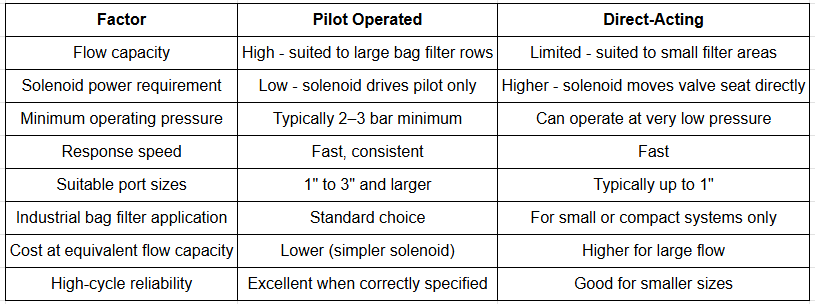
For the majority of industrial bag filter installations – anything beyond a small compact dust collector – pilot operated valves are the correct choice. Direct-acting designs suit very small filter systems or applications where the compressed air pressure is too low to reliably operate the pilot mechanism.
Maintenance Best Practices for Pilot Operated Valves in Dust Collectors
Quarterly pulse test: Activate each valve manually and listen to the pulse. A correctly operating pilot operated valve produces a sharp, consistent crack – a clean, fast opening and closing. A weak or muffled sound indicates a diaphragm losing flexibility or a pilot passage that is partially restricted.
Annual diaphragm inspection: Remove and inspect the diaphragm annually in standard applications; every 8–10 months in high-cycle cement, steel, or power plant installations. Look for surface cracking, edge tears, hardening, or thinning of the material. Replace before failure rather than after.
Compressed air quality check: At every scheduled maintenance interval, inspect the coalescing filter bowl upstream of the valve manifold. Moisture accumulation in the bowl indicates either inadequate dryer capacity or a dryer requiring service. Oil contamination indicates a compressor problem that needs attention before it damages more diaphragms.
Solenoid coil check: Measure coil resistance annually. Compare against the manufacturer’s specification. Coil resistance that has drifted from the original specification – particularly increasing resistance – indicates insulation degradation. A coil in this condition may still operate but is at higher risk of failure.
Manifold pressure verification: With a pressure gauge at the manifold, confirm that supply pressure is within the valve’s rated range and that pressure recovers adequately between pulses. Inadequate recovery indicates either insufficient supply capacity or an interval setting that is too short for the manifold volume.
Keep a site spare kit: For each valve size installed on site, maintain a stock of diaphragm replacement kits – diaphragm, O-rings, and bleed orifice components. This enables same-shift maintenance response to valve failures without waiting on procurement.
Common Mistakes When Specifying or Installing Pilot Operated Pulse Valves
Selecting valve size based on port thread size alone. A 2″ valve from one manufacturer may have a significantly different flow coefficient (Cv) than a 2″ valve from another. If you’re replacing a valve from a different manufacturer, confirm Cv compatibility to ensure the cleaning pulse volume is maintained.
Ignoring minimum operating pressure requirements. Pilot operated valves require a minimum differential pressure to operate the pilot mechanism reliably. If system supply pressure drops below this minimum – during peak demand, for example – valves may fail to open fully, producing weak pulses. Ensure the air supply system can maintain the required minimum pressure under all operating conditions.
Installing without flushing the manifold. Debris from installation – thread sealant particles, pipe scale, or dust from the manifold – can block the pilot passage immediately after commissioning. Flushing the manifold with compressed air before fitting the valves eliminates this failure mode.
Leaving pilot orifice contamination unaddressed. A partially blocked pilot passage causes delayed or incomplete valve opening – which appears as a weak pulse or inconsistent response. This is frequently misdiagnosed as a diaphragm problem. If diaphragm replacement doesn’t resolve the issue, inspect the pilot passage for contamination.
Using incorrect pulse duration settings. Excessively long pulse durations stress the diaphragm beyond what is needed for effective cleaning and waste compressed air. Work with the valve manufacturer’s recommended duration range and adjust based on actual filter performance monitoring.
Replacing valves without identifying the root cause of failure. Premature diaphragm failure is almost always caused by an identifiable condition – contaminated air, excessive pulse frequency, wrong material for the temperature, or incorrect voltage. Replacing the valve without addressing the root cause repeats the same failure.
Industry Best Practices for Pilot Operated Valve System Performance
Match valve sizing to filter bag row area. The relationship between valve flow capacity, blow pipe design, and filter bag area is system-specific. Where available, use the filter OEM’s specification. For retrofits, a pulse valve manufacturer with dust collection application experience can advise on the correct valve size for the specific filter configuration.
Protect the compressed air supply. A three-stage treatment approach – particulate filter, coalescing filter, refrigerant dryer – upstream of the pulse valve manifold provides the compressed air quality that maximises pilot operated valve service life. This is not over-specification for industrial installations; it is the baseline for reliable continuous-duty operation.
Sequence correctly. The sequential controller should allow adequate interval between pulses for manifold pressure recovery and hopper dust settling. The correct interval depends on manifold volume, supply capacity, and filter configuration – not a generic default setting.
Conduct baseline performance recording at commissioning. Record differential pressure at various airflow rates, pulse valve response, and manifold pressure recovery at commissioning. This baseline makes performance degradation detectable before it becomes a compliance or maintenance problem.
Train maintenance staff on pilot valve diagnostics. A maintenance technician who can listen to a pulse, observe a differential pressure trend, and inspect a diaphragm correctly is more valuable than a parts-replacement approach. Diagnostic capability in the maintenance team reduces response time and prevents unnecessary component replacement.
Frequently Asked Questions
What is a pilot operated valve in a dust collector?
A pilot operated valve in a dust collector is the valve that controls the release of compressed air pulses used to clean filter bags in a reverse pulse jet bag filter system. A small electromagnetic solenoid opens a pilot orifice, which vents pressure from behind the main diaphragm, causing the diaphragm to lift and release a burst of compressed air into the blow pipe. This air pulse flexes the filter bag, dislodging accumulated dust into the collection hopper below. Pilot operated valves are the standard design for industrial dust collection because they deliver high flow capacity with low solenoid power.
What is the difference between a pilot operated valve and a direct-acting pulse valve?
In a pilot operated valve, a small solenoid controls the main diaphragm indirectly – by managing pressure behind the diaphragm – allowing large flow rates with low solenoid power. In a direct-acting valve, the solenoid moves the valve seat directly by electromagnetic force, which limits the practical flow capacity to smaller orifice sizes. Pilot operated valves are the standard choice for industrial bag filter systems because they provide the high compressed air flow per pulse needed to clean large filter bag areas effectively. Direct-acting valves suit small compact dust collectors where flow requirements are lower.
How often should pilot operated valves be serviced in a bag filter system?
In standard industrial duty, annual diaphragm inspection is the recommended minimum. In high-cycle applications – cement, steel, power plants running continuous 24-hour operations – planned diaphragm replacement every 8 to 12 months is a practical preventive maintenance approach. Solenoid coil condition should be checked annually. Compressed air treatment equipment upstream of the valve manifold should be inspected at the same frequency to maintain the air quality that supports good valve service life.
What causes pilot operated pulse valves to produce weak cleaning pulses?
The most common causes of weak pulses from pilot operated valves are: a worn or fatigued diaphragm that no longer fully lifts from the seat; a partially blocked pilot passage restricting airflow venting; low manifold pressure due to inadequate supply capacity or an interval setting too short for pressure recovery; and moisture or oil contamination in the compressed air supply causing diaphragm swelling or pilot passage fouling. Diagnosing which cause applies requires systematically checking manifold pressure, inspecting the diaphragm, and testing the pilot passage – rather than assuming diaphragm replacement will resolve the issue.
What compressed air quality is needed for pilot operated pulse valves?
Pilot operated pulse valves perform best with clean, dry, oil-free compressed air. At minimum, a particulate filter and coalescing filter upstream of the manifold are required. A refrigerant air dryer is strongly recommended for continuous-duty industrial applications. Moisture causes diaphragm swelling and pilot passage corrosion. Oil contamination swells NBR diaphragms. Particulates block the pilot orifice. All three contamination types are preventable with appropriate upstream air treatment, and the cost of treatment equipment is far less than the cost of frequent valve maintenance caused by poor air quality.
Can pilot operated valves be retrofitted to existing dust collector systems?
Yes, in most cases. Standard pilot operated pulse valve body sizes – 1″, 1.5″, 2″, 2.5″ – are compatible with the manifold port dimensions used by the major global bag filter OEMs. Before ordering, verify the port thread standard (BSP or NPT), the manifold port size, the coil voltage required by the sequential controller, and the operating pressure range. A reputable pulse valve manufacturer can advise on compatibility for your specific installation and confirm the correct replacement specification.
What is the role of the diaphragm in a pilot operated pulse valve?
The diaphragm is the main flow-control element in a pilot operated pulse valve. In its resting position, compressed air pressure holds the diaphragm closed against its seat – preventing airflow through the valve. When the pilot opens, pressure behind the diaphragm vents, and the diaphragm lifts to allow the cleaning pulse to discharge. The diaphragm material and geometry determine the valve’s flow characteristics, response speed, sealing integrity, and service life. It is the primary maintenance item in a pilot operated valve – the component that most determines cleaning performance and maintenance interval.
How do I know if I need a pilot operated valve or a different valve type for my dust collector?
If your dust collector is a reverse pulse jet bag filter – the most common industrial type, with rows of vertically suspended filter bags cleaned by compressed air pulses from a blow pipe – pilot operated valves are almost certainly the correct choice for your application. The exception is very small compact dust collectors where direct-acting valves may be specified. If you’re unsure of your system type or the correct valve specification, the bag filter’s original design drawings and OEM documentation will specify the valve configuration. A pulse valve manufacturer with dust collection application experience can also review your installation and confirm the correct specification.
Conclusion
The pilot operated valve is one of the most consequential components in a reverse pulse jet dust collection system – not because it’s complicated, but because everything the system does depends on it doing its job correctly. Clean, sharp, consistent pulses. Every cycle. Across years of continuous operation.
When a pilot operated valve is correctly specified for the operating conditions – right diaphragm material, right coil rating, right body size, and supported by clean compressed air – it requires minimal maintenance and contributes to a dust collection system that stays within emission limits, uses compressed air efficiently, and extends filter bag life.
When it isn’t, the problems spread across the system: rising differential pressure, increased energy consumption, early bag failure, and the kind of maintenance workload that makes engineers wonder why the system was ever specified the way it was.
Choosing the right pulse valve manufacturer – one who understands dust collection applications deeply and can support the installation with technical guidance and domestic spare parts availability – is the decision that determines which of those two outcomes you experience.
Specifying or replacing pilot operated valves for your dust collector?
Maniks has manufactured pilot operated reverse jet pulse valves for industrial dust collection systems across India for over 47 years. Our valves are engineered for continuous industrial duty – in cement, steel, power, pharmaceutical, chemical, and process manufacturing applications – with the application knowledge and domestic manufacturing capability to support your installation from specification through to long-term service.
Whether you’re upgrading an underperforming cleaning system, replacing worn valves with better-specified alternatives, or sourcing pulse valves for an OEM build, our technical team will help you identify the right valve configuration for your application.
Explore the Maniks Pilot Operated Reverse Jet Pulse Valve or contact us to discuss your application and request a technical quotation.