
How to Choose the Right Pulse Valve Manufacturer | India
When you’re placing a bulk order for dust collector valves, the stakes are higher than a single-unit purchase. A batch of inconsistent pulse valves doesn’t just cause one machine to underperform – it can affect an entire plant’s filtration efficiency, compressed air consumption, and maintenance schedule for years.
Choosing the right pulse valve manufacturer for a bulk requirement isn’t about finding the lowest quote. It’s about finding a supplier whose manufacturing consistency, material quality, and after-sales support can hold up across hundreds or thousands of units, month after month.
This guide breaks down exactly what to evaluate before you commit to a pulse valve manufacturer for your next bulk order.
What Is a Pulse Valve and Why Does Manufacturer Quality Matter?
A pulse valve is a pneumatically operated valve used in reverse pulse jet dust collectors to release short, high-pressure bursts of compressed air into filter bags or cartridges. This burst dislodges accumulated dust from the filter media, keeping airflow and differential pressure stable during continuous operation.
Every pulse valve in a dust collector fires thousands of cycles per day. Multiply that across a full tank of valves running continuously in a cement plant or foundry, and small manufacturing inconsistencies – a slightly different diaphragm compound, a marginally looser tolerance in the valve body – get magnified fast. One weak valve in a bank of fifty is a manageable problem. A batch of fifty weak valves is a plant-wide reliability issue.
That’s why manufacturer quality, not just product specification, becomes the real deciding factor for bulk purchases.
How Does a Pulse Valve Work?
A pulse valve sits on the compressed air tank, normally held closed by air pressure acting on a diaphragm. When the sequential timer controller sends a signal, a pilot solenoid vents the pressure holding the diaphragm shut. The pressure imbalance snaps the diaphragm open, releasing a short, forceful pulse of air – typically under 150 milliseconds – through the valve and into the blow pipe.
This is why pulse valves are often called pilot operated valves: the small pilot solenoid controls a much larger volume of compressed air indirectly, rather than switching it directly. That indirect control is what allows the valve to deliver a fast, high-volume pulse without needing an oversized solenoid.
Once the pulse is delivered, the solenoid closes, pressure rebuilds, and the diaphragm reseats. Across a full dust collector, this cycle repeats row by row on a timed sequence, cleaning the entire filter bank without ever shutting down airflow.
Why Pulse Valve Reliability Is Critical for Bulk Buyers
For a single dust collector, an underperforming pulse valve is a maintenance ticket. For a plant running multiple collectors, or for an OEM building dust collection systems for clients, inconsistent pulse valve quality across a bulk order becomes a much bigger liability.
Uneven pulse strength across valves causes uneven filter bag cleaning, which shortens bag life unpredictably. Valves that leak air even slightly increase compressor load across the board, raising energy costs that compound over a full production year. And when failures are inconsistent – some valves lasting years, others failing within months – maintenance planning becomes reactive instead of preventive.
For OEMs specifically, pulse valve reliability directly affects the performance guarantees they offer their own customers. A manufacturer’s quality control standards effectively become the OEM’s quality control standards too.
Where Are Dust Collector Pulse Valves Used?
Pulse valves are core components in pulse jet dust collection systems across:
- Cement and clinker plants – packing units, raw mills, clinker coolers
- Steel and foundries – furnace fume extraction, shot blasting, sand handling
- Power generation – coal and ash handling systems, boiler dust extraction
- Pharmaceutical manufacturing – powder handling, tablet coating dust control
- Food processing – flour mills, grain handling, spice processing
- Chemical and textile plants – process dust extraction, fiber collection
- Mining and mineral processing – crusher houses, material transfer points
- Woodworking and furniture manufacturing – sawdust and chip collection systems
Any facility running a bag filter or cartridge dust collector relies on pulse valves as the mechanical heart of its cleaning cycle.
Types of Pulse Valves You’ll Encounter
Pulse Jet Valve
The general term for any valve used in a reverse pulse jet cleaning cycle. Pulse jet valves are engineered for rapid, repeated cycling rather than continuous flow control, which is what distinguishes them from standard industrial valves.
Pulse Jet Solenoid Valve
This refers to the complete valve-and-solenoid assembly, where the solenoid coil receives the electrical signal from the timer controller and controls the pilot circuit that operates the main valve.
Pilot Operated Valve
A design where a small pilot mechanism controls a larger valve indirectly, using pressure differential rather than direct mechanical force. This design allows pulse valves to deliver strong, fast pulses using a relatively small and energy-efficient solenoid.
Comparison: What to Evaluate in a Pulse Valve Manufacturer
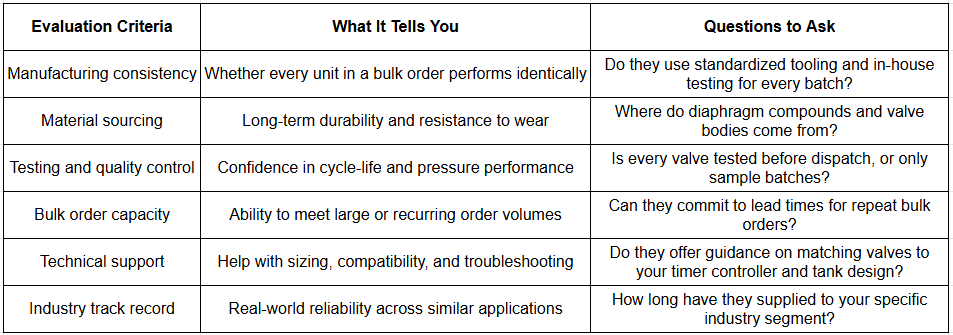
Benefits of Sourcing from a Reliable Pulse Valve Manufacturer
Predictable performance across every unit. When manufacturing tolerances are tight and consistent, every valve in a bulk order behaves the same way, which simplifies maintenance planning significantly.
Lower total compressed air costs. Pulse valves with precise sealing reduce constant air leakage across the plant, which adds up to meaningful compressor energy savings over a year of continuous operation.
Fewer replacement cycles. Durable diaphragm materials and well-machined valve bodies mean fewer valves need replacing mid-cycle, reducing both part costs and labor hours.
Simplified spares management. Standardizing on one trusted manufacturer means your maintenance team stocks fewer variants and troubleshoots faster, since every valve behaves predictably.
Stronger OEM performance guarantees. For OEMs, sourcing from a manufacturer with proven consistency directly supports the reliability claims made to end customers.
Common Industrial Applications for Bulk Pulse Valve Orders
- New dust collector installations requiring a full valve bank
- Plant-wide retrofits replacing aging or inconsistent valve stock
- OEM production of dust collection systems for resale
- Multi-site industrial groups standardizing valve specifications across locations
- Scheduled preventive maintenance programs requiring recurring bulk spares
Maintenance Tips to Extend Pulse Valve Life
Maintain clean, dry compressed air. Moisture and oil in the air supply are the leading causes of premature diaphragm wear, regardless of how well-built the valve is.
Inspect valves during planned shutdowns, not just after failure. Catching a hardening or cracking diaphragm early prevents an unplanned mid-shift failure.
Monitor differential pressure trends. A gradual rise in differential pressure across a filter bank, even with normal cleaning cycles running, often points to weakening pulse valves before they fail outright.
Verify solenoid response consistency. A pulse valve is only as fast as its pilot solenoid. Sluggish solenoid response weakens the entire pulse, even if the diaphragm itself is in good condition.
Keep bulk-matched spares on hand. When you’ve sourced valves in bulk from a single manufacturer, keep replacement units from that same batch specification to avoid introducing performance inconsistency into an otherwise uniform system.
Buying Considerations Before Placing a Bulk Order
Request sample units before committing to full volume. A reputable pulse valve manufacturer will support small trial orders so you can validate performance before scaling up.
Confirm compatibility with your existing timer controller. Solenoid voltage, response timing, and port sizing all need to align with your current sequential timer controller setup to avoid erratic cleaning cycles.
Ask about batch-to-batch consistency guarantees. For recurring bulk orders, consistency across shipments matters as much as the quality of the first batch.
Clarify lead times for repeat orders. If you’re an OEM or multi-site operator, dependable lead times protect your own production schedules downstream.
Evaluate technical support, not just pricing. A manufacturer who helps with sizing, troubleshooting, and system compatibility saves far more in downtime than a marginally lower unit price.
Common Mistakes to Avoid When Sourcing Pulse Valves in Bulk
Prioritizing unit price over total cost of ownership. A cheaper pulse valve that fails early costs more in labor, downtime, and replacement parts than a well-engineered one.
Skipping sample testing before a bulk commitment. Ordering a full batch without validating a sample unit first is a common and avoidable mistake.
Assuming all “pilot operated valves” are built to the same tolerance. The term describes a design principle, not a quality standard – manufacturing precision varies significantly between suppliers.
Ignoring compatibility with existing infrastructure. A pulse valve that doesn’t match your current tank fittings or timer controller specifications creates integration problems that outweigh any cost savings.
Choosing a manufacturer with no industry-specific track record. A supplier experienced in light-duty applications may not have the engineering depth needed for heavy dust-load environments like cement or foundry operations.
Industry Best Practices for Bulk Pulse Valve Procurement
Experienced procurement and maintenance teams tend to follow a consistent approach: they standardize on a single proven pulse valve manufacturer across sites to simplify spares and reduce variability, they request documented cycle-life and testing data rather than relying on verbal assurances, and they build a long-term relationship with their supplier rather than re-sourcing purely on price with every order.
Pairing bulk pulse valve procurement with a preventive maintenance schedule – rather than reactive replacement – consistently reduces total cost of ownership and keeps dust collection systems running at their designed efficiency.
Frequently Asked Questions
1. What is a pulse valve manufacturer responsible for beyond just making the valve? A reliable pulse valve manufacturer is responsible for consistent manufacturing tolerances, material quality control, batch testing, and providing technical support for sizing and compatibility, not just producing the physical component.
2. How is a pulse solenoid valve different from a standard pulse valve? A pulse solenoid valve refers to the complete assembly, including the electrically operated solenoid pilot that triggers the valve. “Pulse valve” is often used more broadly to refer to the same assembly in dust collection contexts.
3. What should I look for when comparing dust collector valves in bulk? Compare manufacturing consistency, diaphragm material quality, tested duty cycles, port sizing compatibility, and the manufacturer’s track record in your specific industry, rather than comparing on price alone.
4. How often should dust collector pulse valves be replaced? Replacement intervals depend on cycling frequency, compressed air quality, and dust load, but well-manufactured pulse valves in properly maintained systems typically run for several years before diaphragm replacement is needed.
5. Can one weak pulse valve affect an entire dust collector? Yes. A single underperforming valve creates uneven cleaning across the filter bank, which can lead to localized dust buildup, reduced airflow, and increased load on the rest of the system.
6. What’s the advantage of a pilot operated valve design? A pilot operated valve uses a small solenoid to control a much larger air flow indirectly, allowing for a fast, powerful pulse without requiring an oversized or energy-inefficient solenoid.
7. Should I request sample units before a bulk pulse valve order? Yes. Testing sample units under your actual operating conditions before committing to a full bulk order is standard practice and helps confirm performance and compatibility in advance.
8. Are Indian pulse valve manufacturers suitable for OEM and large-scale industrial orders? Established Indian manufacturers with decades of dust collection engineering experience routinely supply OEMs and large industrial plants, often offering more responsive technical support and shorter lead times than overseas suppliers.
Conclusion
A bulk pulse valve order is only as reliable as the manufacturer behind it. Consistent manufacturing tolerances, tested diaphragm materials, and dependable technical support matter far more than a low per-unit quote, especially when hundreds of valves will be firing continuously across your dust collection system for years to come.
Before you commit to your next bulk order, evaluate your pulse valve manufacturer the same way you’d evaluate any critical equipment partner: on consistency, track record, and support – not just price.
Sourcing pulse valves for a new installation, retrofit, or OEM production run? Maniks has been engineering reliable pilot operated reverse jet pulse valves for over 47 years, supplying cement, steel, pharmaceutical, power, and manufacturing plants across India. Explore our pilot operated pulse valve range, or contact our technical team to discuss bulk pricing, sample testing, or help selecting the right valve for your system.