
Diaphragm Valve Manufacturers in India for OEM Use
When you’re specifying diaphragm valves for an OEM build or a plant-level procurement, the wrong choice has a way of making itself known – usually at the worst possible moment. A valve that fails early in a dust collector installation doesn’t just cost the price of replacement. It costs the maintenance hours, the production downtime, and, if the failure affects emissions control, the regulatory scrutiny that follows.
The Indian diaphragm valves manufacturer landscape has matured considerably over the past two decades. Domestic suppliers now produce components that compete directly with imported alternatives on materials, precision, and service life – with the added advantage of local availability, faster lead times, and accessible technical support.
This guide walks through what to look for in a diaphragm valves manufacturer, how different valve types suit different industrial applications, and what genuinely separates a capable supplier from one that will create problems down the line.
What Is a Diaphragm Valve and How Does It Work?
A diaphragm valve controls fluid or gas flow using a flexible membrane – the diaphragm – as its primary sealing and flow-control element. Pressing the diaphragm against a weir or seat closes the valve; releasing it allows flow to pass through.
In industrial dust collection applications, the diaphragm valve serves a specific and critical function: it controls the release of high-pressure compressed air used to clean fabric filter bags in reverse pulse jet systems. The diaphragm opens and closes rapidly – often in under 100 milliseconds – delivering a sharp burst of air that flexes the filter bag and dislodges accumulated dust.
The mechanical elegance of this design is that the diaphragm is the only moving part in contact with the process medium. There are no sliding seals, no packing glands, and no metal-to-metal contact in the flow path. This gives diaphragm valves inherently low maintenance requirements and long service life when the correct diaphragm material is specified for the application.
Why the Choice of Diaphragm Valve Supplier Matters More Than It Appears
Purchase managers evaluating diaphragm valve price across multiple suppliers sometimes focus on the unit cost of the valve body and miss the variables that actually determine the cost of valve ownership over a 3-to-5-year period.
Those variables include: diaphragm replacement frequency, spare parts availability, coil reliability in the installation environment, and whether the supplier can provide meaningful technical support when a system isn’t performing as expected.
A diaphragm valve manufacturer with deep application experience in dust collection systems understands the interaction between valve specification, compressed air quality, controller settings, and filter bag performance. That knowledge translates into better specification guidance upfront, which means fewer problems in operation.
A supplier who simply lists standard dimensions and prices without offering application input is providing a commodity product, not a solution. For OEM manufacturers building dust collectors or filter systems for their customers, this distinction matters at every installation.
Types of Diaphragm Valves Used in Industrial Applications
Pneumatic Diaphragm Valves
A pneumatic diaphragm valve uses compressed air as the actuating medium. An air signal – either from a solenoid pilot or a pneumatic controller – applies or relieves pressure to move the diaphragm. This type is widely used in process industries where electrical actuation is restricted for safety reasons, or where the installation environment makes electrical equipment impractical.
In dust collection, pneumatic diaphragm valves appear in larger-capacity applications where the volume of compressed air per pulse requires a valve body too large for direct solenoid actuation. They’re also used in hazardous area installations where ATEX or flameproof ratings are required.
Solenoid Diaphragm Valves
The solenoid diaphragm valve combines an electromagnetic solenoid with a diaphragm valve body. The solenoid receives an electrical signal from the sequential timer controller, actuates a pilot mechanism, and the resulting pressure differential across the diaphragm opens the main valve to release the compressed air pulse.
This is the most common configuration in industrial bag filter systems. The solenoid provides precise electrical control of pulse timing, the pilot design determines response speed, and the diaphragm handles the actual compressed air flow. Solenoid diaphragm valves are available in voltages to suit most industrial control systems: 24V DC, 110V AC, and 220V AC are the most widely used.
Tank Mounted Diaphragm Valves
Tank mounted configurations integrate the diaphragm valve directly onto a compressed air reservoir – the tank – which is itself mounted on the bag filter housing. Rather than running a separate compressed air manifold along the outside of the filter, the tank stores compressed air close to the blow pipe, providing a high-volume pulse with less pressure drop.
This design is particularly effective in larger bag filter systems and high-particulate-loading applications where the volume and sharpness of each air pulse directly impacts cleaning effectiveness. Tank mounted valves simplify the installation and can be retrofitted to existing filter housings that weren’t originally designed with external manifolds.
What Makes a Good Diaphragm Valve Manufacturer in India?
Shortlisting a diaphragm valve supplier – whether for OEM procurement or plant maintenance – involves evaluating several dimensions that go beyond the technical datasheet.
Manufacturing Quality and Process Control
The diaphragm itself is the heart of the valve. Its moulding precision, material consistency, thickness uniformity, and bonding quality determine how many millions of cycles it will complete before failure. A manufacturer with controlled moulding processes and incoming material inspection produces a diaphragm that performs consistently across a production batch.
The valve body machining tolerances affect the sealing geometry and the diaphragm’s working range. A poorly machined seat means the diaphragm can’t seal completely, causing slow air leaks that waste compressed air and allow the valve to “breathe” between pulses – reducing cleaning effectiveness over time.
Application Engineering Capability
OEM manufacturers building dust collection equipment need more than a valve – they need a specification that works for their specific filter design. A good diaphragm valve supplier can advise on body size relative to blow pipe and venturi configuration, pulse duration ranges for the diaphragm material specified, compressed air volume and pressure requirements per pulse, and compatibility with existing manifold or tank configurations.
This kind of application support requires engineers with actual dust collection system knowledge, not only product knowledge.
Spare Parts Availability and Lead Times
For plant maintenance teams, the diaphragm replacement kit needs to be available immediately when required – not on a 6-to-12-week import lead time. A domestic diaphragm valve supplier with stock of standard replacement diaphragms, O-rings, and solenoid coils enables responsive maintenance and minimises downtime when valves need servicing.
For OEM manufacturers, reliable component lead times from the valve supplier directly affect the OEM’s ability to deliver finished equipment to their customers on schedule.
Range and Customisation
Industrial applications vary widely. A diaphragm valve manufacturer with a comprehensive range – multiple body sizes, diaphragm material options, coil voltages, and body configurations – can supply the right specification for each application rather than requiring the buyer to adapt their system to the available product range.
Key Industries Served by Diaphragm Valve Suppliers in India
Dust Collection and Air Pollution Control
The primary application for industrial diaphragm valves in India is reverse pulse jet dust collection. Bag filters used in cement plants, steel mills, power plants, foundries, and chemical facilities all rely on diaphragm valves to deliver the compressed air pulses that keep filter bags clean and airflow maintained.
The regulatory environment around industrial emissions in India – driven by CPCB standards and growing enforcement – has increased the criticality of reliable dust collection equipment. A bag filter system that doesn’t maintain cleaning effectiveness due to valve underperformance is not just an operational problem; it’s an environmental compliance risk.
OEM Equipment Manufacturing
Manufacturers of bag filters, dust collectors, fume extraction systems, and industrial ventilation equipment specify diaphragm valves as components in their finished products. For OEM buyers, consistency across production batches, documentation (drawings, test certificates, material certificates), and the supplier’s ability to support high-volume procurement are important criteria.
An OEM relationship with a diaphragm valve manufacturer in India offers the added advantage of proximity – easier to communicate, faster to resolve specification issues, and simpler to manage quality concerns without international supply chain complexity.
Pharmaceuticals and Food Processing
These industries use diaphragm valves in dust collection for ingredient handling, tablet manufacturing, and packaging facilities. Applications here may require food-grade or pharmaceutical-grade diaphragm materials, and valve cleanliness during manufacture is an important consideration. Indian manufacturers supplying these sectors should be able to provide material declarations and, where required, FDA-compliant material certifications.
Chemicals and Specialty Applications
Chemical plant powder handling and reactor ventilation systems may involve process gases or vapours that attack standard diaphragm materials. A diaphragm valve supplier able to provide PTFE, EPDM, or other specialist diaphragm compounds – and who understands the compatibility requirements – is necessary for these applications rather than a general-purpose supplier.
Textiles, Woodworking, and Light Industrial
These sectors tend to use smaller bag filter systems with less demanding duty cycles. Standard diaphragm valve specifications are generally appropriate, and the procurement focus for these buyers tends to be on price, availability, and straightforward technical support for maintenance staff who may not have deep dust collection expertise.
Diaphragm Valve Comparison: Key Specifications to Evaluate
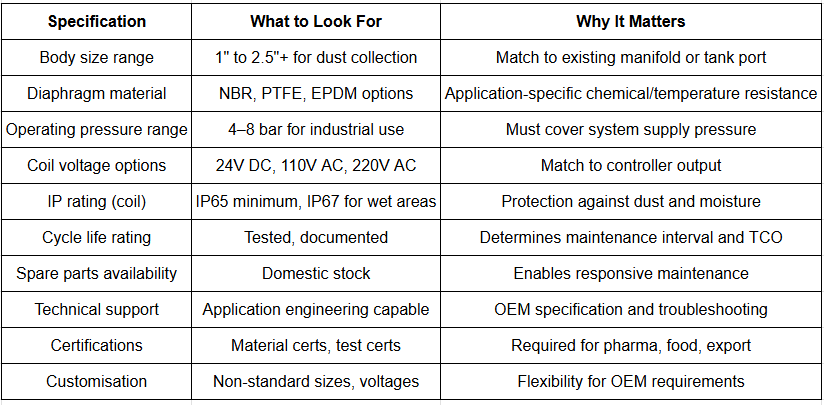
Evaluating Diaphragm Valve Price: What the Unit Cost Doesn’t Tell You
When comparing diaphragm valve prices across suppliers, the initial unit cost is a starting point, not a conclusion.
Total cost of ownership over a 5-year period for a 20-valve bag filter installation includes: initial purchase, diaphragm replacement kits (likely 1–2 replacements per valve over 5 years), labour for maintenance, any downtime costs from early failures, and the cost of compressed air wasted through leaking or poorly performing valves.
A valve priced 15% lower than a quality alternative that requires diaphragm replacement at half the interval and contributes to higher differential pressure – meaning the filter operates less efficiently – will cost more over its operating life despite the lower purchase price.
For OEM manufacturers, there’s an additional dimension: a valve failure in a customer’s installation reflects on the OEM’s equipment, not the valve supplier’s reputation. The indirect cost of a warranty call, a site visit, and a difficult customer conversation far exceeds the cost of sourcing a better-specified valve in the first place.
How to Choose a Diaphragm Valve Manufacturer for OEM Applications
For OEM buyers specifically, the supplier evaluation should include:
Batch consistency. Request dimensional inspection reports from a representative production batch. Diaphragm thickness, body bore tolerances, and thread dimensions should be consistent across units, not just within specification on average.
Documentation capability. OEM customers often require material certificates, test certificates, and manufacturing drawings for their own quality records and for submission to end-user customers. Confirm the supplier can provide these routinely, not just on special request.
Prototype and sample support. Before committing to a production volume, test sample valves in your actual system configuration. A supplier who can provide samples quickly and who engages technically during your evaluation process is demonstrating the kind of relationship that works well at production scale.
Supply chain reliability. Understand the supplier’s manufacturing capacity, lead times for standard products, and how they handle demand spikes. An OEM with growing order volumes needs a valve supplier who can scale with them.
References. Ask for references from other OEM customers in similar sectors. A manufacturer who has supported similar OEM relationships can speak to how they handle volume orders, documentation requirements, and the occasional specification challenge.
Maintenance Guidance for Diaphragm Valves in Industrial Service
Inspect quarterly: During a manual test cycle, listen to each valve for consistent response. A healthy diaphragm valve produces a sharp, immediate pulse. Delayed response or a weak pulse indicates a diaphragm nearing the end of its service life or a pilot passage partially obstructed.
Replace diaphragms on a planned schedule: In continuous industrial duty, planned replacement every 12 months is practical for most applications. In high-cycle installations – cement, steel, power plants running 24/7 – replacement at 8–10 months may be more appropriate. Don’t wait for visible failure.
Check compressed air quality: Moisture and oil contamination are the primary causes of premature diaphragm deterioration. Inspect the coalescing filter bowl for moisture accumulation at every scheduled maintenance. A wet filter bowl on a system with an air dryer installed indicates the dryer needs service.
Inspect solenoid coil condition: Check coil resistance annually or when response becomes inconsistent. A coil with degraded insulation may still respond but with reduced electromagnetic force – resulting in sluggish pilot operation that appears as a valve performance problem.
Maintain a site spare inventory: For every valve size installed, keep at minimum one diaphragm replacement kit per three valves on site. This allows immediate corrective action without waiting on procurement for routine maintenance items.
Common Mistakes When Buying Diaphragm Valves
Specifying on dimensions alone without verifying material compatibility. A standard NBR diaphragm that works perfectly in a cement plant application can fail rapidly in a chemical plant where the process involves solvents or acidic vapours. Always confirm diaphragm material compatibility with the actual process environment.
Assuming all suppliers of the same nominal size are interchangeable. Different manufacturers’ valves of the same nominal port size can have different body geometries, sealing face dimensions, and pilot passage designs. Substituting one brand for another mid-system without verifying compatibility can result in poor sealing, inconsistent performance, or manifold fitment problems.
Buying from distributors who have no manufacturing relationship. Some distributors supply valves with no direct connection to the manufacturing process – no quality records, no material traceability, and no ability to resolve technical issues. For industrial and OEM applications, buying direct from a manufacturer or from a distributor with documented supply chain traceability is far preferable.
Ignoring the solenoid coil voltage. Running a 24V DC coil on a 220V AC supply destroys it immediately. This is a simple specification check that is missed with surprising frequency during replacement procurement, particularly when site maintenance staff are ordering urgently.
Delaying replacement to save cost. A diaphragm that is visibly degraded or that has been producing weak pulses for months is doing real damage to bag filter performance – blinded filter bags, rising differential pressure, and increased fan motor loading. The cost of a planned diaphragm replacement is substantially less than the downstream cost of premature bag filter maintenance.
Frequently Asked Questions
What is a diaphragm valve used for in industrial applications?
In industrial dust collection systems, a diaphragm valve controls the release of short, high-pressure bursts of compressed air used in reverse pulse jet bag filter cleaning. The valve opens for a fraction of a second, releasing an air pulse through a blow pipe and venturi nozzle that flexes the filter bag and dislodges accumulated dust. They’re also used in process industries to control liquid or gas flow where a flexible membrane seal is preferred over sliding seal designs.
What is the difference between a pneumatic diaphragm valve and a solenoid diaphragm valve?
A pneumatic diaphragm valve is actuated by a compressed air signal, making it suitable for hazardous area installations or where electrical control is restricted. A solenoid diaphragm valve is actuated by an electrical signal from a controller – a solenoid pilot converts the electrical signal into a pneumatic action that opens the main diaphragm. Solenoid diaphragm valves are the most common choice for dust collector bag filter systems because they integrate directly with sequential timer controllers and allow precise pulse timing.
How do I choose the right diaphragm valve for my dust collector?
Match the valve body size to your manifold port or tank connection dimensions. Confirm the operating pressure matches your compressed air supply. Select diaphragm material based on your process environment – NBR for general industrial use, PTFE for chemical resistance, EPDM for high-temperature applications. Verify coil voltage against your controller output. For high-cycle installations, prioritise suppliers who can provide tested cycle life data.
What diaphragm materials are available and when should each be used?
NBR (Nitrile) is standard for most industrial dust collection applications – good resistance to oils, moderate temperatures, and general process environments. PTFE-coated NBR adds chemical resistance and is used in mild corrosive environments. Full PTFE or EPDM diaphragms are specified for aggressive chemical applications or sustained high-temperature environments. Food-grade and pharmaceutical-grade compounds are available for process industries with specific material compliance requirements.
How often should diaphragm valves be serviced in a bag filter system?
In standard industrial duty, diaphragm inspection is recommended annually. In high-cycle applications – cement plants, steel mills, power stations running 24 hours a day – planned diaphragm replacement on an 8-to-12-month cycle is a practical approach to preventive maintenance. Maintaining a spare diaphragm kit on site for each valve size installed allows immediate response to unexpected failures between planned maintenance events.
What is a tank mounted valve and when is it used?
A tank mounted valve integrates the diaphragm valve directly onto a compressed air reservoir that is fitted to the bag filter housing. Rather than running a remote manifold, the tank stores compressed air close to the blow pipe – providing a high-volume, sharp pulse with less pressure drop. Tank mounted configurations are used in larger bag filter systems and high-particulate-loading applications where pulse sharpness and volume directly affect cleaning performance.
How do I evaluate a diaphragm valve supplier for OEM procurement?
Key criteria: manufacturing quality and batch consistency, ability to provide material and test certificates, application engineering support for specification decisions, domestic spare parts availability, production capacity to support your volume requirements, and references from similar OEM customers. Evaluate sample valves in your actual system configuration before committing to production volumes.
What is the typical diaphragm valve price range in India?
Diaphragm valve prices in India vary with body size, material specification, and whether the valve includes a solenoid coil. Standard industrial solenoid diaphragm valves for dust collection applications range from a few hundred to a few thousand rupees per unit depending on size and specification. For OEM procurement at volume, manufacturer pricing and batch consistency are more important decision factors than unit list price. Total cost of ownership – accounting for diaphragm replacement frequency, spares availability, and maintenance labour – is the more meaningful comparison basis than initial purchase price alone.
Conclusion
The diaphragm valves manufacturer you choose for an industrial or OEM application doesn’t just supply a component – they influence the reliability of every dust collection system that component goes into. In industries where bag filter performance is a regulatory requirement as much as an operational one, that’s a consequential decision.
Indian diaphragm valve manufacturers with genuine application experience in dust collection, sound manufacturing processes, and the ability to support OEM customers with technical documentation and responsive spare parts supply now offer a fully competitive alternative to imported options – with the significant advantages of domestic availability, shorter lead times, and accessible engineering support.
The right supplier is the one whose specification guidance matches your actual application, whose quality is consistent across production batches, and whose team picks up the phone when you need technical support.
Need diaphragm valves for a dust collection system or OEM application?
Maniks has manufactured precision-engineered diaphragm valves, tank mounted valves, solenoid diaphragm assemblies, and complete dust collector valve solutions for over 47 years. We supply OEM manufacturers, plant engineering teams, and maintenance departments across India and internationally – with the application knowledge to help you specify correctly, and the domestic manufacturing capability to support your timelines.
Whether you’re replacing worn valves, upgrading a filter system, or specifying components for a new OEM build, our technical team is ready to help you find the right solution for your specific application.
Explore Maniks Tank Mounted Valves and Diaphragm Valve Solutions or contact us for a technical consultation and quotation.