
Ball vs Butterfly vs Diaphragm Valve: Which One to Choose?
Three valve types get specified for roughly the same range of industrial flow-control jobs, and engineers new to a project often default to whichever one their last plant used – without checking whether it’s actually the right fit for the current application. That default choice can mean paying for leak-tightness you don’t need, or worse, installing a valve that can’t handle the media it’s meant to control. Diaphragm valves, ball valves, and butterfly valves each solve flow control differently, and the differences matter well beyond initial cost. This comparison breaks down how each one works, where each genuinely outperforms the others, and how to choose correctly the first time.
How Each Valve Type Works
Diaphragm Valves
A diaphragm valve uses a flexible diaphragm, rather than a moving ball or disc, to open, close, or regulate flow. The diaphragm itself forms the seal against the valve body, which is what gives diaphragm valves their defining advantage: no moving metal parts in direct contact with the flow path, and a leak-proof shutoff with no packing gland to maintain.
A pneumatic diaphragm valve uses external compressed air to flex the diaphragm; a solenoid diaphragm valve uses an electrical signal, commonly integrated with a sequential timer controller in dust collector pulse-cleaning applications.
Ball Valves
A ball valve uses a rotating ball with a bored hole through its center. Turning the handle or actuator a quarter-turn aligns the bore with the pipe for full flow, or perpendicular to it for a tight shutoff. Ball valves are known for fast, reliable on/off shutoff and low pressure drop when fully open.
Butterfly Valves
A butterfly valve uses a rotating disc mounted on a shaft through the center of the flow path. Rotating the disc a quarter-turn opens or closes the valve. Butterfly valves are compact, lightweight for their size, and well suited to large-diameter pipelines where a ball or diaphragm valve would be bulkier and more expensive.
Side-by-Side Comparison
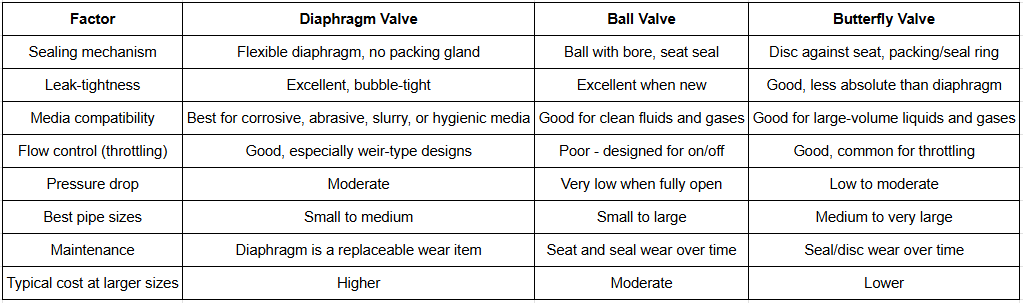
Where Diaphragm Valves Are the Clear Choice
- Dust collector pulse-jet cleaning – the diaphragm’s fast, repeatable flex action is exactly what’s needed to fire short compressed air bursts into filter bags; neither a ball nor butterfly valve is designed for this kind of high-frequency cyclic actuation.
- Corrosive or abrasive media – chemical processing and mineral handling applications benefit from lining options (EPDM, PTFE, Ebonite, Neoprene) that resist wear and chemical attack in ways a metal ball or disc can’t match.
- Hygienic and contamination-sensitive processes – pharmaceutical and food-grade applications favor the diaphragm valve’s smooth, crevice-free flow path, which is easier to clean and doesn’t trap product the way a ball valve’s bore can.
- Slurry and viscous media – a diaphragm valve’s full-bore, straight-through design resists clogging better than a ball valve’s bore, which can trap solids at the seat.
Where Ball or Butterfly Valves Make More Sense
- Simple on/off shutoff on clean fluid or gas lines – a ball valve’s low pressure drop and fast, reliable quarter-turn action often make it the more economical, lower-maintenance choice.
- Large-diameter pipelines – a butterfly valve’s compact, lightweight design becomes significantly more cost-effective than a diaphragm or ball valve as pipe size increases.
- Applications needing precise throttling on clean media – a butterfly valve’s disc position offers good flow control without the diaphragm’s flow restriction at partial opening.
Common Industrial Applications by Valve Type
- Diaphragm valves – dust collector and baghouse cleaning systems, pharmaceutical processing, food and beverage lines, chemical handling, water treatment dosing
- Ball valves – compressed air and gas isolation, clean water lines, general on/off shutoff across nearly every industry
- Butterfly valves – HVAC water systems, large-diameter process piping, cooling water circuits
Maintenance Tips by Valve Type
- Diaphragm valves – inspect the diaphragm during scheduled shutdowns, since it’s a wear item by design; a hissing leak usually signals it’s due for replacement.
- Ball valves – check for handle stiffness or incomplete shutoff, which typically indicates seat wear or debris lodged against the ball.
- Butterfly valves – monitor for seal degradation around the disc edge, especially in valves cycled frequently for throttling rather than simple on/off use.
- All three types – confirm actuator (pneumatic or solenoid) voltage and pressure ratings remain matched to your plant’s supply, since electrical or air supply drift is a common, overlooked cause of inconsistent valve performance.
Buying Considerations
- Media type and chemical compatibility – this alone eliminates unsuitable valve types faster than any other single factor
- Cyclic vs. static duty – pulse-cleaning and other high-frequency cyclic applications favor diaphragm valves specifically
- Pipe size and pressure drop tolerance – larger lines often favor butterfly valves on cost; smaller, corrosive-media lines favor diaphragm valves
- Throttling vs. pure on/off need – ball valves excel at on/off only; diaphragm and butterfly valves both handle throttling reasonably well
- Diaphragm valve price relative to ball or butterfly alternatives, factored against total cost of ownership including spares and maintenance, not just upfront cost
Common Mistakes to Avoid
- Specifying a ball valve for pulse-jet dust collector cleaning, where it isn’t designed for the rapid cyclic actuation the application demands.
- Choosing butterfly valves for highly corrosive or abrasive slurry service, where seal and disc wear can be significantly faster than a properly lined diaphragm valve.
- Ignoring media compatibility in favor of upfront price alone, leading to premature failure and higher total cost from repeat replacement.
- Using a diaphragm valve where a simple, lower-cost ball valve would fully meet the application’s on/off shutoff needs, adding unnecessary cost.
Industry Best Practices
- Match valve type to media characteristics first – corrosiveness, abrasiveness, viscosity – before comparing cost between valve types.
- Reserve diaphragm valves for cyclic, hygienic, or corrosive-media applications where their specific strengths are actually needed.
- Evaluate total cost of ownership, including spares and expected service life, rather than comparing only initial purchase price across valve types.
- Confirm actuator compatibility (pneumatic supply or electrical voltage) with existing plant infrastructure before finalizing valve selection.
Frequently Asked Questions
1. What is the main difference between a diaphragm valve and a ball valve? A diaphragm valve uses a flexible diaphragm to seal flow with no moving parts in direct media contact, while a ball valve uses a rotating ball with a bore – diaphragm valves suit corrosive, abrasive, or hygienic media better, while ball valves excel at simple on/off shutoff on clean fluids and gases.
2. Why are diaphragm valves used in dust collector systems instead of ball valves? Diaphragm valves are built for fast, repeatable cyclic actuation, which is exactly what’s needed to fire pulse-jet cleaning bursts – ball and butterfly valves aren’t designed for this kind of high-frequency cycling.
3. Which valve type is best for corrosive chemicals? Diaphragm valves, particularly with linings like PTFE or Ebonite matched to the specific chemical, generally offer better corrosion resistance than the metal components exposed to flow in ball or butterfly valves.
4. Are butterfly valves cheaper than diaphragm valves? At larger pipe sizes, butterfly valves are typically more cost-effective due to their compact, lightweight design; at smaller sizes or in corrosive/hygienic applications, the cost gap narrows and diaphragm valves often justify their price through better media compatibility.
5. Can a diaphragm valve be used for throttling flow, not just on/off? Yes, particularly weir-type diaphragm valve designs, which offer reasonable flow control – though ball valves are generally unsuitable for throttling and should be reserved for on/off applications.
6. What’s the difference between a pneumatic diaphragm valve and a solenoid diaphragm valve? A pneumatic diaphragm valve is actuated using external compressed air, while a solenoid diaphragm valve is triggered by an electrical signal, making the solenoid type the standard choice for integration with sequential timer controllers in automated systems.
7. Which valve type requires the least maintenance? It depends on the application – ball valves in clean fluid service often need minimal maintenance, while diaphragm valves in cyclic or corrosive-media applications require periodic diaphragm replacement as a normal wear item, not a sign of valve failure.
8. Do diaphragm valve manufacturers in India offer the same range as ball and butterfly valve suppliers? Established diaphragm valve manufacturers in India typically offer multiple body materials and lining options suited to specific applications, alongside broader industrial valve ranges, so most plants can source all three valve types from a single qualified supplier.
Choosing the Right Valve for Your Application
There’s no universally “best” valve among diaphragm, ball, and butterfly types – each is engineered for a different combination of media, duty cycle, and pipe size, and the right choice comes down to matching those factors to your specific application rather than defaulting to habit.
For dust collector pulse-cleaning, corrosive or abrasive media handling, or any hygienic process application, a properly specified diaphragm valve is very likely your best-performing option. Our team can help confirm the right valve type and configuration for your specific process.
Explore Maniks’ full range of tank-mounted diaphragm valves, or request a technical consultation and quote.