
Boost Dust Collector Efficiency with the Right Pulse Valve
A dust collector running hotter, louder, or with higher differential pressure than it used to isn’t always a sign the whole system needs an overhaul. More often, it’s a handful of pulse valves that are costing you compressed air and cleaning performance without anyone noticing until the utility bill or the pressure gauge tells the story.
The pulse solenoid valve is a small component with an outsized effect on dust collector efficiency. Get valve selection and tuning right, and the system cleans effectively while using only the compressed air it actually needs. Get it wrong, and you’re paying for that inefficiency every single cycle, all day, every day.
This guide covers exactly where efficiency gets lost in a pulse-cleaning dust collector system, and what to check – from valve sizing to timing – to get it back.
What Is a Pulse Solenoid Valve, and Why Does It Drive Efficiency?
A pulse solenoid valve releases short, high-pressure bursts of compressed air into filter bags or cartridges to dislodge accumulated dust, in what’s known as reverse pulse jet cleaning. It’s triggered electrically, usually by a sequential timer controller that fires each valve in a bank in turn.
Efficiency in a dust collector comes down to a simple balance: clean often enough to keep airflow steady, without cleaning so often – or so forcefully – that you’re wasting compressed air on cycles the system didn’t actually need. The pulse valve sits right at the center of that balance, which is why valve selection affects energy cost and equipment reliability more directly than most other components in the system.
Where Dust Collector Efficiency Actually Gets Lost
Oversized Valves Waste Air Without Cleaning Better
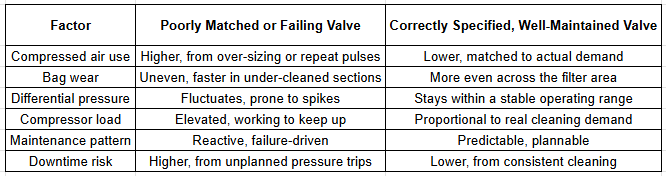
A pulse valve larger than the system requires draws more compressed air per pulse, but doesn’t clean the bag any more effectively once the diaphragm has fully displaced. That excess air draw repeats on every single cycle, across every valve in the bank, which adds up to a meaningful and entirely avoidable compressed air optimization loss over a year of operation.
Mistimed Pulse Frequency
Two failure modes sit on either side of correct timing:
- Cleaning too often wastes compressed air and accelerates diaphragm wear from unnecessary cycling.
- Cleaning too infrequently lets dust cake on the bags, raising differential pressure and forcing the collector’s fan to work harder.
Factory-default sequential timer settings are a starting point, not a final answer – they should be tuned to your plant’s actual dust load, not left untouched after commissioning.
Weak or Inconsistent Valve Response
A valve with a sluggish or partially degraded pilot mechanism often needs two or three pulses to clean a bag that a properly functioning valve would clean in one. That repeat-pulsing multiplies compressed air across the whole bank and adds unnecessary load on the plant’s compressor – a hidden cost that rarely gets traced back to the actual valve causing it.
Silent Valve Failures
A pulse valve that’s stopped firing correctly doesn’t trigger an alarm. It just lets one section of the baghouse gradually blind while the overall pressure gauge – which averages across the whole unit – still looks acceptable. By the time that section forces a pressure trip, the plant has likely been running inefficiently for weeks.
How the Right Pulse Valve Improves Efficiency: Before and After
Practical Steps to Improve Efficiency
- Right-size the valve to actual tank pressure and dust load, rather than defaulting to whatever size was used previously without re-checking against current conditions.
- Re-tune ON/OFF timing on the sequential timer controller to match current dust load, especially after any process change that alters particulate volume.
- Check valve response time periodically, not just whether it fires – a valve that needs multiple pulses to clean effectively is quietly driving up air consumption.
- Track differential pressure trends, not just the instantaneous reading, since a slow upward drift across weeks is often the first sign of valve or diaphragm degradation.
- Standardize on a pulse valve manufacturer with consistent build quality, since inconsistent diaphragm or coil quality across a valve bank creates uneven cleaning that’s hard to diagnose one valve at a time.
Common Industrial Applications
- Baghouse and cartridge dust collectors in cement, steel, and foundry operations
- Reverse pulse jet cleaning systems in pharmaceutical and food processing plants
- Chemical and mineral processing dust extraction
- Any pulse valve for dust collector application where compressed air cost and bag filter performance are both operational priorities
Maintenance Tips to Sustain Efficiency Gains
- Inspect diaphragms during scheduled shutdowns, since a diaphragm nearing end-of-life often shows as a weaker pulse before it fails outright.
- Keep a compressed air dryer functioning upstream – moisture and scale entering the valve body degrade diaphragm life and response consistency over time.
- Re-validate timer settings after any production change that shifts dust load, rather than assuming the original commissioning settings still apply.
- Log differential pressure by baghouse section where possible, so a localized efficiency drop points directly at the valve bank responsible.
Buying Considerations
- Flow capacity matched to actual tank pressure and dust load, not a generic size carried over from a previous installation
- Duty cycle rating appropriate to your actual pulse frequency
- Response consistency – a pilot operated valve with a reliable, fast-acting pilot mechanism reduces the repeat-pulsing that drives up air consumption
- Manufacturer testing and traceability, since consistent batch quality is what prevents uneven cleaning across a valve bank
- Compatibility with your existing sequential timer controller, so timing can be tuned without a mismatched electrical specification
Common Mistakes to Avoid
- Oversizing valves “to be safe,” which increases air consumption without improving cleaning outcomes.
- Leaving sequential timer settings at factory default indefinitely, regardless of changes in dust load or production volume.
- Treating differential pressure as a pass/fail number rather than tracking its trend over time, which misses early warning signs of inefficiency.
- Replacing valves reactively after failure instead of monitoring response consistency as part of routine preventive maintenance.
- Mixing valve manufacturers within one bank, making it harder to isolate which units are underperforming.
Industry Best Practices
- Size and tune pulse valves to actual operating conditions, and revisit that sizing whenever production volume changes materially.
- Pair every pulse solenoid valve with a sequential timer controller tuned to real dust load, not left on default settings from commissioning.
- Monitor differential pressure trends by section, not just as a single collector-wide reading.
- Build valve response checks into routine preventive maintenance rather than waiting for a failure to prompt inspection.
- Standardize on valve manufacturers with documented in-house testing, since consistent build quality is what keeps a full valve bank performing uniformly.
Frequently Asked Questions
1. How does a pulse solenoid valve affect dust collector efficiency? Valve size, response speed, and timing directly determine how much compressed air is used per cleaning cycle and how evenly bags are cleaned – an oversized, mistimed, or degraded valve wastes air without improving cleaning results.
2. What’s the biggest cause of wasted compressed air in a dust collector? Oversized pulse valves and mistimed cleaning frequency are the two most common causes, both of which are correctable through proper valve sizing and sequential timer tuning.
3. How often should pulse valve timing be reviewed? Timing should be reviewed whenever dust load or production volume changes meaningfully, not left permanently at factory-default settings from commissioning.
4. Can a failing pulse valve increase energy costs without causing a visible problem? Yes – a valve needing repeat pulses to clean effectively, or one that’s stopped firing in one section of the baghouse, quietly increases compressed air and compressor energy use before it causes a noticeable pressure issue.
5. What’s the difference between a pilot operated valve and a standard pulse valve for efficiency purposes? A pilot operated valve typically offers more consistent, reliable actuation under higher pressure and frequent cycling, which reduces the repeat-pulsing that drives up compressed air consumption in high-duty applications.
6. How can I tell if my dust collector valves are running inefficiently? Rising differential pressure trends, increased compressor run time without a corresponding increase in production dust load, and uneven bag wear across sections are all signs worth investigating at the valve level.
7. Does valve manufacturer quality affect long-term efficiency? Yes – inconsistent diaphragm or coil quality across a valve bank leads to uneven cleaning performance that’s difficult to diagnose without checking each valve individually, which is why consistent manufacturing quality matters for system-wide efficiency.
8. What’s the first step to improving dust collector efficiency through valve selection? Start by confirming current valve sizing against actual tank pressure and dust load, since oversizing is the most common and most easily corrected source of wasted compressed air.
Getting More Out of Your Dust Collector
Improving dust collector efficiency rarely requires a system-wide overhaul – it usually comes down to making sure the pulse solenoid valves doing the cleaning are correctly sized, properly tuned, and performing consistently across the full valve bank.
If your plant is seeing rising differential pressure, higher-than-expected compressed air use, or inconsistent cleaning across your baghouse, Maniks‘ engineering team can review your valve sizing, timing, and dust load to recommend the right pulse valve configuration for real efficiency gains.
Explore Maniks’ full range of pilot operated pulse jet valves, or request a technical efficiency review.