
Indian vs Imported Pulse Jet Solenoid Valves
When a pulse jet solenoid valve fails on your bag filter system, production doesn’t wait. The compressed air pressure drops, filter bags stop cleaning, and within hours you’re looking at increased emissions, reduced airflow, and the kind of downtime your maintenance team dreads explaining.
This is the moment that separates a thoughtful procurement decision from a regrettable one.
If you’re currently evaluating Indian-made versus imported pulse jet solenoid valves, this guide will walk you through the factors that actually matter on the plant floor – not just the price tag or the country of origin label.
What Is a Pulse Jet Solenoid Valve, and Why Does It Matter?
A pulse jet solenoid valve is the electrically actuated control valve that triggers short, high-pressure bursts of compressed air to clean fabric filter bags in a dust collection system. In a reverse pulse jet cleaning system, these valves open and close in rapid sequence – typically every few milliseconds – releasing a blast of air that dislodges accumulated dust from the outside of the filter bags.
In a typical bag filter installation, you’ll find anywhere from 6 to 60 or more of these valves, each connected to a compressed air manifold and controlled by a sequential timer or pulse controller. The valve’s job is simple: open fast, close fast, and do it reliably tens of thousands of times.
When the valve performs well, your filter bags stay clean, airflow remains consistent, and the dust collection system operates efficiently. When it doesn’t, you deal with blinded bags, high differential pressure, increased energy consumption, and premature filter replacement.
For cement plants, steel mills, foundries, pharmaceutical facilities, and power plants – industries where dust control is both a regulatory requirement and a production necessity – choosing the right pulse solenoid valve is not a minor purchasing decision.
How a Pilot Operated Reverse Jet Pulse Valve Works
Before comparing Indian and imported options, it helps to understand the basic mechanics. Most industrial-grade pulse valves used in bag filter applications are pilot operated valves – a design where a small solenoid pilot controls a larger diaphragm valve.
Here’s the sequence:
- The sequential timer controller sends a brief electrical signal (typically 50–150 milliseconds) to the solenoid pilot.
- The pilot opens, venting the pressure from the back of the diaphragm.
- The pressure differential across the diaphragm causes it to lift, opening the main valve body.
- Compressed air discharges rapidly into the blow pipe and through the venturi nozzle, cleaning a row of filter bags.
- The solenoid de-energises, pressure re-builds behind the diaphragm, and the valve closes – ready for the next cycle.
The diaphragm is the heart of the valve. Its material, thickness, and moulding quality determine how many millions of cycles the valve will reliably complete before it needs servicing.
Indian vs Imported Pulse Jet Solenoid Valves: A Practical Comparison
Let’s go through the factors that engineers and purchase managers should actually weigh.
1. Initial Cost and Total Cost of Ownership
Imported pulse valves – primarily from European and American manufacturers – carry a significant price premium. For a 20-valve bag filter system, the difference in valve cost alone can run into several lakhs of rupees.
But initial cost is only part of the picture. Total cost of ownership includes:
- Spare parts pricing and availability
- Import lead times during breakdowns
- Customs duties and logistics costs
- Local service and technical support
- Downtime cost during spare wait periods
Imported valves often require ordering diaphragms, solenoid coils, and O-rings from overseas, with lead times of 4–12 weeks depending on the supplier’s stock situation. During that wait, plants either run with damaged valves or shut down the affected filter compartment.
Indian-manufactured dust collector pulse valves typically offer next-day or same-week spare parts availability, with technical support accessible by phone or site visit.
Verdict: Imported valves have higher upfront cost and higher spares cost. For many plants, the total cost of ownership over a 5-year period makes Indian options considerably more economical.
2. Build Quality and Materials
This is where honest evaluation matters most.
High-quality imported valves have historically set the benchmark for diaphragm longevity, coil reliability, and body machining tolerances. There’s a reason many Indian plants installed imported brands in the 1980s and 1990s – at that time, domestic manufacturing hadn’t reached the same standards.
That situation has changed substantially.
Established Indian pulse valve manufacturers now produce valves with:
- Precision-machined aluminium alloy bodies with anodised or powder-coated finishes
- Nitrile (NBR) or PTFE-coated diaphragms rated for high cycle counts
- Coils wound and encapsulated to IP65 or IP67 ratings
- Body designs compatible with standard 1″, 1.5″, 2″, and 2.5″ sizes used by global dust collector OEMs
The key differentiator is no longer “Indian vs imported” as a category – it’s the specific manufacturer’s quality control processes, material specifications, and design engineering.
A well-engineered Indian pulse valve from a manufacturer with decades of dust collection industry experience will outlast a budget import from an unknown supplier.
3. Compatibility with Existing Dust Collector Systems
Most dust collection systems in Indian plants use industry-standard port sizes and connection configurations. Whether your bag filter was manufactured domestically or is an imported system from Intensiv-Filter, Herding, or similar OEMs, the valve mounting, blow pipe connection, and electrical connection requirements tend to follow standard dimensions.
Quality Indian pulse solenoid valves are designed to be drop-in compatible with the most common global filter systems. This makes replacement straightforward without modifications to the manifold or blow pipe assembly.
Imported valves from some OEMs use proprietary configurations that require their specific spare parts, locking you into their supply chain for the life of the equipment.
4. Spare Parts Availability and Maintenance Planning
For maintenance engineers, this is often the deciding factor.
A pulse valve for a dust collector requires periodic maintenance:
- Diaphragm replacement: Typically every 1–3 years depending on cycle frequency, compressed air quality, and dust type.
- Solenoid coil inspection: Annually or when response time degrades.
- O-ring and seal replacement: During diaphragm servicing.
- Filter/strainer cleaning: To prevent particulate contamination of the pilot passage.
When you need a diaphragm at 10 PM before a planned shutdown maintenance window, domestic availability is not a luxury – it’s an operational necessity.
Indian manufacturers supplying genuine spare parts can support rapid maintenance cycles, planned shutdown schedules, and emergency breakdowns without the delays inherent in international supply chains.
5. Technical Support and Application Engineering
Selecting the right pulse valve involves more than picking a size. Factors like:
- Compressed air supply pressure (typically 5–7 bar for standard applications)
- Pulse duration and frequency requirements
- Ambient temperature range
- Dust type and filter bag configuration
- Whether the system uses online or offline cleaning
…all influence the right valve specification.
Indian manufacturers with deep dust collection experience can provide application-specific guidance – recommending the right body size, diaphragm material, coil voltage, and manifold configuration for your specific system. This level of technical support is difficult to obtain from an import agent representing a foreign brand.
6. Delivery Lead Time
For new projects, imported valves can add 8–16 weeks to procurement timelines depending on availability. For urgent replacements, the impact is even more acute.
Domestic manufacturers typically offer:
- Stock availability for standard sizes and voltages
- Quick dispatch for urgent requirements
- Customisation within shorter lead times for non-standard specifications
In industries where plant startup schedules carry daily penalties, this can be a decisive factor.
Comparison Table: Indian vs Imported Pulse Jet Solenoid Valves
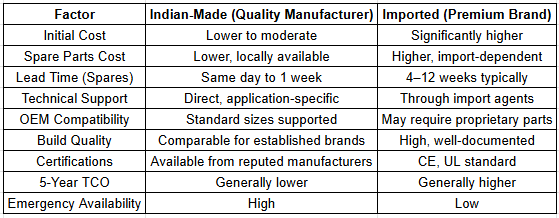
Common Industrial Applications for Pulse Solenoid Valves
Pulse jet valves for dust collectors are used across virtually every sector that generates process dust:
- Cement Industry: Kiln feed systems, clinker cooler vents, cement mill bag filters, packing plant dust collectors. High temperatures and abrasive dust demand robust diaphragm materials.
- Steel and Foundries: Electric arc furnace fume extraction, shot blasting dust control, cupola furnace filters. High particulate loading means higher valve cycle frequencies.
- Pharmaceutical Manufacturing: Active pharmaceutical ingredient dust control, granulation and tablet coating ventilation. These applications demand clean-room-grade materials and consistent performance.
- Power Plants: Coal handling dust suppression, fly ash silos, coal mill vents. Valves here must cope with fine, abrasive particulate and continuous duty cycles.
- Food Processing: Flour mills, spice grinding, grain handling facilities. Food-grade diaphragm materials may be required.
- Textiles: Fibre dust from carding, spinning, and weaving processes.
- Chemical Plants: Powder handling systems, reactor ventilation, bag filter dust collectors in chemical manufacturing.
- Mining: Crusher dust, conveyor transfer points, ore handling facilities.
In each of these environments, the pulse valve for the dust collector is working continuously, often 24 hours a day, through multiple cleaning cycles per minute. Reliability is not optional.
What to Look for When Buying a Pulse Jet Solenoid Valve
Whether you’re buying Indian or imported, these specifications matter:
- Body Size: Match to your existing manifold port size. Common sizes are 1″ (25mm), 1.5″ (40mm), 2″ (50mm), and 2.5″ (65mm).
- Operating Pressure Range: Standard dust collector systems operate between 5 and 7 bar. Confirm the valve’s rated pressure range.
- Coil Voltage: Match to your controller output – 24V DC, 110V AC, and 220V AC are the most common. Incorrect voltage is the most frequent installation error.
- Diaphragm Material: NBR (Nitrile) suits most general applications. PTFE-coated or full PTFE diaphragms are needed for chemical resistance or high-temperature environments.
- IP Rating of Solenoid Coil: IP65 minimum for dusty industrial environments. IP67 for wet or washdown areas.
- Response Time: A good pulse valve should open and close within 20–50 milliseconds. Sluggish response means incomplete bag cleaning.
- Cycle Life Rating: Look for manufacturers who specify tested cycle life. A quality industrial pulse valve should reliably handle several million cycles.
- Compatibility: Confirm the valve body dimensions match your existing blow pipe and manifold before ordering.
Common Mistakes to Avoid
- Using incorrect coil voltage: Running a 24V DC coil on 220V AC will destroy the coil instantly. Always verify voltage before installation.
- Ignoring compressed air quality: Moisture, oil contamination, or particulates in the compressed air supply degrade diaphragms rapidly. A properly maintained air dryer and filter upstream of the valve manifold is essential.
- Neglecting pulse duration settings: Too short a pulse won’t clean the bags. Too long a pulse wastes compressed air and stresses the diaphragm. Work with your controller settings to find the optimal pulse time for your filter media.
- Mixing valve brands on the same manifold: Different valve body geometries and flow characteristics can result in uneven cleaning across filter rows.
- Delaying diaphragm replacement: Waiting until a valve fails completely causes more damage than a planned diaphragm replacement. Schedule inspection annually or after every 1 million cycles in high-frequency applications.
- Buying without checking spare parts availability: Some cheaper imports have no local spare parts support. When the diaphragm fails 18 months later, you’re left sourcing internationally.
Maintenance Best Practices for Pulse Valves in Dust Collectors
- Inspect quarterly: Check for audible air leaks around the valve body and solenoid pilot. Even a small leak indicates diaphragm or seal wear.
- Monitor differential pressure: A rising differential pressure across the bag filter despite the cleaning system running normally is a sign that valves may not be firing correctly.
- Listen to the cleaning cycle: Experienced maintenance staff can identify weak or missed pulses by sound. A healthy pulse valve produces a sharp, consistent crack during each firing.
- Log valve performance: Note when valves were last serviced and what was replaced. This builds a maintenance history that helps predict failure before it occurs.
- Keep a spare kit on hand: Maintain at least one set of diaphragms and O-rings for each valve size installed. This enables immediate response to failures without waiting on procurement.
- Check the timer controller: Intermittent valve misfires are sometimes a controller problem rather than a valve problem. Confirm electrical signals are reaching each solenoid coil before replacing the valve.
The Role of the Sequential Timer Controller
A pulse solenoid valve is only as effective as the controller driving it. The sequential timer controller determines:
- Which valve fires and when
- The pulse duration (on-time)
- The interval between pulses (off-time or cycle time)
- Whether cleaning is continuous (online) or occurs during shutdown (offline)
In correctly designed systems, the controller sequences through each valve row in turn, giving each row time to clean and for dislodged dust to settle in the hopper before the next cleaning cycle.
Mismatched controller settings are a common cause of premature diaphragm failure and incomplete filter cleaning. When replacing pulse valves, it’s worth reviewing whether the controller parameters are correctly set for the current filter configuration and dust load.
Frequently Asked Questions
What is a pulse jet solenoid valve used for?
A pulse jet solenoid valve controls the release of short, high-pressure bursts of compressed air used to clean filter bags in a reverse pulse jet dust collection system. It opens and closes rapidly on command from a timer controller, sending a blast of air through the blow pipe and into the filter bags to dislodge accumulated dust.
What is the difference between a pilot operated valve and a direct-acting solenoid valve in dust collectors?
A pilot operated pulse valve uses a small electrical solenoid to control compressed air pressure behind a large diaphragm, which then opens and closes the main air passage. This design handles higher flow rates at lower power consumption. A direct-acting solenoid moves the valve seat directly by electromagnetic force, which suits smaller sizes but requires more electrical power for larger flow applications. Most industrial bag filter systems use pilot operated designs for their flow capacity and reliability.
How often should pulse solenoid valves be serviced?
Diaphragm inspection is recommended every 12 months or after approximately 1 million cycles in continuous-duty applications. In high-cycle installations – such as cement plants running 24 hours a day – this interval may be shorter. O-rings and solenoid coil condition should be checked at the same time. A planned maintenance schedule based on cycle count is more reliable than waiting for visible failure.
Can Indian-made pulse valves replace imported valves directly?
In most cases, yes. Standard port sizes (1″, 1.5″, 2″, 2.5″) are widely compatible across dust collector systems. The key is to verify body dimensions, port thread type, and coil voltage before ordering. Reputed Indian manufacturers produce valves specifically designed to be drop-in replacements for commonly installed imported brands.
What compressed air pressure is required for pulse jet cleaning?
Standard reverse pulse jet dust collection systems typically operate with compressed air at 5 to 7 bar (70 to 100 PSI) at the valve manifold. Some applications use higher pressures up to 8 bar for heavy dust loads or larger filter areas. The pulse valve must be rated for the operating pressure of your specific system.
Why does my pulse valve keep failing prematurely?
The most common causes of premature pulse valve failure are: contaminated compressed air (moisture or oil attacks the diaphragm), incorrect pulse duration settings (excessive on-time stresses the diaphragm), incorrect coil voltage, and infrequent maintenance allowing minor leaks to worsen. Reviewing compressed air quality and controller settings usually resolves repeated failures.
What is the difference between online and offline pulse jet cleaning?
Online cleaning means the pulse jet system cleans filter bags while the dust collector remains in service – production continues without interruption. Offline cleaning isolates one compartment at a time, stopping airflow through that section before cleaning. Online cleaning is more common in continuous process industries. The valve selection and controller settings differ slightly between the two approaches.
How do I know which size pulse valve I need?
The correct valve size depends on the number of filter bags per row, the total filter area, the manifold pipe diameter, and the compressed air volume required per pulse. Your dust collector OEM drawings will specify the valve connection size. For retrofits or upgrades, consult a specialist who can assess your existing manifold configuration and recommend the correct replacement size.
Conclusion
The choice between Indian and imported pulse jet solenoid valves is no longer simply a question of quality versus cost. The industrial landscape has shifted significantly over the past two decades, and well-engineered domestic valves now compete directly with imported options on performance, materials, and reliability.
Where Indian-made valves offer a clear advantage is in total cost of ownership, spare parts availability, technical support, and delivery lead times. For plants that cannot afford extended downtime waiting for imported components, these are not minor advantages.
The right question isn’t “imported or Indian?” – it’s “which manufacturer has the engineering experience, quality controls, and support infrastructure to keep my dust collection system running?”
For pulse solenoid valves, dust collector pulse valves, and the complete range of bag filter equipment, the answer increasingly points to manufacturers who combine decades of application knowledge with responsive domestic support.
Need help selecting the right pulse valve for your dust collector?
Maniks has manufactured precision-engineered reverse jet pulse valves, pilot operated valves, diaphragm assemblies, and dust collector controllers for over 47 years. Our team works with cement, steel, power, pharmaceutical, and process industries across India to keep bag filter systems running at peak efficiency.
Whether you’re replacing a worn valve, upgrading an older system, or specifying equipment for a new installation, our technical team can help you identify the right solution for your application.
Explore the Maniks Pilot Operated Reverse Jet Pulse Valve or contact us directly for a technical consultation and quotation.