
Pulse Jet Solenoid Valve Guide for Cement, Steel & Foundry
Walk through any cement grinding unit, steel rolling mill, or foundry sand-reclamation line, and you’ll find the same equipment doing quiet, unglamorous, essential work: a bank of pulse valves firing in sequence to keep the dust collector’s filter bags clean. When one of those valves fails, it doesn’t announce itself – dust just starts building up, differential pressure creeps up, and eventually a bag blinds or ruptures.
Choosing the right pulse jet solenoid valve is one of the few decisions in a dust collection system that directly affects both filtration efficiency and long-term maintenance cost. Get it right, and the collector runs quietly for years. Get it wrong, and you’re replacing diaphragms every few months while fighting inconsistent cleaning across the baghouse.
This guide covers what actually separates a reliable pulse jet valve from one that will cause problems in cement, steel, and foundry environments – the industries where dust loads are heaviest and valve failure is least forgiving.
What Is a Pulse Jet Solenoid Valve?
A pulse jet solenoid valve is a dust collector pulse valve that releases short, high-pressure bursts of compressed air into filter bags or cartridges to shake off accumulated dust. It’s triggered electrically – typically by a sequential timer controller – and fires in quick pulses rather than continuous flow, which is why the cleaning method is called reverse pulse-jet cleaning.
In practical terms: without this valve, a baghouse filter would clog steadily until airflow drops and the whole system needs manual cleaning or bag replacement. With it, cleaning happens automatically, in the background, while production continues.
How a Pulse Solenoid Valve Works
When the sequential controller sends an electrical signal, the pulse solenoid valve opens for a fraction of a second, releasing compressed air through the diaphragm and into the filter bag. The sudden pressure wave flexes the bag outward, knocking dust loose into the hopper below. The valve then closes automatically, ready for its next cycle.
A pilot operated valve uses a small internal pilot mechanism to actuate the main valve body – this design allows the valve to handle higher pressure and larger air volumes reliably, which matters in cement and steel applications where compressed air demand is high and duty cycles are frequent.
Why Cement, Steel & Foundry Environments Are Harder on Valves
These three industries share conditions that push dust collector valves harder than a typical light-industrial application:
- Cement plants generate extremely fine, abrasive particulate that accelerates wear on seals and diaphragms.
- Steel and rolling mills combine high ambient temperatures near furnaces with heavy dust loads, testing a valve’s thermal limits.
- Foundries produce a mix of sand fines, metal dust, and often higher humidity – a combination that stresses both the diaphragm material and the valve body’s corrosion resistance.
This is exactly why valve specification – not just valve selection – matters so much in these three sectors.
Types of Pulse Valves and Where Each Fits
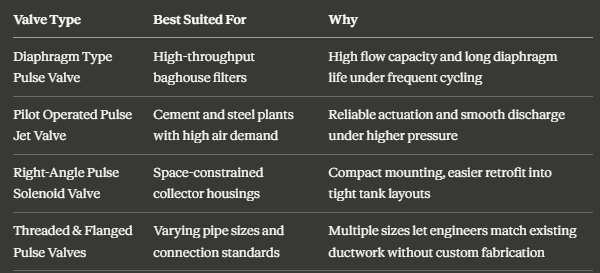
Specifications That Actually Matter
Before comparing pulse jet valve manufacturer datasheets, these are the numbers worth checking line by line:
Duty Cycle
This is the single most overlooked spec, and the one most responsible for premature valve failure. For AC-powered valves, the energized (ON) time should not exceed 20% of the total cycle – roughly one-fifth of the de-energized time. For DC-powered valves, that limit tightens to 10%. Running a valve outside its rated duty cycle overheats the coil and shortens service life significantly, regardless of how well-built the valve otherwise is.
Electrical Rating
Standard pulse valves typically run on AC 50Hz supply between 24V and 220V, or DC 24V, with an allowable voltage fluctuation of around ±10%. Confirm this against your plant’s actual supply stability – cement and steel plants with heavy motor loads often see voltage dips that a marginal valve won’t tolerate.
Temperature Limits
Check both maximum medium temperature (the compressed air/process temperature the valve handles) and maximum ambient temperature (the surrounding environment). A valve rated for standard ambient conditions will degrade faster mounted near a rotary kiln or furnace exhaust than one specified with the plant’s actual thermal conditions in mind.
Size and Connection Type
Pulse valves are typically available from 3/4″ up to 2 1/2″ thread sizes, with BSP end connections as standard. Matching thread size to your existing ductwork avoids costly adapter fabrication during installation or replacement.
What Makes a Pulse Jet Solenoid Valve High-Quality
Two valves can look identical on a spec sheet – same size, same voltage, same duty cycle rating – and still perform very differently once installed. The difference usually comes down to a handful of build-quality markers that don’t always show up in a datasheet comparison.
Diaphragm Material and Molding Consistency
The diaphragm is the component that fails first on almost every pulse valve, since it flexes on every single cycle. A high-quality valve uses a diaphragm compound engineered for repeated flexing without cracking or losing elasticity, and – just as important – consistent molding from batch to batch. Inconsistent diaphragm quality is why some “identical” replacement parts last years and others fail within months.
Coil Insulation Class
Coil insulation class determines how much heat the coil can tolerate before insulation breakdown occurs. A valve built with a higher insulation class coil has more thermal margin, which matters directly in high-cycle applications like cement and steel plants where valves are firing frequently and ambient temperatures run hot.
Body Machining and Seat Finish
A precisely machined valve body and seat ensures the diaphragm seals fully on every cycle. Rough or inconsistent machining creates micro-leak paths that show up as a faint hiss long before the diaphragm itself has actually worn out – a problem that no diaphragm replacement will fix, because the fault is in the body, not the wear part.
Pilot Mechanism Reliability (for Pilot Operated Valves)
In a pilot operated valve, the small internal pilot mechanism controls actuation of the main valve. A well-engineered pilot design responds consistently at rated pressure and doesn’t stick or drift with age – a failing pilot mechanism is a common cause of weak or delayed pulses that gets misdiagnosed as a diaphragm problem.
Manufacturer Testing and Traceability
A pulse valve manufacturer with in-house testing – checking duty cycle endurance, leak rate, and response time before valves leave the factory – catches build defects that a purely visual inspection wouldn’t. ISO-certified manufacturing processes exist specifically to make this testing consistent across every production batch, not just the units used for marketing samples.
Real-World Signal: Consistent Batch Performance
The clearest sign of a high-quality pulse valve manufacturer isn’t any single spec – it’s those of a plant running dozens of valves from the same batch seeing consistent failure timelines rather than a handful of early failures mixed with valves that outlast the rest. Inconsistent batch performance almost always traces back to manufacturing quality control, not valve design.
Common Industrial Applications
- Baghouse and cartridge dust collectors in cement grinding and packing units
- Sinter plant and blast furnace dust extraction in steel manufacturing
- Sand reclamation and shakeout dust control in foundries
- Bag filter cleaning across chemical, pharmaceutical, and food processing lines
- Oil and gas refinery dust and vapor extraction systems
Maintenance Tips for Longer Valve Life
- Respect the duty cycle rating. If your process demands more frequent pulsing than the valve’s rated duty cycle allows, the fix is a higher-duty valve or an adjusted sequential timer setting – not running the existing valve harder.
- Prevent condensate and scale buildup. Moisture and scale entering the valve body are common causes of diaphragm degradation; a functioning air dryer or drain point upstream helps significantly.
- Check mounting orientation periodically. While most pulse valves can be mounted in any position, vibration-heavy environments like foundries can gradually loosen fittings over time.
- Inspect diaphragms during scheduled shutdowns. A diaphragm nearing end-of-life often shows as slower valve response or a hissing air leak before it fails outright.
- Match replacement parts exactly. Using a diaphragm or coil not rated for the specific valve model is one of the fastest ways to void performance and shorten service life.
Buying Considerations
- Duty cycle rating matched to your actual pulse frequency, not just the valve’s maximum spec sheet number
- Thread size and connection type matched to existing ductwork
- Ambient and medium temperature ratings verified against your specific plant environment, not generic industry averages
- Enclosure requirements – flameproof enclosures are necessary in hazardous zones common to oil, gas, and some chemical processing areas
- In-house testing and ISO certification from the pulse valve manufacturer, as a proxy for consistent quality across production batches
- Availability of spares – diaphragms and coils wear before the valve body does, so ongoing spare part access matters more than the initial purchase price
Common Mistakes to Avoid
- Ignoring duty cycle limits to squeeze more cleaning cycles out of an undersized valve – this is the leading cause of early coil burnout.
- Choosing valve size based on pipe diameter alone, without checking actual air flow and pressure requirements.
- Skipping enclosure specification in hazardous areas, treating it as an optional upgrade rather than a compliance requirement.
- Mixing valve brands and models across one dust collector without standardizing spares, which complicates maintenance and increases downtime during failures.
- Deferring diaphragm replacement until total failure, rather than during scheduled maintenance windows.
Industry Best Practices
- Size pulse valves to your actual dust load and pulse frequency, not a generic industry rule of thumb.
- Pair every pulse jet solenoid valve with a correctly matched sequential timer controller – mismatched timing is as damaging as a mismatched valve.
- Standardize valve models across a plant wherever possible to simplify spares inventory and reduce technician training time.
- Schedule diaphragm inspection alongside routine filter bag maintenance, since both wear on similar timelines.
- Specify flameproof or corrosion-resistant variants upfront for hazardous or humid environments, rather than retrofitting later.
Frequently Asked Questions
1. What is a pulse jet solenoid valve used for? It’s used in dust collector systems to release timed bursts of compressed air that clean filter bags or cartridges, maintaining consistent airflow and filtration efficiency.
2. What’s the difference between a pulse valve and a pilot operated valve? A pilot operated valve is a specific design of pulse valve that uses a small pilot mechanism to actuate the main valve body, allowing it to handle higher pressure and air volume more reliably than simpler direct-acting designs.
3. How does duty cycle affect pulse valve life? Exceeding the rated duty cycle – 20% ON time for AC valves, 10% for DC valves – causes coil overheating and significantly shortens the valve’s service life, even if the valve itself is well-built.
4. Which pulse valve type suits cement and steel plants best? Pilot operated pulse jet valves are generally best suited to cement and steel applications due to their reliable actuation under higher air pressure and frequent cycling demands.
5. How often should dust collector valves be inspected? Diaphragms and coils should be checked during scheduled maintenance shutdowns; a valve showing slower response, air leakage, or a hissing sound usually signals it needs attention before it fails completely.
6. Are pulse jet valves suitable for hazardous environments? Yes, with the correct specification. Flameproof enclosures are available for pulse valves used in oil, gas, and chemical processing zones where explosive atmospheres are a concern.
7. What sizes do dust collector valves come in? Pulse valves typically range from 3/4″ to 2 1/2″ thread sizes with standard BSP connections, allowing them to match most existing ductwork without custom fabrication.
8. How do I choose the right pulse valve manufacturer? Look for in-house design and testing capability, ISO-certified quality processes, clear duty cycle and temperature specifications, and reliable spare parts availability – not just the lowest quoted price.
Getting the Right Valve for Your Plant
A pulse jet solenoid valve looks like a small, simple component on paper – but in cement, steel, and foundry environments, the difference between a correctly specified valve and a generic one shows up directly in filtration performance, compressed air consumption, and how often your maintenance team is climbing up to the baghouse.
If you’re specifying valves for a new dust collector, retrofitting an ageing system, or troubleshooting inconsistent cleaning across your baghouse, Maniks can review your duty cycle, dust load, and environmental conditions to recommend the right pulse valve configuration for your plant.
Explore the full range of pilot operated and pulse jet solenoid valves, or request a technical consultation.