
Diaphragm Valve Manufacturers in India: Complete Buyer Guide
Specifying diaphragm valves for an industrial project usually raises the same three questions, in some order: Indian or imported? What should I actually be checking before I sign the PO? And why does diaphragm valve price vary so much between quotes that look identical on paper?
This guide answers all three in one place. It covers how diaphragm valves work, how Indian and imported suppliers actually compare in day-to-day plant operation, what separates a reliable diaphragm valves manufacturer from one that will cause problems later, and what drives the price differences you’ll see across quotations.
What Is a Diaphragm Valve?
A diaphragm valve is a flow-control device that uses a flexible diaphragm – rather than a ball, gate, or plug – to regulate airflow or fluid flow through a system. Because the diaphragm itself forms the seal, these valves deliver leak-proof, contamination-free operation, which is why they’re the default choice in dust collector cleaning cycles, pharmaceutical lines, food processing, and chemical handling.
A pneumatic diaphragm valve is actuated using external compressed air, while a solenoid diaphragm valve is triggered by an electrical signal – typically from a sequential timer controller in dust collector applications, where the valve fires short bursts of air to knock dust loose from filter bags in a reverse pulse jet cleaning cycle.
Diaphragm valves aren’t a one-time purchase, either. Diaphragms wear with every cycle, coils eventually fail, and gaskets age – so every valve purchase is really the start of an ongoing spares relationship with whoever manufactured it. That’s why the manufacturer matters as much as the valve itself.
Indian vs Imported Diaphragm Valves: How They Actually Compare
This is usually the first fork in the decision, so it’s worth settling with real comparisons rather than assumption.
What Indian Diaphragm Valve Manufacturers Offer
Established diaphragm valve manufacturers in India – companies with genuine in-house R&D, not trading-house resellers – typically deliver:
- Faster spares turnaround. A domestic diaphragm valve supplier can usually dispatch a replacement diaphragm or coil within days; an imported part often takes weeks to clear customs.
- Lower total project cost. Diaphragm valve price from a domestic manufacturer usually comes without the import duty, freight, and currency exposure that inflate an imported unit’s landed cost.
- Direct technical support, without questions being relayed through a distributor to a factory overseas.
- Customization without heavy minimum order quantities – useful for retrofit projects with non-standard voltage, size, or enclosure needs.
- ISO-certified manufacturing that meets the same BS EN, DIN, and API benchmarks imported valves are held to.
Where Imported Valves Still Make Sense
- Extreme process conditions – very high pressure ratings or exotic media compatibility where one specific brand has a long, proven track record in that exact application.
- Existing plant standardization – if a facility has run one imported brand across every line for years, switching mid-fleet can complicate spares inventory more than it saves.
- Contractual specification – some EPC contracts or export-oriented projects name an imported brand for compliance reasons unrelated to actual valve performance.
Side-by-Side Comparison
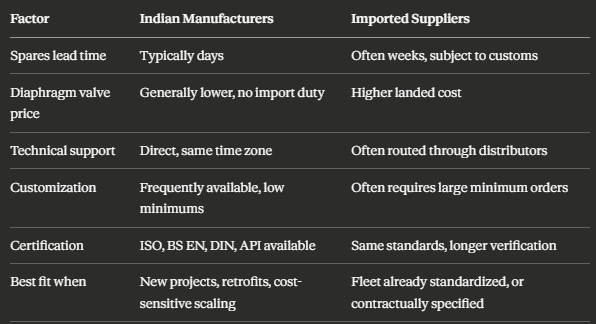
For most dust collector, tank discharge, and process control applications, a well-certified Indian manufacturer delivers equivalent performance with faster support and a lower total cost of ownership – which is why “Made in India” no longer signals a compromise on quality, just a different balance of trade-offs.
What to Look for When Choosing a Diaphragm Valve Manufacturer
Once you’ve settled the Indian-vs-imported question, the harder part is separating a genuinely reliable manufacturer from one that only looks reliable on a spec sheet. Check these before finalizing any vendor:
1. Manufacturing Depth, Not Just Assembly
Ask whether the company designs and manufactures valves in-house or resells components sourced elsewhere. In-house R&D and tooling capability is what makes fast customization and consistent quality control possible – a reseller can rarely offer either.
2. Certification and Documented Standards
ISO certification, along with compliance to relevant standards like BS EN, DIN, or API where applicable, signals consistent quality control across production batches rather than one well-built sample unit.
3. Material and Lining Range
Confirm the manufacturer offers body materials (aluminum, cast iron, stainless steel) and lining options (EPDM, PTFE, Ebonite, Neoprene, and similar) that match your specific media – a supplier with a narrow material range will push you toward whatever they stock, not what your application actually needs.
4. Application-Specific Engineering
Check for flameproof enclosures if you’re working in a hazardous zone, IP65/IP55 weatherproof housings for outdoor installations, and flexible voltage options (24VDC, 110VAC, 230VAC) to match your electrical infrastructure.
5. Spares Availability and After-Sales Support
Since diaphragms and coils are wear items, ask directly about typical spares turnaround time and whether technical support comes from the design team or a sales intermediary. This matters more over the life of the valve than the initial purchase price.
6. Real Reference Applications
A manufacturer with documented experience across cement, pharmaceutical, chemical, or food processing sectors has likely already solved the edge cases your application might raise – ask for relevant examples rather than a generic capabilities list.
What Actually Drives Diaphragm Valve Price
Diaphragm valve price isn’t a fixed number, and quotes that look wildly different often reflect genuine differences rather than pure margin. The main drivers are:
- Valve size – larger sizes require more material and tighter tolerances
- Body material – stainless steel commands a premium over aluminum or cast iron
- Voltage/coil specification – non-standard voltages can add cost if they fall outside a manufacturer’s standard range
- Pneumatic vs solenoid actuation – solenoid diaphragm valves add electrical components a pneumatic version doesn’t need
- Enclosure requirements – flameproof or IP65-rated enclosures for hazardous or outdoor installations increase cost over a standard housing
- Import overhead – for imported valves specifically, duty, freight, and currency fluctuation can add substantially to landed cost beyond the factory price
Because of these variables, most manufacturers – including Maniks – quote based on your specific application rather than a published price list, and a lower quoted price is worth double-checking against material, certification, and after-sales support before assuming it’s the better deal.
How Diaphragm Valves Work
Regardless of manufacturer or origin, the operating principle is consistent: when actuated, compressed air flexes the diaphragm, opening or closing the flow path. In pulse-cleaning dust collector applications, this same mechanism fires short bursts of air into filter bags, dislodging accumulated dust as part of a reverse pulse jet cleaning cycle – directly supporting bag filter performance and compressed air optimization across the system.
Which Industries Use Diaphragm Valves, and What Each Needs
Diaphragm valves show up across a wide range of industrial sectors, but the right valve configuration – material, lining, actuation type, enclosure – changes depending on the application. Here’s what selection typically looks like industry by industry.
- Cement and Mineral Processing: Cement plants rely heavily on tank-mounted diaphragm valves to fire pulse-jet cleaning cycles in baghouse dust collectors, where fine, abrasive particulate accumulates fast on filter bags. Here, valve selection prioritizes wear-resistant diaphragm materials and enclosures rated for dusty, high-vibration environments over anything else.
- Steel, Foundries, and Metal Processing: Steel rolling mills and foundries combine high ambient heat near furnaces with heavy dust loads, which means diaphragm valves need to hold up to both thermal stress and abrasive particulate simultaneously. Temperature-rated valves and robust enclosure options matter more here than in lighter-duty applications.
- Pharmaceutical Manufacturing: Pharmaceutical lines need hygienic, contamination-free flow control above all else, since any leakage or particulate ingress risks product integrity. Diaphragm valves used here typically favor solenoid diaphragm valve configurations with linings – such as PTFE – chosen specifically for chemical inertness and cleanability.
- Food Processing: Food-grade applications demand corrosion-resistant materials suited to frequent washdown cycles, along with linings that won’t degrade under exposure to cleaning agents. Selection here overlaps closely with pharmaceutical requirements, though duty cycles and pressure ratings often differ based on the specific process line.
- Chemical and Process Plants: Chemical processing is where lining choice matters most – EPDM, Ebonite, Neoprene, and PTFE each handle different corrosive or abrasive media differently, so matching lining to the specific chemical in contact with the valve is essential rather than optional. A pneumatic diaphragm valve is often preferred here for its simpler design in explosive-atmosphere zones, paired with flameproof enclosures where required.
- Water and Wastewater Treatment: Water treatment applications favor diaphragm valves for their long service life under continuous cycling and reliable shutoff, especially in dosing and chemical-feed lines where leak-proof operation is a compliance requirement, not just a convenience.
- Power Generation: Power plants use diaphragm valves across auxiliary systems, including ash handling and emission control dust collectors, where reliability under continuous operation directly affects plant uptime and energy efficiency.
- Textiles, Mining, and Woodworking: These sectors typically use diaphragm valves in dust collector and pneumatic conveying systems, where particulate load varies significantly by process stage – mining and woodworking in particular generate coarser, higher-volume dust that calls for higher-flow-capacity valve configurations than a typical clean-room application would need.
How to Choose the Right Diaphragm Valve for Your Industry
Across all these sectors, the selection process comes down to the same handful of questions:
- What’s the dust or fluid load, and how abrasive or corrosive is it? This determines diaphragm material and lining choice more than any other factor.
- What’s the ambient and process temperature? Confirm both maximum medium temperature and maximum ambient temperature against your actual plant conditions, not generic averages.
- Is the installation in a hazardous zone? If so, flameproof enclosures aren’t optional – they’re a compliance requirement.
- Pneumatic or solenoid actuation? This depends on whether the valve needs to integrate with an existing sequential timer controller or plant automation system.
- What voltage and enclosure rating matches your electrical infrastructure and environment? Outdoor or washdown installations need IP65/IP55-rated housings; indoor clean environments may not.
Maintenance Tips for Longer Service Life
- Schedule diaphragm inspection during planned shutdowns, rather than waiting for failure – a diaphragm nearing end-of-life often shows early signs like a faint hiss or slower valve response.
- Match replacement parts to the exact valve model. An off-spec diaphragm or coil is a common cause of premature repeat failure.
- Confirm voltage compatibility before installation, checking supply voltage against the valve’s actual nameplate rating.
- Keep enclosure seals intact. A compromised IP65 or flameproof enclosure defeats its protection rating even if the valve internals are fine.
- Build a direct line to your supplier’s technical team, not just their sales desk – this pays off far more during commissioning and troubleshooting than at the point of purchase.
Common Mistakes to Avoid
- Assuming imported automatically means better quality, overlooking that many Indian manufacturers meet identical ISO and international standards.
- Comparing diaphragm valve price on unit cost alone, without factoring in freight, duty, and spares lead time for imported alternatives.
- Choosing a supplier without verifying after-sales support capacity, only discovering slow response times once the valve is already installed.
- Underestimating customization needs during planning, then finding the chosen manufacturer can’t accommodate a non-standard spec without a large minimum order.
- Skipping reference checks, selecting a manufacturer based on a spec sheet alone without confirming real experience in a similar application.
Industry Best Practices
- Evaluate total cost of ownership – spares logistics and support included – not just the quoted unit price.
- Match certification requirements (ISO, BS EN, DIN, API) to your specific industry before comparing manufacturers.
- Prioritize suppliers who support both the initial project and the ongoing spares relationship that follows.
- Standardize valve models across a plant or project wherever feasible, to simplify spares inventory and maintenance training.
- Document valve specifications (voltage, enclosure rating, size) centrally, so future replacement decisions are based on evaluation rather than defaulting to “whatever was already there.”
Frequently Asked Questions
1. Are Indian diaphragm valves as reliable as imported ones? Established Indian diaphragm valve manufacturers with ISO-certified processes and in-house R&D produce valves that meet the same BS EN, DIN, and API standards as imported brands, with the added benefit of faster local spares and support.
2. What determines diaphragm valve price? Price depends on valve size, body material, voltage specification, whether it’s a pneumatic or solenoid diaphragm valve, and enclosure requirements – imported units also carry added freight, duty, and currency costs.
3. What’s the difference between a pneumatic diaphragm valve and a solenoid diaphragm valve? A pneumatic diaphragm valve is actuated using external compressed air, while a solenoid diaphragm valve uses an electrical signal to control the valve directly, integrating with a sequential timer controller in dust collector systems.
4. When should a plant choose an imported diaphragm valve over an Indian one? Imported valves make sense for extremely specialized process conditions, existing fleet standardization on one imported brand, or contractual specification tied to a particular certification or client requirement.
5. What should I check before finalizing a diaphragm valves manufacturer? Confirm in-house manufacturing depth, ISO certification, material and lining range for your specific media, application-specific engineering (enclosures, voltage options), and after-sales spares support – not just the quoted price.
6. How long does it take to get spare parts for an imported diaphragm valve? It varies by supplier and customs conditions, but imported spares commonly take several weeks, compared to a domestic diaphragm valve supplier who can often ship within days.
7. Do Indian diaphragm valve manufacturers offer customization? Yes – many accommodate custom voltage, size, and enclosure requirements, often without the high minimum order quantities imported suppliers require.
8. Which industries commonly use diaphragm valves? Cement, pharmaceuticals, food processing, chemical processing, water treatment, and power generation industries all rely on diaphragm valves for flow control and dust collector cleaning applications.
Making the Right Call for Your Plant
There’s no universal answer to Indian versus imported, or to which manufacturer is “best” – the right choice depends on your application’s criticality, your existing standardization, and how much weight you place on spares lead time versus price alone. For most industrial dust collector, tank discharge, and pulse-cleaning applications, a well-certified Indian manufacturer offers equivalent performance, faster support, and a lower total cost of ownership.
If you’re weighing this decision for a new installation or an upgrade to an aging system, Maniks’ engineering team can review your voltage, enclosure, and application requirements and recommend the right diaphragm valve configuration – backed by 47+ years of manufacturing experience and ISO-certified quality control.
Explore the full range of tank-mounted diaphragm valves, or request a technical consultation and custom quote.