
Sequential Timer Controller for Dust Collectors
In industrial dust collection systems, compressed air is one of the most expensive utilities. While pulse-jet cleaning is highly effective for maintaining filter performance, inefficient cleaning cycles can lead to excessive compressed air usage, higher energy bills, and unnecessary wear on system components. This is where a sequential timer controller becomes essential.
A Sequential Timer automates the cleaning sequence of pulse jet valves, ensuring that compressed air is used only when required and in the correct order. Instead of cleaning all filters simultaneously or operating on fixed, inefficient intervals, the controller activates each valve sequentially for precise filter cleaning. This optimized operation reduces compressed air consumption, extends filter life, and improves the overall efficiency of dust collection systems.
At Maniks, we manufacture reliable solid-state sequential timer controllers engineered for demanding industrial environments, delivering precise pulse control and long-term operational reliability.
Quick Answer
A sequential timer controller reduces compressed air consumption by activating pulse jet valves in a controlled sequence rather than simultaneously. This prevents unnecessary air usage, maintains optimal filter cleaning, reduces pressure drop, extends filter life, and lowers operating costs.
Why Compressed Air Efficiency Matters
Compressed air accounts for a significant portion of industrial energy costs. In dust collection systems, excessive pulse cleaning can result in:
- Increased electricity consumption
- Higher compressor operating costs
- Faster diaphragm wear
- Reduced filter life
- Unnecessary maintenance
- Increased production costs
An optimized cleaning cycle helps industries reduce operating expenses while maintaining efficient dust collection performance.
What Is a Sequential Timer Controller?
A sequential timer controller is an electronic control unit designed to operate pulse jet valves in a predetermined sequence and at adjustable time intervals.
Instead of opening multiple valves simultaneously, the controller energizes each valve one after another. This allows compressed air to be distributed efficiently while maintaining continuous dust collector operation.
Modern controllers feature adjustable ON and OFF times, enabling operators to optimize cleaning cycles based on dust load and operating conditions.
How Does a Sequential Timer Controller Work?
The controller continuously monitors the programmed timing sequence and sends electrical signals to individual pulse valves.
The cleaning cycle typically follows these steps:
Step 1: Dust Accumulates
Dust particles collect on the surface of filter bags during operation.
Step 2: Timer Starts
The Sequential Timer initiates the cleaning program.
Step 3: Valve Activation
One pulse valve opens and releases a short burst of compressed air.
Step 4: Filter Cleaning
The compressed air removes accumulated dust from the filter bag.
Step 5: Next Valve Operates
After the programmed OFF time, the controller activates the next valve.
This sequential operation continues until all filters have been cleaned.
How a Sequential Timer Controller Saves Compressed Air
1. Prevents Simultaneous Valve Operation
Opening multiple valves at the same time causes sudden drops in compressed air pressure and increases compressor load.
A sequential controller activates only one valve at a time, ensuring efficient air usage while maintaining cleaning performance.
2. Optimizes Cleaning Intervals
Not every dust collector requires continuous cleaning.
Adjustable timer settings allow operators to customize pulse frequency based on:
- Dust concentration
- Production rate
- Filter condition
- Airflow requirements
This prevents unnecessary pulse cycles and reduces compressed air consumption.
3. Maintains Stable Air Pressure
Sequential valve operation prevents excessive pressure fluctuations within the compressed air system.
Stable pressure improves:
- Pulse efficiency
- Compressor performance
- Valve reliability
- Filter cleaning effectiveness
4. Reduces Compressor Running Time
When compressed air demand decreases, compressors cycle less frequently.
Benefits include:
- Lower electricity costs
- Reduced mechanical wear
- Longer compressor life
- Lower maintenance expenses
5. Extends Filter Bag Life
Excessive pulse cleaning accelerates filter media wear.
Using a sequential timer controller, filters are cleaned only when necessary, extending service life while maintaining efficient airflow.
6. Improves Overall Dust Collector Performance
Consistent cleaning prevents excessive pressure drop across filter bags, ensuring:
- Better airflow
- Higher dust collection efficiency
- Lower emissions
- Improved workplace safety
Key Features of a Modern Sequential Timer Controller
When selecting a controller, look for features such as:
- Adjustable pulse ON time
- Adjustable pulse OFF time
- Multiple output channels
- LED status indicators
- Compact design
- Solid-state electronics
- Reliable industrial performance
- Easy installation and programming
These features provide flexibility for different dust collection applications.
Applications Across Industries
A sequential timer controller is widely used in:
- Cement plants
- Steel manufacturing
- Foundries
- Food processing
- Pharmaceutical industries
- Chemical plants
- Textile mills
- Woodworking facilities
- Power plants
Any industry using pulse-jet dust collectors can benefit from optimized timer control.
Sequential Timer Controller vs Manual Cleaning
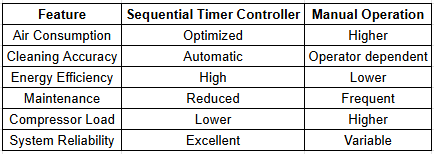
Benefits of Choosing Maniks Sequential Timer Controllers
Maniks designs advanced solid-state timer controllers that deliver reliable and efficient pulse control for industrial dust collection systems.
Key advantages include:
- Accurate pulse sequencing
- Reduced compressed air consumption
- Easy parameter adjustment
- Reliable long-term operation
- Durable industrial-grade construction
- Low maintenance
- Improved dust collector performance
- Energy-efficient operation
These controllers integrate seamlessly with Maniks pulse jet valves to provide complete dust collection automation.
Best Practices to Maximize Energy Savings
To achieve the best performance:
- Set appropriate pulse intervals based on dust load.
- Inspect pulse valves regularly.
- Monitor differential pressure across filters.
- Avoid unnecessary cleaning cycles.
- Maintain proper compressed air pressure.
- Replace damaged diaphragms promptly.
- Use high-quality controllers and pulse valves.
Following these practices can significantly reduce energy costs while extending equipment life.
Frequently Asked Questions
What is a sequential timer controller?
A sequential timer controller is an electronic device that activates pulse jet valves one at a time to automate filter cleaning in dust collector systems.
How does a Sequential Timer reduce compressed air consumption?
It controls valve operation in a programmed sequence, preventing unnecessary simultaneous air discharge and optimizing cleaning frequency.
Can a sequential controller improve filter life?
Yes. Controlled pulse cleaning reduces excessive filter stress, helping extend filter bag life and lower replacement costs.
Is a sequential timer controller suitable for all dust collectors?
Most pulse-jet dust collection systems can benefit from a sequential timer controller, especially those operating continuously in industrial environments.
What factors should be considered before selecting a controller?
Consider the number of valves, adjustable timing range, operating voltage, environmental conditions, and compatibility with your dust collection system.
Conclusion
A sequential timer controller is a vital component for improving the efficiency of industrial dust collection systems. By controlling pulse jet valves in an optimized sequence, it minimizes compressed air consumption, reduces energy costs, extends filter life, and enhances overall system performance. Investing in a high-quality controller not only lowers operating expenses but also ensures reliable and consistent dust collection.
At Maniks, we provide advanced solid-state sequential timer controllers engineered for precision, durability, and seamless integration with pulse-jet dust collection systems. Our solutions help industries maximize efficiency while reducing maintenance and energy costs.
Looking for a reliable Sequential Timer Controller for your dust collection system? Contact Maniks to find the right solution for your industrial application.