
Role of Pulse Jet Valve in Dust Collector Efficiency
Industrial dust collection systems play a critical role in maintaining clean air, ensuring regulatory compliance, and protecting equipment across manufacturing plants. However, the efficiency of a dust collector depends on more than just filters; it relies heavily on the performance of the Pulse Jet Valve.
A high-quality Pulse Jet Valve ensures that filter bags remain clean by delivering precise bursts of compressed air. This cleaning process prevents excessive pressure drop, improves airflow, extends filter life, and reduces operational costs.
As a leading industrial valve manufacturer, Maniks designs reliable reverse jet pulse valves engineered for demanding industrial environments. Their valves provide consistent performance, energy efficiency, and long service life for bag filters and dust collection systems.
Quick Answer
A Pulse Jet Valve improves dust collector efficiency by delivering short, powerful bursts of compressed air that clean filter bags without interrupting operation. This maintains proper airflow, reduces pressure drop, minimizes energy consumption, extends filter life, and ensures consistent dust collection performance.
Why Dust Collector Efficiency Matters
Dust collectors are installed in industries such as:
- Cement plants
- Steel manufacturing
- Foundries
- Pharmaceutical facilities
- Food processing plants
- Chemical industries
- Textile manufacturing
- Woodworking plants
Over time, dust accumulates on filter bags, restricting airflow and reducing filtration efficiency. If the filters are not cleaned effectively, the system experiences:
- Higher energy consumption
- Reduced suction capacity
- Increased maintenance costs
- Frequent filter replacement
- Production downtime
This is where the Pulse Jet Valve becomes one of the most important components of the entire dust collection system.
What is a Pulse Jet Valve?
A Pulse Jet Valve is a fast-acting diaphragm valve designed to release a controlled pulse of compressed air into filter bags or cartridges.
The sudden air pulse shakes accumulated dust from the filter surface, allowing the dust to fall into the hopper while the dust collector continues operating.
Modern pulse jet solenoid valve systems are electronically controlled to ensure precise cleaning intervals and consistent performance.
How Does a Pulse Jet Valve Work?
The cleaning cycle follows a simple but highly effective process:
Step 1: Dust Collection
Dust-laden air enters the collector.
Step 2: Filtration
Dust particles accumulate on the outer surface of filter bags.
Step 3: Pressure Build-Up
As dust increases, airflow becomes restricted.
Step 4: Valve Activation
The controller energizes the pulse solenoid valve.
Step 5: Compressed Air Release
The valve instantly opens and releases a powerful burst of compressed air.
Step 6: Filter Cleaning
The sudden expansion removes the dust cake from the filter bags.
Step 7: Continuous Operation
The dust collector resumes optimal airflow without interrupting production.
Role of Pulse Jet Valve in Dust Collector Efficiency
1. Maintains Proper Airflow
Airflow is one of the most important performance indicators in any dust collector.
Dirty filters reduce airflow, causing:
- Lower collection efficiency
- Poor suction
- Higher fan load
- Increased operating costs
A properly functioning dust collector pulse valve keeps filters clean and maintains consistent airflow throughout the system.
2. Reduces Pressure Drop
Pressure drop is the resistance created when dust accumulates on filter bags.
Excessive pressure drop results in:
- Increased energy consumption
- Lower filtration efficiency
- Reduced production efficiency
An efficient pulse valve for dust collector cleans filters before excessive pressure develops, keeping the system operating within its ideal pressure range.
3. Extends Filter Bag Life
Filter bags represent one of the largest maintenance expenses in dust collection systems.
When cleaning is uneven or ineffective:
- Filters clog quickly
- Dust penetrates filter media
- Frequent replacements become necessary
A high-performance Pulse Jet Valve ensures gentle yet effective cleaning, significantly increasing filter life.
4. Reduces Energy Consumption
When filters clog, blower motors must work harder to maintain airflow.
This increases:
- Power consumption
- Electricity bills
- Mechanical wear
Efficient pulse cleaning minimizes fan resistance, lowering overall energy costs.
5. Improves Dust Collection Efficiency
A clean filter surface captures fine particles more effectively.
Proper cleaning ensures:
- Better filtration efficiency
- Lower emissions
- Cleaner workplace air
- Improved environmental compliance
This makes the Pulse Jet Valve an essential component in modern dust collector valves.
Importance of High-Speed Valve Response
One of the defining characteristics of an effective pulse jet solenoid valve is its response speed.
The valve must:
- Open instantly
- Deliver a powerful air pulse
- Close immediately
- Prevent compressed air wastage
Slow valves reduce cleaning efficiency and increase compressed air consumption.
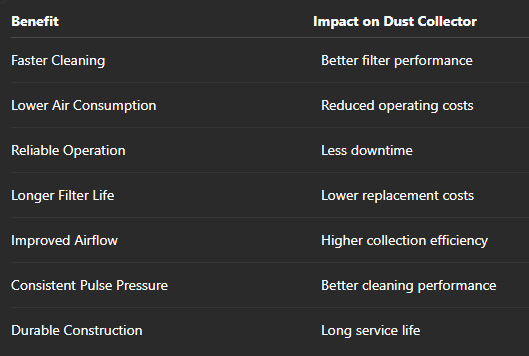
Benefits of Using a High-Quality Pulse Jet Valve
Choosing a premium valve offers several operational advantages.
Features to Look for in a Pulse Jet Valve
When selecting a valve for industrial dust collection systems, consider:
- Fast response time
- High flow capacity
- Robust diaphragm design
- Corrosion-resistant materials
- Low maintenance requirements
- Long operating life
- Stable performance under continuous operation
- Compatibility with automation systems
Working with an experienced pulse valve manufacturer ensures you receive products designed for demanding industrial applications.
Why Pilot Operated Valves Are Preferred
Most industrial pulse cleaning systems use a pilot operated valve because it offers:
- Faster switching
- Lower coil power consumption
- Reliable operation at high pressure
- Higher airflow capacity
- Longer diaphragm life
These advantages make pilot-operated designs ideal for large dust collectors operating continuously.