
Sequential Controller for Factories | Reduce Downtime
In modern manufacturing, even a few minutes of unplanned downtime can lead to significant production losses. That’s why more industries are investing in automation solutions like a sequential controller. Designed to manage equipment operations in a precise sequence, a sequential controller helps factories streamline processes, improve safety, and minimize costly interruptions.
Whether you operate a manufacturing plant in Pune or anywhere across Maharashtra, implementing the right sequence controller can dramatically improve operational efficiency and reduce downtime.
What Is a Sequential Controller?
A sequential controller is an electronic device that automatically controls multiple operations in a predefined sequence. It ensures machines, motors, burners, valves, or other equipment operate in the correct order and at the right time.
Unlike manual control systems, a sequential controller eliminates human error and guarantees consistent operation.
In Simple Terms:
Think of it as a conductor in an orchestra, each instrument plays at exactly the right moment. Similarly, a sequence controller coordinates industrial equipment to work seamlessly together.
Why Downtime Is a Major Concern in Factories
Downtime affects more than just production schedules. It can result in:
- Loss of productivity
- Increased operational costs
- Delayed deliveries
- Higher maintenance expenses
- Reduced customer satisfaction
- Equipment wear and tear
For industries in competitive markets, minimizing downtime is essential for maintaining profitability.
How a Sequential Controller Reduces Downtime
1. Automates Critical Processes
Manual operations are prone to errors and delays. A sequential timer controller automates repetitive tasks, ensuring each step occurs exactly when needed.
For example:
- Starting motors in sequence
- Operating burners safely
- Managing conveyor systems
- Coordinating pumps and valves
Automation eliminates inconsistencies and improves process reliability.
2. Prevents Equipment Overload
Starting multiple machines simultaneously can cause power surges or mechanical stress.
A sequential timer staggers equipment startup, reducing:
- Electrical load spikes
- Mechanical strain
- Component failures
This significantly extends equipment life while lowering maintenance requirements.
3. Enhances Burner Safety
In applications involving combustion systems, a sequence controller for burner ensures proper ignition, flame monitoring, and shutdown procedures.
Benefits include:
- Safe startup and shutdown
- Reduced risk of flame failure
- Prevention of unsafe operating conditions
- Compliance with industrial safety standards
This is especially critical in boilers, furnaces, and heating systems.
4. Minimizes Human Error
Human intervention often leads to operational mistakes.
A sequential controller:
- Follows programmed logic precisely
- Maintains process consistency
- Reduces operator dependency
- Improves repeatability
Less manual involvement means fewer errors and less downtime.
5. Enables Faster Troubleshooting
Modern sequence controllers often include diagnostic indicators that quickly identify faults.
Operators can:
- Detect issues faster
- Isolate malfunctioning components
- Restore operations quickly
Reduced troubleshooting time directly translates to lower downtime.
Key Features of a Sequential Timer Controller
When selecting a sequence controller, look for these essential features:
- Adjustable timing intervals
- Multiple output channels
- Compact design
- Solid-state reliability
- Easy programming
- LED status indicators
- High durability in industrial environments
These features make the controller suitable for demanding factory operations.
Industries That Benefit Most
A sequential controller is widely used across industries such as:
- Manufacturing
- Packaging
- Food processing
- Chemical plants
- Pharmaceuticals
- Boilers and burners
- Material handling systems
- Textile industries
In Pune’s rapidly growing industrial ecosystem, these controllers are becoming indispensable.
Sequential Controller vs PLC: Which Is Better?
While PLCs are highly versatile, they may be overkill for simple sequencing tasks.
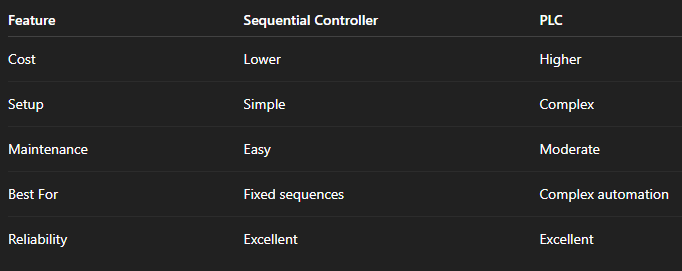
For straightforward sequencing applications, a sequential timer controller is often the more economical and efficient choice.
Real-World Example
Imagine a manufacturing unit with multiple motors driving a conveyor system.
Without a sequence controller:
- Motors may start simultaneously
- High inrush current can trip breakers
- Equipment stress increases
- Production interruptions occur
With a sequential controller:
- Motors start one after another
- Electrical load is balanced
- System reliability improves
- Downtime decreases significantly
This simple automation upgrade can deliver substantial long-term savings.
Factors Affecting Sequence Controller Price
The sequence controller price depends on several factors:
- Number of output channels
- Timing range
- Control complexity
- Build quality
- Environmental protection rating
- Application-specific customization
While price is important, selecting a reliable and durable controller offers better long-term value.
Why Choose Solid-State Sequential Controllers?
Solid-state controllers offer several advantages over electromechanical alternatives:
- No moving parts
- Longer operational life
- Faster response times
- Minimal maintenance
- Improved reliability
- Compact design
This makes them ideal for modern industrial automation systems.
Best Practices for Implementation
To maximize benefits:
- Choose the right controller for your application
- Ensure proper installation
- Program accurate timing intervals
- Train operators adequately
- Perform regular maintenance checks
Proper implementation ensures optimal performance and longevity.
Why Manufacturers Trust Maniks
Maniks offers high-performance solid-state sequential controllers designed for industrial reliability.
Key Advantages:
- Robust construction
- Precise sequencing control
- Long service life
- Easy integration
- Excellent after-sales support
- Competitive pricing
For factories in Pune, Maharashtra, and across India, Maniks provides dependable automation solutions that improve productivity and reduce downtime.
Frequently Asked Questions
1. What is a sequential controller used for?
A sequential controller automates equipment operations in a predetermined order, improving efficiency and reducing manual intervention.
2. How does a sequential timer controller work?
It activates outputs one after another based on preset timing intervals.
3. Is a sequence controller suitable for burners?
Yes, a sequence controller for burner ensures safe ignition, operation, and shutdown.
4. What is the difference between a PLC and a sequential controller?
A PLC handles complex automation, while a sequential controller is ideal for fixed, repetitive sequencing tasks.
5. How much does a sequence controller cost?
The sequence controller price varies based on features, outputs, and application requirements.
Conclusion
Reducing downtime is a top priority for every factory. A sequential controller offers a simple yet highly effective way to automate operations, protect equipment, and improve productivity.
From motor sequencing to burner control, these controllers play a vital role in ensuring smooth, reliable industrial processes. For manufacturers in Pune and across Maharashtra, investing in a high-quality sequential controller is a smart step toward operational excellence.
If you’re looking to improve factory efficiency and reduce costly downtime, explore Maniks’ advanced solid-state sequential controllers today.